

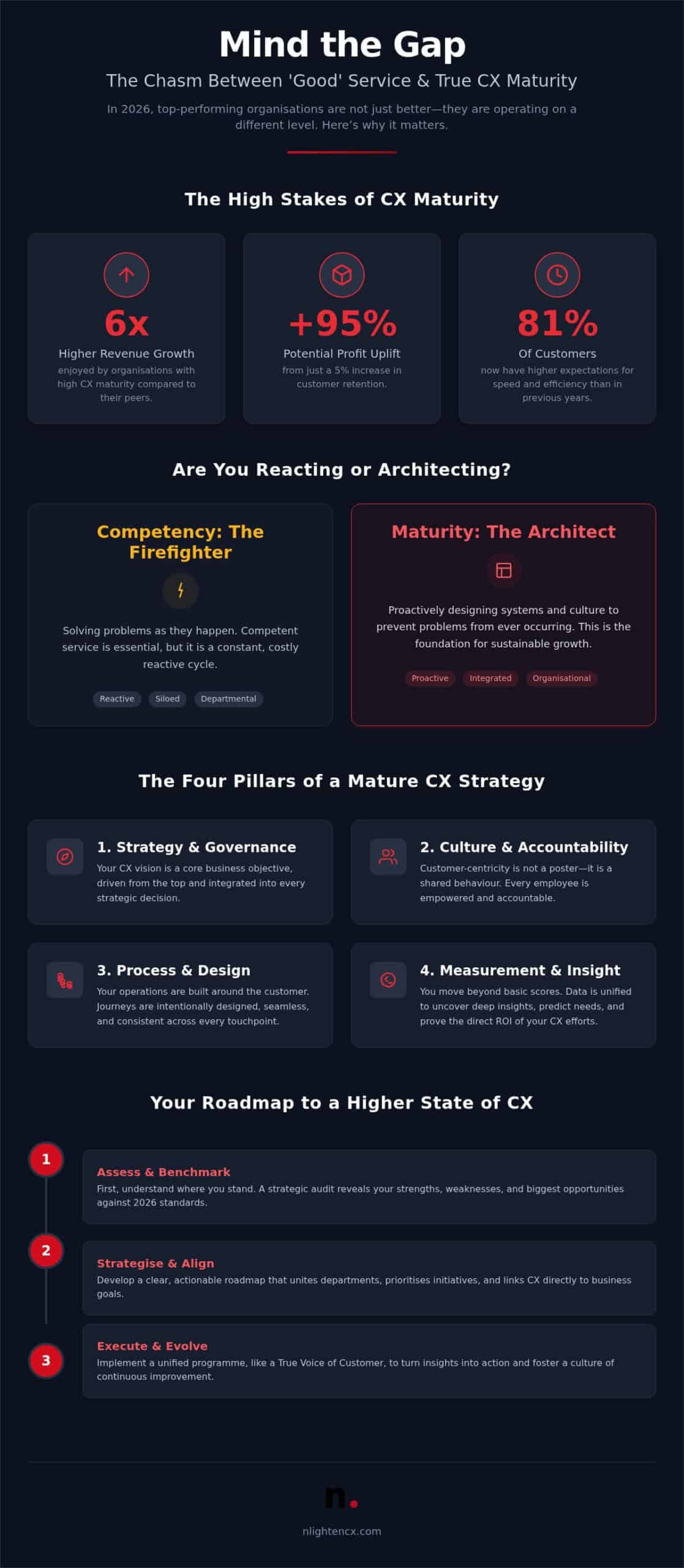
Why does your organisation still lose customers despite providing what you consider to be excellent service? In 2026, the gap between “decent” service and a truly mature customer strategy has become a chasm that swallows profits. To bridge this divide, you must accurately assess customer experience maturity within your specific business context. Top-performing companies now generate six times the revenue growth of those lagging behind; yet, many South African firms remain hindered by siloed departments and fragmented data that obscure the true customer journey.
You likely recognise the difficulty of proving the ROI of CX initiatives to a board that demands immediate financial justification. It’s exhausting to manage high churn rates whilst your teams operate in isolation. Since a 5% increase in customer retention can boost profits by up to 95%, the stakes for your bottom line couldn’t be higher. This guide promises to provide a clear methodology for evaluating your current CX capabilities and building a roadmap for sustainable growth. We’ll examine the latest 2026 benchmarks and show you how to link maturity directly to business stability; ensuring your strategy is a calculated investment rather than a series of random acts of service.
Key Takeaways
- Understand the critical link between organisational sophistication and business stability within the competitive South African landscape.
- Learn how to assess customer experience maturity by evaluating four strategic dimensions, from governance to internal culture.
- Discover why the nlightencx Free CX Quiz serves as the vital starting point for benchmarking your current capabilities against 2026 standards.
- Identify actionable methods to dismantle departmental silos and overcome cost-related objections by prioritising high-value customer retention.
- Gain a structured roadmap for moving up the maturity curve through the implementation of the True Voice Of Customer Program.
What is Customer Experience Maturity and Why Does It Matter?
Customer experience is not a department; it’s a measure of how successfully your organisation integrates customer-centricity into its operational rhythm. It goes beyond mere service quality. It encompasses the systems, data flows, and cultural mindsets that dictate every interaction. To effectively assess customer experience maturity, one must look past the surface level of “being nice” to customers and scrutinise the underlying infrastructure. In its essence, customer experience maturity reflects the level of sophistication in an organisation’s behaviours and processes. It’s the difference between a company that happens to have happy customers and a company that is designed to create them.
In the South African market, business stability is a premium. High-maturity organisations generate six times the revenue growth of their less-developed peers. This isn’t a coincidence. It is the result of moving from reactive fire-fighting to proactive experience design. When you understand your maturity level, you can address the hidden costs of customer churn before they erode your margins. Every siloed department that fails to share data represents a leak in your profitability. Maturity stops those leaks by creating a unified, data-driven approach to the customer journey.
The Business Case for Assessing Maturity
“Good enough” service is no longer a safety net; it’s a liability. By 2026, 81% of customers reported higher expectations for speed and efficiency than in previous years. Relying on NPS alone often masks deep-seated friction points that only a maturity audit can reveal. High maturity directly correlates with increased customer lifetime value. It transforms the customer relationship from a series of transactions into a resilient asset that supports long-term growth. If you don’t assess customer experience maturity, you are essentially flying blind, unable to link your CX efforts to business stability.
Maturity vs. Competency: Understanding the Difference
Many firms mistake service competency for strategic maturity. Being competent means you can resolve a complaint effectively. Being mature means your organisation has the foresight to prevent the complaint from occurring in the first place. Maturity requires a shift from siloed, departmental efforts to a unified focus where data is shared across the entire national footprint. It ensures that whether a customer interacts with your brand in a physical centre or through a digital portal, the quality remains consistent. True maturity is about consistency, scalability, and the ability to prove that your CX strategy is actually working.
The Four Critical Dimensions of the CX Maturity Model
To effectively assess customer experience maturity, you must look beyond isolated metrics and examine the structural pillars of your business. Maturity isn’t a single score. It’s a multi-dimensional state. We categorise these into four critical areas: Strategy and Governance, Culture and Accountability, Process and Design, and Measurement and Insight. Think of the maturity model as a strategic customer experience management tool that aligns your internal mechanics with external customer expectations. Without this alignment, your CX efforts will remain fragmented and incapable of delivering a sustainable competitive advantage.
Strategy and Culture: The Foundation of Maturity
Does your CX strategy live in the boardroom or just in a marketing presentation? Maturity begins with high-level alignment. Your CX goals must be indistinguishable from your broader business objectives. If they aren’t, your initiatives will lack the authority needed to drive meaningful change. This requires fostering customer-centric behaviour amongst diverse teams, from finance to logistics. It isn’t enough for staff to be “polite.” They must understand their specific role in the customer journey. Tools like the CX Handbook are essential here. They provide the necessary standardisation of excellence across all touchpoints, ensuring that your brand promise is delivered consistently regardless of the department involved. When every employee is accountable for the customer’s perception, the organisation moves away from reactive service toward a culture of intentional experience design.
Process and Measurement: The Engine Room
How do you organise service delivery? Mature organisations use CX research and journey mapping to identify “moments of truth.” These are the high-stakes interactions where loyalty is either won or lost. Whilst many competitors focus solely on transaction speed or contact centre efficiency, a mature approach prioritises the emotional connection. Logic dictates that a fast transaction that leaves a customer feeling undervalued is a failure. By implementing the True Voice Of Customer Program, you move beyond basic metrics like NPS to gain deep situational awareness. This allows you to integrate customer insights directly into your operational workflows, ensuring that your business evolves based on actual human perception rather than internal assumptions. If you’re ready to identify your current gaps, you can assess customer experience maturity by using a professional benchmarking tool to see where your organisation truly stands on the curve.
How to Conduct a Strategic CX Audit: A Step-by-Step Framework
Auditing your organisation’s current state is the only way to move from guesswork to strategic certainty. You cannot manage what you haven’t measured. To accurately assess customer experience maturity, you need a structured approach that scrutinises both your internal processes and your customers’ actual perceptions. This isn’t a one-off exercise. It’s a foundational diagnostic that informs your entire growth strategy for 2026 and beyond. Follow these five steps to build your roadmap:
- Step 1: Benchmark your current state. Use the nlightencx Free CX Quiz to get an immediate, high-level view of where your capabilities sit on the maturity curve.
- Step 2: Perform deep-dive CX research. Move beyond numbers. Conduct qualitative interviews and surveys to understand the “why” behind customer behaviours.
- Step 3: Map the current customer journey. Visualise every touchpoint to find friction points and service gaps that frustrate your customers and cost you money.
- Step 4: Evaluate staff skills. Identify training needs through a comprehensive CX audit of your teams’ ability to deliver on your brand promise.
- Step 5: Synthesise findings. Collate your data into a prioritised CX improvement plan that targets the most significant impact on retention first.
Gathering the Right Data
Don’t confuse internal perception with external reality. Your leadership team might believe your service is seamless, but your customers likely have a different story. In 2026, effective Voice of the Customer research must go deeper than just listening to those who complain. You must actively seek out “silent” customers-the ones who leave without saying a word. These quiet exits often represent the largest portion of your churn. By capturing their insights, you gain a more honest reflection of your market standing. Use CX research South Africa methodologies to ensure you’re looking at the data through both an analytical and an empathetic lens.
Analysing the Gaps
Once your data is collected, you’ll likely encounter “CX Debt.” This is the accumulated cost of unresolved customer pain points that erode loyalty over time. To assess customer experience maturity effectively, you must compare your national service standards against specific industry benchmarks. Are you keeping pace with the 81% of customers who now expect faster service? Prioritise your fixes based on their direct impact on business stability. Addressing a friction point that causes 20% of your churn is far more valuable than updating a minor aesthetic detail. This logical, results-oriented approach ensures your resources are invested where they generate the highest return.
Overcoming the Common Barriers to CX Evolution
Why do so many South African businesses stall after they assess customer experience maturity? The answer usually lies in organisational inertia rather than a lack of intent. One of the most significant hurdles is the “cost objection.” Leaders often fixate on the immediate expense of CX initiatives whilst ignoring the massive drain of customer churn. Logic dictates that the cost of acquiring a new customer is significantly higher than retaining an existing one. In fact, increasing retention by just 5% can lead to profit gains of up to 95%. By shifting your focus toward the longevity of your current relationships, you aren’t just saving money; you’re securing your business stability in a volatile market.
Departmental silos represent another formidable barrier to progress. When marketing, sales, and operations don’t share customer data, the experience becomes fragmented and frustrating for the end-user. Your customers don’t see departments; they see one brand. Breaking these silos requires a unified vision where every leader is responsible for the emotional connection strategy. This consistency is particularly vital during periods of rapid growth. Scaling your operations shouldn’t mean diluting your service quality. It requires a structured approach that prioritises human perception alongside operational efficiency. Leaders must champion this shift, ensuring that customer-centricity is woven into the very fabric of the organisation’s DNA.
The Myth of the ‘Quick Fix’
Buying new CRM software won’t solve a broken customer culture. Technology is an enabler, not a cure. If your underlying processes are flawed, software will only help you fail faster. Strategic growth demands a long-term commitment to improving behaviours and mindsets rather than chasing short-term metrics that don’t reflect actual loyalty. You cannot automate empathy or process-map your way out of a culture that doesn’t value the customer. Customer experience maturity is a continuous journey of refinement and adaptation, not a final destination to be reached and forgotten.
Engaging Your Workforce
Your employees are the primary architects of your customer’s experience. If they don’t understand the “why” behind your CX vision, they cannot deliver it. High employee churn is often a symptom of a lack of purpose and empowerment. By providing CX Training that equips teams with specific customer-centric skills, you reduce turnover and build a more resilient workforce. Professional development through advanced CX Masterclasses ensures your staff stay ahead of 2026 trends and feel personally invested in the organisation’s success. When your people are equipped with the right tools, such as the CX Handbook, they become your most powerful asset in driving sustainable growth. To begin dismantling these organisational barriers, assess customer experience maturity and identify exactly where your friction points lie.
Partnering for Growth: How nlightencx Accelerates Your CX Journey
Achieving a high level of customer centricity is not a solo endeavour. It requires a level of strategic objectivity that internal teams, often bogged down by legacy processes, struggle to maintain. At nlightencx, we act as a seasoned mentor to help you assess customer experience maturity and convert those findings into a resilient growth engine. Just as you might explore Consultation with Neil Norton Design for bespoke residential interior projects, our tailored CX consulting provides the expert path toward doing it right. By implementing the True Voice Of Customer Program, we give your leadership team the deep situational awareness needed to move beyond guesswork and into the realm of data-driven certainty.
Sustainability in the South African market depends on your ability to professionalise your customer interactions. To support this, we offer high-impact CX Masterclasses designed for senior leaders and practitioners who need to master the art of experience design. These sessions are supplemented by practical resources such as the CX Handbook. This handbook serves as your internal reference for standardising excellence across every touchpoint. It ensures that the transformation we start together is sustained long after the initial consulting phase is complete.
From Assessment to Action
Data without a plan is merely noise. nlightencx specialises in turning complex audit data into high-growth strategies that address your specific market challenges. As a national consultancy, we understand the unique nuances of the South African business landscape; from local regulatory pressures to shifting consumer behaviours. We have seen how strategic design can transform high churn rates into enduring loyalty. By identifying the specific friction points in your journey, we help you prioritise the initiatives that will yield the highest return on investment. Logic dictates that when you fix the root cause of customer frustration, business stability follows as an inevitable result.
Your Next Steps in 2026
The window for “good enough” service has closed. With 81% of customers now demanding faster and more personalised service than they did just a year ago, the cost of inaction is rising. Why wait for your churn rates to dictate your strategy? Now is the time to assess customer experience maturity and reclaim control over your brand’s perception. A professional CX audit is the first step toward a more secure and profitable future. It provides the clarity needed to dismantle silos and empower your workforce with a unified vision of excellence. Don’t leave your customer loyalty to chance when you can build it on a foundation of expert insight.
Take the Free CX Quiz today to benchmark your organisation.
Securing Your Competitive Advantage in 2026
The chasm between businesses that merely survive and those that dominate is defined by their level of customer-centric sophistication. Maturity isn’t a software score; it’s the deliberate integration of strategy, culture, and measurement into a single, cohesive engine. High-maturity organisations don’t just hope for loyalty. They design for it. By dismantling departmental silos and addressing the accumulated “CX debt” of unresolved pain points, you protect your margins and ensure long-term business stability. Logic dictates that a business designed around the customer is a business built to last.
Now is the time to assess customer experience maturity within your own organisation to identify the specific friction points stalling your growth. With dozens of South African corporate success stories and our signature True Voice Of Customer Program, nlightencx provides the expertise needed to move you up the maturity curve. Whether through comprehensive CX Masterclasses for professional development or bespoke strategy sessions, we ensure your leadership team is equipped for the challenges of the 2026 market. Your roadmap to sustainable growth starts with a single, calculated step toward excellence.
Ready to transform your customer journey into a resilient asset? Book a strategic CX consulting session with nlightencx today. Take the lead in your industry by turning customer insights into measurable business results.
Frequently Asked Questions
How long does a typical customer experience maturity assessment take?
A comprehensive evaluation typically requires between four and twelve weeks to complete, depending on the scale of your operations and data accessibility. It isn’t a race. Rushing the process leads to shallow insights that fail to drive real change. A thorough audit involves stakeholder interviews, data analysis, and customer research to ensure the final roadmap is both realistic and actionable for your specific national context.
Is there a difference between a CX audit and a maturity assessment?
Yes, although they are closely linked. A CX audit is a tactical snapshot of your current performance and touchpoints. In contrast, when you assess customer experience maturity, you examine the underlying organisational capabilities, culture, and governance that sustain that performance. Think of the audit as checking the engine’s current speed, whilst the maturity assessment evaluates the engine’s design and its potential for long-term endurance.
Can a small business have a high level of CX maturity?
Absolutely. Maturity is defined by the sophistication of your processes and behaviours, not the size of your balance sheet. Smaller firms often have an advantage because they can dismantle silos and pivot towards customer-centricity much faster than large corporates. A nimble South African SME with integrated data and a clear CX vision can easily outperform a massive competitor that suffers from fragmented departments and legacy thinking.
How often should we re-assess our customer experience maturity?
You should ideally conduct a formal review every twelve to eighteen months. Markets evolve rapidly. By 2026, customer expectations for speed and personalisation have reached new heights, making yesterday’s “mature” processes obsolete today. Regular re-assessment ensures your strategy remains aligned with shifting consumer behaviours and technological advancements. It prevents your organisation from stagnating or falling behind more agile competitors who are constantly refining their customer-centricity.
What are the most important KPIs to track during a CX evolution?
Focus on metrics that link directly to business stability and profitability. Whilst NPS provides a surface-level sentiment, you must track Customer Lifetime Value (CLV), retention rates, and the cost of service. Mature organisations also monitor employee engagement scores, as internal culture is the primary driver of external experience. These KPIs offer a logical, data-driven view of your progress and help prove the ROI of your CX initiatives to the board.
How do I convince the board to invest in a CX maturity assessment?
Frame the investment as a strategy for risk mitigation and revenue security. Use hard data to highlight the hidden costs of customer churn and departmental silos. Explain that a maturity assessment isn’t a “nice-to-have” marketing exercise; it’s a diagnostic tool that identifies friction points eroding your bottom line. When you present it as a structured roadmap for sustainable growth and competitive resilience, the business case becomes undeniable to results-oriented directors.
What is the role of technology in a mature customer experience?
Technology acts as a critical enabler for scaling your human-centric strategy. In a mature environment, tools like AI-powered agents and integrated CRM platforms are used to handle routine tasks, allowing your team to focus on complex emotional connections. However, technology must never be the strategy itself. A mature organisation ensures its digital tools are seamlessly integrated across all touchpoints to provide a unified, friction-free journey for every South African customer.
Can we improve our CX maturity without hiring a consultant?
You can certainly begin the journey internally by utilising professional resources like the CX Handbook and internal training. However, internal teams often suffer from “organisational blindness,” where they struggle to see friction points that have become normalised over time. An external perspective provides the objectivity and cross-industry expertise needed to assess customer experience maturity accurately. It ensures you don’t waste time on trial and error whilst your competitors are already moving ahead.