

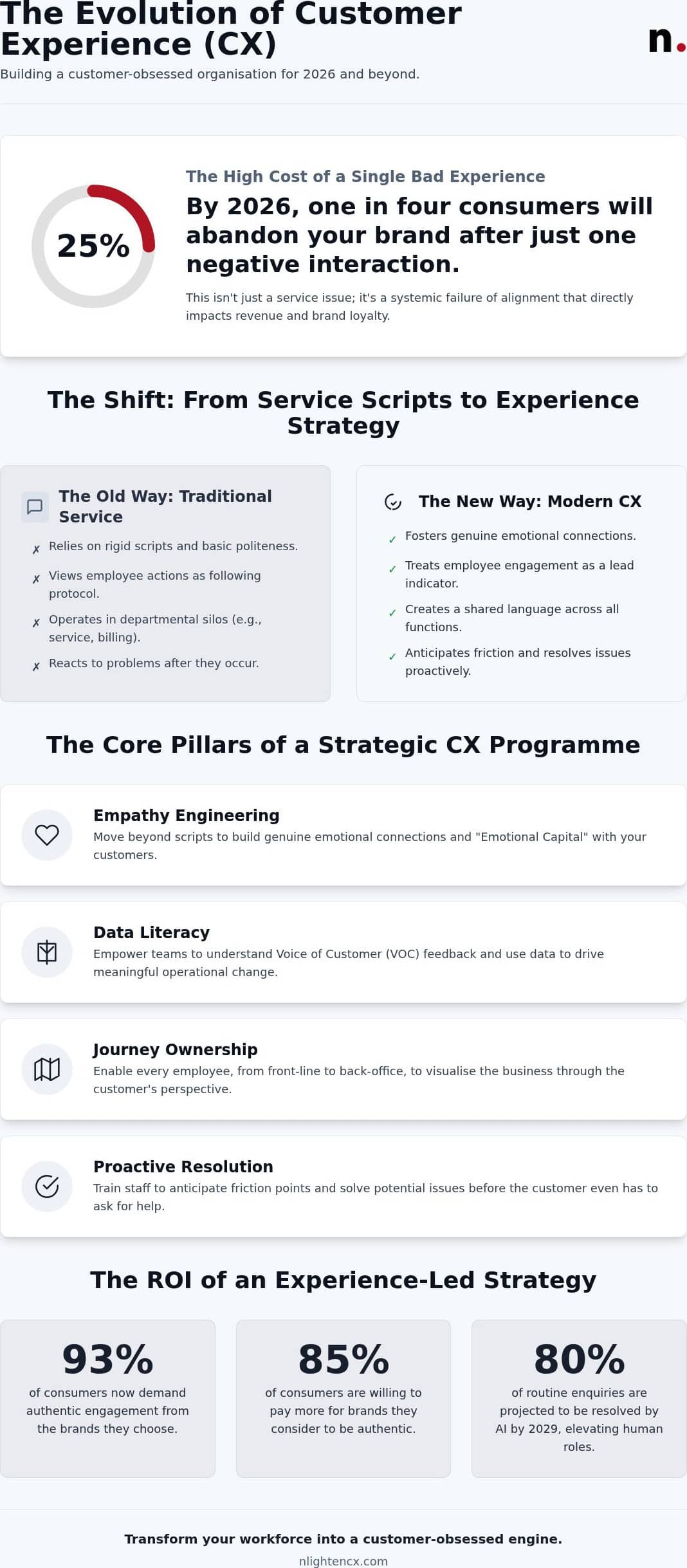
Did you know that in 2026, one in four consumers will abandon your brand after a single negative interaction? It’s a sobering reality for any business leader. You’ve likely felt the frustration of watching churn rates climb whilst your “service team” follows every protocol to the letter. Why do employees often lack a genuine emotional connection with the clients they serve? The truth is that inconsistent service quality across different departments isn’t a staff problem; it’s a systemic failure of alignment.
Effective CX training for employees isn’t about memorising scripts or polite greetings. It’s about a strategic re-engineering of empathy and operational logic. By reading this guide, you’ll learn how to transform your workforce into a customer-obsessed engine that drives loyalty, reduces churn, and secures long-term profitability. We’ll explore the methodology behind building a unified service culture where every team member takes ownership of the customer journey, resulting in measurable improvements to your loyalty scores and business stability. It’s time to move beyond basic service and start building an organisation that thrives on authentic connection.
Key Takeaways
- Shift from rigid service scripts to a holistic strategy that treats employee engagement as the primary lead indicator for customer satisfaction.
- Implement strategic CX training for employees that prioritises “Empathy Engineering” to foster genuine emotional connections with your clients.
- Guarantee long-term results by integrating leadership modelling into your culture, ensuring the behaviours learned in workshops become permanent organisational habits.
- Quantify your success by linking training outcomes directly to measurable reductions in customer churn and overall acquisition costs.
- Utilise diagnostic tools like the True Voice of Customer program to identify friction points and create a clear roadmap for team alignment.
Defining CX Training for Employees in 2026
In a landscape where agentic AI is projected to resolve 80% of routine enquiries by 2029, what remains for your human workforce? The answer lies in the complex, high-stakes interactions that technology cannot yet replicate. Traditional customer service training, which relied heavily on rigid scripts and basic politeness, has become obsolete. By 2026, the focus has shifted toward a more sophisticated, human-centric model. CX training for employees is the strategic process of aligning employee behaviour with the customer journey to create meaningful, value-driven outcomes.
Why is this distinction critical for your business stability? Whilst a service script tells an employee what to say, holistic experience management teaches them how to think. This shift acknowledges that employee engagement is the primary lead indicator of customer satisfaction. If your team members don’t feel a sense of ownership, they won’t deliver the authentic engagement that 93% of consumers now demand. To understand the foundations of this discipline, one must ask: What is Customer Experience (CX)? It’s the sum of every interaction, and managing it requires a workforce that understands the emotional drivers behind every data point.
The Evolution from Service to Experience
Being polite is no longer a competitive advantage; it’s a baseline requirement. In modern markets, customers expect rapid, autonomous problem-solving. True CX training for employees empowers staff with the autonomy to navigate complex pain points without constant managerial intervention. This training doesn’t just sit with the frontline. It influences the back-office, the billing department, and the logistics teams, ensuring that every touchpoint reinforces the brand promise. When employees understand the “why” behind the journey, they move from being passive participants to active experience designers.
Why National Organisations are Prioritising CX Learning
For national organisations, the challenge is consistency. A customer should receive the same high-quality experience whether they’re interacting with a digital portal or a physical branch. Strategic CX learning addresses the “Internal Silo” problem by creating a shared language across different functions. How often do your departments operate as islands? Training unifies these groups, allowing them to identify churn risks long before they manifest as lost revenue. By 2026, the ability to predict and prevent a bad experience has become the hallmark of a secure, growth-oriented business.
The Core Modules of a Strategic CX Training Programme
How do you ensure that your investment in CX training for employees yields a tangible return? A successful programme must move beyond theoretical lectures into the realm of practical, daily application. To achieve this, your development strategy should be built upon four non-negotiable pillars. These pillars ensure that every staff member, regardless of their department, operates from a shared playbook of excellence. Without this structure, service quality remains inconsistent and fragmented.
- Empathy Engineering: Moving beyond scripts to build genuine emotional connections.
- Data Literacy: Understanding Voice of Customer (VOC) feedback to drive operational change.
- Journey Ownership: Visualising the business through the customer’s perspective.
- Proactive Resolution: Anticipating friction before the customer has to ask for help.
These modules don’t just solve current problems. They build a resilient organisation that can withstand market shifts and rising consumer expectations. If you want to assess where your team currently sits amongst these pillars, using a diagnostic tool is an essential first step toward clarity.
Emotional Architecture and Empathy
Every interaction leaves an “Emotional Signature” on your customer. Do they feel valued, or like a transaction number? Strategic CX training for employees teaches staff to recognise these signatures in real-time. By mastering de-escalation techniques, employees can diffuse frustration whilst maintaining your brand’s integrity. This process builds “Emotional Capital”, which acts as a buffer during inevitable service failures. When customers trust your intent, they stay loyal even when things go wrong. Authentic engagement builds trust, and data shows that 85% of consumers are willing to pay more for brands they consider authentic.
Journey Mapping as a Daily Employee Tool
Journey mapping is often seen as an executive exercise, but it’s most powerful when used by the frontline. Employees must learn to see the business through the “Customer Lens” to identify “Moments of Truth”. These are the specific touchpoints where an employee’s intervention has the highest impact on loyalty. In complex environments, this requires a deep understanding of B2B customer journey mapping to manage long-term stakeholder relationships. Equipping your team with these tools ensures they don’t just follow a path; they actively improve it. For those ready to institutionalise these skills, a professional CX Masterclass provides the necessary rigour to align an entire organisation.
Beyond the Classroom: Building a Sustainable CX Culture
Why do so many corporate initiatives wither shortly after the final workshop? The answer lies in the “one-off event” fallacy. Training is not a vaccine that provides permanent immunity against poor service; it’s a lifestyle change that requires daily discipline. To build a sustainable culture, CX training for employees must be supported by a framework of leadership accountability and constant reinforcement. If the organisation returns to “business as usual” on Monday morning, the investment is effectively lost.
Sustaining a customer-centric mindset requires more than just memory. It demands that every department, from finance to logistics, understands how their specific output impacts the end-user. This is achieved through consistent internal communications that keep CX goals top-of-mind. When customer feedback is shared openly across the business, it ceases to be a “service team” problem and becomes a collective mission. Integrating these metrics into standard performance reviews ensures that employees are incentivised to prioritise the experience over mere transactional volume.
Leadership Alignment and Modelling
Frontline excellence is impossible without executive buy-in. Leaders must move beyond signing off on budgets and start modelling the specific behaviours taught in the classroom. This involves creating a “Feedback Loop” where employees feel psychologically safe reporting friction points in the customer journey. When staff see their insights leading to operational changes, their engagement levels skyrocket. For those at the helm of national organisations, consulting a strategic guide to CX training is a prerequisite for ensuring that high-level strategy translates into boots-on-the-ground reality.
Internal Certification and Continuous Learning
Sustainability also depends on accessible resources. Tools like the CX Handbook serve as a permanent reference for practitioners, ensuring that the principles of empathy and journey ownership remain fresh. Monthly micro-learning sessions and brief CX refreshers prevent the natural knowledge decay that follows a major workshop. Recognising and rewarding employees who deliver “True Voice” excellence creates a healthy competitive drive towards better service. When you reward the right behaviours, you reinforce the culture you’ve worked so hard to build. This continuous loop of learning and recognition is what separates high-performing organisations from those that simply “do” CX training for employees as a box-ticking exercise.
Measuring the ROI of CX Employee Development
How do you justify the budget for CX training for employees? For many executives, customer experience remains a nebulous concept until it’s translated into the cold, hard language of the balance sheet. To secure long-term profitability, you must establish clear KPIs before and after any training intervention. By linking development directly to the reduction of customer churn and acquisition costs, you transform a discretionary expense into a strategic investment. It’s a shift from seeing staff as a cost centre to viewing them as a primary driver of retention.
One of the most powerful correlations in modern business is the link between the Employee Effort Score and the Customer Effort Score. When your team lacks the skills or autonomy to solve problems, their effort increases, which invariably mirrors the customer’s frustration. Reducing this friction through targeted training creates a smoother operational flow that benefits both sides of the counter. Additionally, your business earns a “Retention Dividend” when skilled service recovery turns a potential defector into a lifelong advocate. This dividend is the measurable financial gain from keeping a customer who was on the brink of leaving.
Hard Metrics: Churn, Lifetime Value, and Profitability
Calculating the ROI of your team’s development starts with a simple comparison: what is the cost of a lost customer versus the cost of team training? Research in 2026 indicates that one in four consumers will leave a brand after just one bad experience. A single failure can trigger an immediate departure, yet a trained employee can mitigate that risk in seconds. Beyond churn, improved CX reduces the “Cost to Serve” by eliminating the need for repeat complaints and lengthy escalations. When employees get it right the first time, you save on operational overheads and administrative time. For a comprehensive breakdown of these financial drivers, consult our guide on customer experience ROI for businesses.
Soft Metrics: Employee Retention and Brand Health
The benefits of CX training for employees extend inward to your workforce stability and overall brand equity. There’s a direct correlation between professional development and reduced employee turnover; staff who feel equipped to succeed are far less likely to leave for competitors. You can also measure the shift in brand sentiment across national social listening channels as your team begins to deliver more consistent, authentic interactions. To understand your starting point, use the Free CX Quiz as a baseline for your organisation’s current maturity level.
Ready to see these metrics improve in your own organisation? Start by assessing your current standing with nlightencx to build your business case for transformation.
Implementing Your CX Training Roadmap with nlightencx
Transforming an organisation into a customer-centric engine is not a matter of chance; it’s a matter of methodology. At nlightencx, we provide the structured roadmap necessary to turn theoretical empathy into operational excellence. The nlightencx Masterclass serves as the primary vehicle for this transformation, offering a rigorous deep dive into the mechanics of experience management. Unlike generic workshops that offer surface-level advice, our approach is multidisciplinary and rooted in the reality of national business dynamics. Implementing strategic CX training for employees requires a partner who understands that training is only one piece of a larger strategic puzzle.
How do you ensure your training budget isn’t wasted on an irrelevant curriculum? We utilise the True Voice of Customer program as a vital diagnostic tool before any classroom intervention begins. Identifying specific organisational friction points ensures that your investment in CX training for employees is precisely targeted to solve real-world problems. Post-training, the CX Handbook remains with your practitioners as the definitive guide for maintaining service excellence. This ensures the momentum generated during our sessions isn’t lost amongst the pressures of daily operations.
The nlightencx Masterclass Experience
Our Masterclass is designed to move teams from simple awareness to active advocacy. We customise the curriculum to reflect your specific industry challenges, ensuring every exercise feels relevant to your staff’s daily reality. This approach combines human psychology with operational strategy to create a workforce that takes full ownership of the customer journey. By the end of the session, your employees will have the tools to actively engineer better outcomes rather than just reacting to complaints. We empower your team to become the bold innovators your customers expect in 2026.
Next Steps for National Growth
The path to a customer-obsessed culture begins with data, not assumptions. We strongly recommend conducting comprehensive CX research before finalising your training plans. This research provides the evidentiary foundation for your strategy, allowing you to build a programme that addresses verified pain points. Once the research is complete, we move through strategy development and into the execution of the training itself. This methodical flow ensures that every action taken is both earned and necessary for your business stability.
Are you ready to secure your organisation’s future in an increasingly competitive landscape? The first step is a consultation to assess your current service quality and identify the gaps in your team’s development. Enrol your team in an nlightencx Masterclass today to begin your organisational transformation.
Securing Your Competitive Advantage in 2026
The transition from a transactional service model to a customer-centric culture is a strategic necessity for business stability. You’ve seen how CX training for employees serves as the catalyst for this shift, turning empathy into a measurable financial asset. By integrating the insights from our True Voice of Customer Program and equipping your practitioners with the specialist CX Handbook, you ensure that high-level strategy translates into consistent, high-quality interactions across every department.
Success requires more than just a single workshop; it demands an authoritative partner who can align your leadership and frontline teams toward a unified goal. Are you prepared to lead your organisation into a more profitable future? By acting now, you can eliminate the friction points that drive churn and secure the long-term loyalty of your client base. It’s time to transform your workforce into an engine of growth.
Empower your workforce with an nlightencx Masterclass and begin the journey toward organisational excellence today. Your customers are waiting for the authentic engagement only a truly aligned team can provide.
Frequently Asked Questions
What is the difference between customer service training and CX training?
Customer service training focuses on the specific moment of interaction, often relying on scripts and politeness to resolve immediate issues. In contrast, CX training for employees is a holistic discipline that encompasses the entire customer journey. It moves beyond reactive problem-solving to teach staff how to manage the emotional and operational drivers of loyalty. Whilst service is a department, CX is a strategy that aligns every touchpoint with the brand promise.
How long does it take to see results from employee CX training?
You’ll notice shifts in employee behaviour and communication styles immediately after a workshop. However, measurable improvements in hard metrics like customer churn or loyalty scores typically manifest within three to six months. This timeframe allows for the new cultural habits to bed down across the organisation. The speed of results depends heavily on leadership’s commitment to modelling the behaviours taught and reinforcing them through daily internal communications.
Can CX training help reduce employee turnover in my organisation?
Yes, there is a direct correlation between professional development and staff retention. Employees who feel equipped to handle complex customer interactions experience less work-related stress and higher job satisfaction. By providing your team with the tools to succeed, you foster a sense of ownership and purpose. When staff members see the tangible impact of their empathy on business growth, they become more engaged and less likely to seek opportunities elsewhere.
Is CX training relevant for back-office employees who never see customers?
CX training is essential for every department because every internal process eventually impacts the end-user. Back-office teams often manage the invisible touchpoints, such as billing accuracy or logistics, that can make or break a customer’s trust. Training helps these employees understand their role within the broader customer journey. When the back-office views the frontline as their internal customer, the entire organisation operates with a unified, customer-centric logic.
How do we measure the success of a CX training programme?
Success is measured through a combination of hard financial data and soft sentiment metrics. Key indicators include a reduction in customer churn, improved Net Promoter Scores, and a decrease in the cost to serve. You should also track the Employee Effort Score; a lower score suggests that your team finds it easier to deliver excellent service. Using tools like the Free CX Quiz before and after CX training for employees provides a clear baseline for organisational maturity.
What are the most important skills for employees to learn in a CX workshop?
The four non-negotiable pillars include empathy engineering, data literacy, journey mapping, and proactive problem-solving. Employees must learn to recognise the emotional signature of an interaction and de-escalate frustration whilst maintaining brand integrity. Data literacy is equally vital, as it allows staff to interpret Voice of Customer feedback and take corrective action. These skills empower your workforce to move from passive participants to active experience designers who secure long-term profitability.
How often should employees undergo CX refresher training?
Culture is built through consistency, so we recommend a blend of annual intensives and monthly micro-learning sessions. Knowledge decay is a natural risk after any major workshop; regular refreshers keep CX goals top-of-mind. These sessions don’t need to be lengthy. Short, focused updates on new customer insights or journey mapping refinements ensure that the customer-centric mindset remains a permanent organisational habit rather than a fleeting initiative.
Does nlightencx provide training for national organisations across South Africa?
Yes, nlightencx operates with a national scope, providing authoritative consulting and training for brands across South Africa. Our specialist CX Masterclass and True Voice of Customer Program are designed to scale across diverse business dynamics, ensuring consistent service quality regardless of your team’s size or location. We partner with national organisations to build resilient, customer-obsessed cultures that thrive in competitive markets. Our methodology is built for the specific challenges of the South African landscape.