

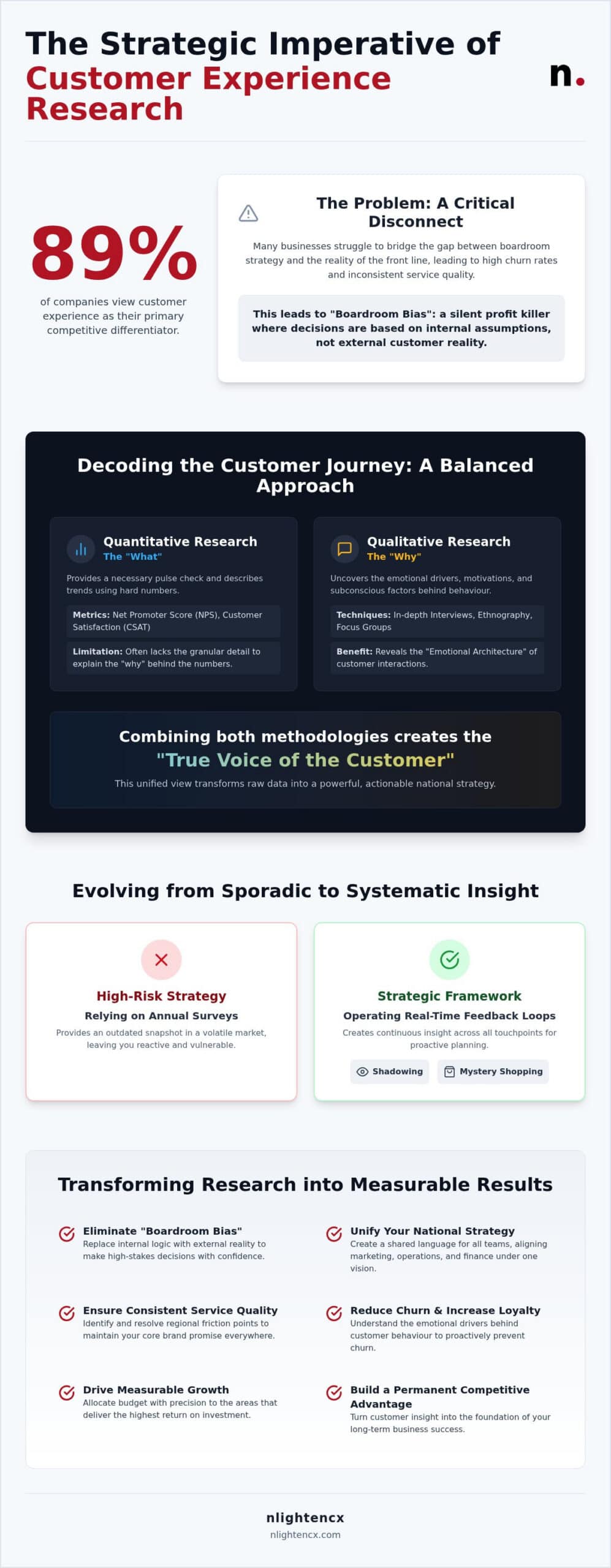
Did you know that whilst 89% of companies view customer experience as their primary competitive differentiator, many still struggle to bridge the gap between boardroom strategy and the reality of the front line? It’s a common struggle. You’ve likely felt the sting of high churn rates or the frustration of inconsistent service quality across your national branches. This is why selecting the right customer experience research services is no longer a luxury; it’s the foundational step for any business that intends to survive and thrive in 2026.
It’s exhausting to manage a strategy that looks perfect on paper but fails to resonate with the people who actually pay your bills. This guide provides the strategic roadmap you need to eliminate churn and drive measurable growth. We’ll examine how to move beyond basic data collection to find the “True Voice of Customer” that dictates your market position. We’ll explore how to select and implement the services that bridge the disconnect between leadership and the customer. You’ll learn how to secure a clear ROI on your CX initiatives and build a unified national strategy for excellence. Let’s look at how to turn your research into a permanent competitive advantage.
Key Takeaways
- Eliminate “boardroom bias” by utilising professional customer experience research services to diagnose the specific emotional drivers behind customer behaviour.
- Identify why a blend of quantitative metrics and qualitative depth is essential for maintaining consistent service quality across all national branches.
- Master the framework for selecting a boutique research partner that provides the strategic implementation support required to drive measurable business growth.
- Discover how the “True Voice of Customer” program transforms raw data into a unified national strategy that reduces churn and increases loyalty.
- Learn the practical steps to assess your current CX baseline and pitch the necessity of professional research to your board with confidence.
The Strategic Necessity of Customer Experience Research Services
What is the actual state of your customer relationships? Many executives operate on assumptions, yet true growth requires a systematic diagnostic process. Professional customer experience research services function as the primary tool for understanding customer experience at its most granular level. It’s the difference between guessing why customers leave and knowing exactly which emotional drivers are failing. By identifying these friction points, you move from reactive fire-fighting to proactive strategic planning.
Boardroom bias is a silent profit killer. It occurs when leadership makes decisions based on internal logic rather than external reality. High-level research acts as the antidote to this insular thinking. It replaces “we think” with “we know.” This shift is vital for reducing customer churn across a national footprint. When you possess actionable intelligence, you aren’t just collecting data points; you’re gaining the clarity needed to make high-stakes decisions with confidence.
Why National Organisations Require Specialised Research
Maintaining consistent service quality across diverse channels is a significant challenge for large-scale organisations. A strategy that works in one region might fail in another due to local nuances or operational bottlenecks. Specialised research identifies these regional friction points whilst ensuring the core brand promise remains intact. It provides a shared language for multidisciplinary teams. When marketing, operations, and finance all see the same customer reality, they can align under a single, unified vision of excellence.
The Financial Case for Strategic Insight
Every business decision has a price tag. Investing in new features or services that your customers don’t actually value is a waste of capital. Strategic research ensures your budget is allocated to the areas that drive the highest customer experience roi for businesses. It’s about precision. Why spend millions on a digital interface if the primary point of frustration is the delivery speed? For large-scale organisations, the cost of ignorant churn, where customers leave for reasons the board doesn’t even realise exist, can represent millions in lost annual revenue. High-quality customer experience research services ensure you never lose a customer to a problem you didn’t know you had.
Essential Methodologies: Decoding the Customer Journey
How do you move from high-level theory to practical execution? It requires a sophisticated diagnostic toolkit. Whilst quantitative metrics like NPS and CSAT provide a necessary pulse check, they frequently lack the granular detail required for a strategic pivot. This is exactly where professional customer experience research services offer the qualitative depth that raw numbers cannot reach. By utilising ethnography and deep interviews, you uncover the “why” behind the “what.”
Qualitative vs Quantitative Research: Finding the Balance
Numbers describe a trend; research explains the motive. For service-led organisations, understanding the “Emotional Architecture” of an interaction is paramount. This concept is a core pillar of CX design for service businesses. It’s not enough to know that a customer is satisfied. You must understand if they feel valued, secure, or frustrated. Focus groups and in-depth interviews reveal these subconscious loyalty drivers that binary surveys inevitably miss. Precision matters here. Without the “why,” your strategy is merely a guess based on a graph.
Systematic Insight Gathering Techniques
Relying on an annual survey is a high-risk strategy for any national organisation. In a volatile market, you require a systematic customer insight gathering framework that operates in real-time. This involves creating feedback loops across both digital and physical touchpoints. Techniques such as “Shadowing” and “Mystery Shopping” are particularly effective in a national context. They provide an unfiltered look at how your brand promise is delivered across different branches. For a foundational introduction to customer experience, one must recognise that data is only useful if it’s consistent.
Hidden pain points often reside in the silent gaps between departmental handovers. This is why customer journey mapping for B2B is so effective for identifying friction in complex professional relationships. The goal is to synthesise these disparate data points into a cohesive narrative. When you can tell the story of your customer’s frustration, you can begin to solve it. If you’re ready to move beyond assumptions, you might consider starting with a free CX quiz to benchmark your current performance.
Evaluating CX Research Partners: A Framework for Selection
Choosing a partner for customer experience research services is a high-stakes decision. Do you need a generic report or a strategic roadmap? Many organisations fall into the trap of hiring generic consultancies, assuming scale equals success. However, CX is deeply human. A boutique approach often provides the nuanced understanding of emotional drivers that a massive, process-driven firm might overlook. You need a partner who understands the national market landscape and can navigate the complexities of your specific industry.
A data vendor gives you a spreadsheet. A strategic advisor gives you a solution. Look for partners who see research as the foundation, not the final product. Even large-scale public initiatives, such as the Federal Customer Experience strategy, demonstrate that success depends on integrating research into a broader operational framework. It’s about moving from data collection to cultural transformation. You don’t just need numbers; you need a partner who can tell you what those numbers mean for your bottom line.
Crucial Criteria for CX Consulting Partners
Does the partner understand the psychological levers of loyalty? It isn’t enough to be good with numbers. They must also grasp the operational realities of your business. A partner with a proven record in customer experience management training is invaluable. This ensures that the insights they gather can actually be taught and adopted by your staff on the ground. They must bridge the gap between “what the data says” and “how the team acts.” Ensure your chosen partner has multidisciplinary skills spanning both psychology and business operations.
Red Flags to Avoid in Research Services
Be wary of any provider that relies exclusively on automated tools. Whilst AI is powerful, it lacks the human interpretation required to decode complex emotional interactions. Does the report look like a template? If the findings don’t address your specific organisational friction points, they’re useless. Avoid generic reports that fail to reference your brand promise. If a partner can’t explain the “why” behind their findings without relying on jargon, they probably don’t understand the customer. Your brand is unique. Your customer experience research services should be as well.
Transforming Research into Results: The True Voice of Customer
Data without implementation is just expensive noise. To achieve genuine growth, you must bridge the gap between what you’ve learned and what your staff actually does. This is where professional customer experience research services evolve into a strategic asset rather than a one-off expense. The ultimate goal of this journey is the implementation of a True Voice of Customer Program. It isn’t just about hearing the customer; it’s about embedding their reality into your operational DNA. When research findings are socialised across all levels of a national organisation, they become a catalyst for change rather than a document on a shelf.
From Reports to Cultural Transformation
Why do so many CX initiatives fail to move the needle? Usually, it’s because the insights never reach the front line. For research to be effective, it must lead directly to CX training for employees. This process translates high-level strategy into specific behaviours. By using research to build a “Customer-First” culture, you reduce internal friction and clarify expectations for every team member. The True Voice of Customer program creates organisational awareness by ensuring that the customer’s reality is visible and undeniable to every staff member. Acting on these insights allows you to design consistent, high-quality interactions that reflect your brand promise at every touchpoint.
Measuring the Impact of Research-Led Strategy
Success must be quantifiable. If your research-led strategy is sound, you should see a direct correlation in your retention metrics. Tracking improvements in customer loyalty and churn reduction post-research is essential for proving ROI to the board. Don’t operate in a vacuum. Use benchmarking to measure your progress against national standards and competitors. It’s also vital to recognise that the customer journey map is a living document. Customer expectations shift, and your research must be iterative to keep pace. Regular pulse checks ensure your strategy remains relevant as market conditions evolve.
Are you ready to turn your data into a measurable competitive advantage? Transform your research into a permanent business asset by implementing the True Voice of Customer Program today to secure your market position for 2026 and beyond.
Implementing Your CX Research Strategy for National Success
How do you initiate a national transformation? You start by acknowledging that you cannot manage what you haven’t measured. The first logical step is to assess your current baseline. Taking a Free CX Quiz provides the immediate clarity required to identify where your organisation stands today. This isn’t just about curiosity. It’s about establishing the hard data needed to pitch professional customer experience research services to your board. You must speak the language of risk and return. Show them how research acts as the foundation for every subsequent CX Strategy and Customer Journey Mapping initiative.
How do you justify the investment? Boards demand clear outcomes. You must demonstrate that customer experience research services are the only reliable way to eliminate the “ignorant churn” that erodes profitability. By presenting the board with a baseline assessment, you move the conversation from subjective opinions to objective business requirements. Once the research phase is complete, the transition to journey mapping becomes seamless. You cannot build a map on a foundation of assumptions. The research provides the empirical evidence required to redesign touchpoints that actually work for the end user.
Immediate Actions for Decision Makers
Success requires more than just a signature on a contract. You must conduct an internal audit of your existing customer data and feedback loops to understand where the “Critical Friction Points” reside. These are the specific moments in the journey where you are losing value or loyalty. Once identified, these points become the priority for your research phase. However, research alone won’t change behaviour. You must enrol leadership in a CX Masterclass to ensure every decision-maker is aligned on the ultimate goals. This creates the top-down buy-in necessary for a national rollout whilst ensuring the strategy remains cohesive across all branches.
The nlightencx Approach to Strategic Growth
At nlightencx, we don’t just provide data; we provide a multidisciplinary team that centres the customer in every facet of your business strategy. Our approach ensures that your research leads to actionable CX Design. For internal practitioners, our CX Handbook serves as a vital resource for maintaining standards long after the initial consulting phase ends. We bridge the gap between boardroom ambition and front-line reality. Are you ready to stop guessing and start growing? Enquire about our CX research services to begin your transformation.
Securing Your Market Position Through Strategic Insight
The path to business stability in 2026 is paved with empirical evidence, not assumptions. We’ve examined how the right diagnostic tools eliminate boardroom bias and bridge the gap between strategy and customer reality. It’s clear that qualitative depth is the only way to uncover the subconscious drivers of loyalty. By moving beyond static reports, you can foster a cultural transformation that resonates across every national branch.
Investing in professional customer experience research services is no longer optional; it’s a foundational requirement for sustainable growth. At nlightencx, we bring multidisciplinary strategic expertise to help you navigate this transition. Whether through our Signature True Voice of Customer Program or our Expert-led CX Masterclasses, we provide the roadmap to turn friction into opportunity. Don’t leave your market position to chance. Partner with nlightencx to transform your customer insights into growth and build a resilient organisation that truly listens to its people.
Frequently Asked Questions
What are customer experience research services?
Customer experience research services are a systematic diagnostic process used to understand the perceptions, emotional drivers, and friction points of your client base. Unlike simple data collection, these services employ methodologies such as deep interviews, ethnography, and journey mapping to uncover the “why” behind customer behaviour. The goal is to provide actionable intelligence that informs your broader business strategy and ensures consistent service quality across all national touchpoints.
How much do CX research services typically cost for a national organisation?
The investment for these services varies significantly based on the scope of the organisation and the complexity of the customer journey. Factors such as the number of national branches, the depth of qualitative research required, and the level of strategic implementation support all influence the final fee. Most professional consultancies provide customised proposals after an initial assessment of your specific friction points and business objectives rather than offering a generic price list.
How long does a comprehensive customer experience research project take?
A comprehensive project typically spans between eight to twelve weeks, depending on the scale of your organisation. This timeline allows for the initial diagnostic phase, the gathering of qualitative insights through interviews or shadowing, and the synthesis of data into a strategic roadmap. Whilst smaller audits may be completed faster, a deep dive into the national customer experience requires sufficient time to ensure the findings are both accurate and actionable for the board.
What is the difference between market research and CX research?
Market research generally focuses on broad trends, competitor analysis, and potential customer demographics to guide market entry. In contrast, CX research focuses specifically on the existing relationship between a brand and its customers. It prioritises understanding the emotional architecture of interactions and identifying internal friction points that impact loyalty. Whilst market research looks for new opportunities, CX research looks to strengthen and sustain the professional relationships you already have.
Can CX research services help reduce customer churn?
Yes, professional customer experience research services are one of the most effective tools for reducing churn. By identifying the specific friction points that cause frustration, you can intervene before a customer decides to leave. Research uncovers “ignorant churn,” where clients depart for reasons the boardroom isn’t even aware of. Addressing these root causes allows you to build a more resilient retention strategy and increase long-term profitability across all national branches.
What deliverables should I expect from a CX research consultant?
You should expect a detailed diagnostic report that translates raw data into strategic insights. Common deliverables include comprehensive customer journey maps, a prioritised list of friction points, and a practical implementation roadmap for service improvement. Many boutique consultancies also provide internal resources, such as a CX Handbook or specialised training recommendations, to ensure that the research findings lead to a permanent cultural shift within the organisation.
Is a Voice of Customer program part of CX research services?
A Voice of Customer program is often the primary framework within which research services are delivered. It serves as the gold standard for transforming customer awareness by creating a continuous feedback loop between the client and the organisation. At nlightencx, our True Voice of Customer Program is the ultimate goal of our research phase. It ensures that the customer’s reality is embedded into your operational DNA and socialised across all levels of leadership.
How do we measure the ROI of customer experience research?
ROI is measured by tracking improvements in key performance indicators such as customer retention rates, lifetime value, and the reduction of service-related complaints. You should also see a decrease in the cost of acquisition as loyalty increases and word-of-mouth referrals grow. By benchmarking your progress against national standards post-implementation, you can demonstrate a clear financial link between research-led strategy and measurable business growth for the boardroom.