

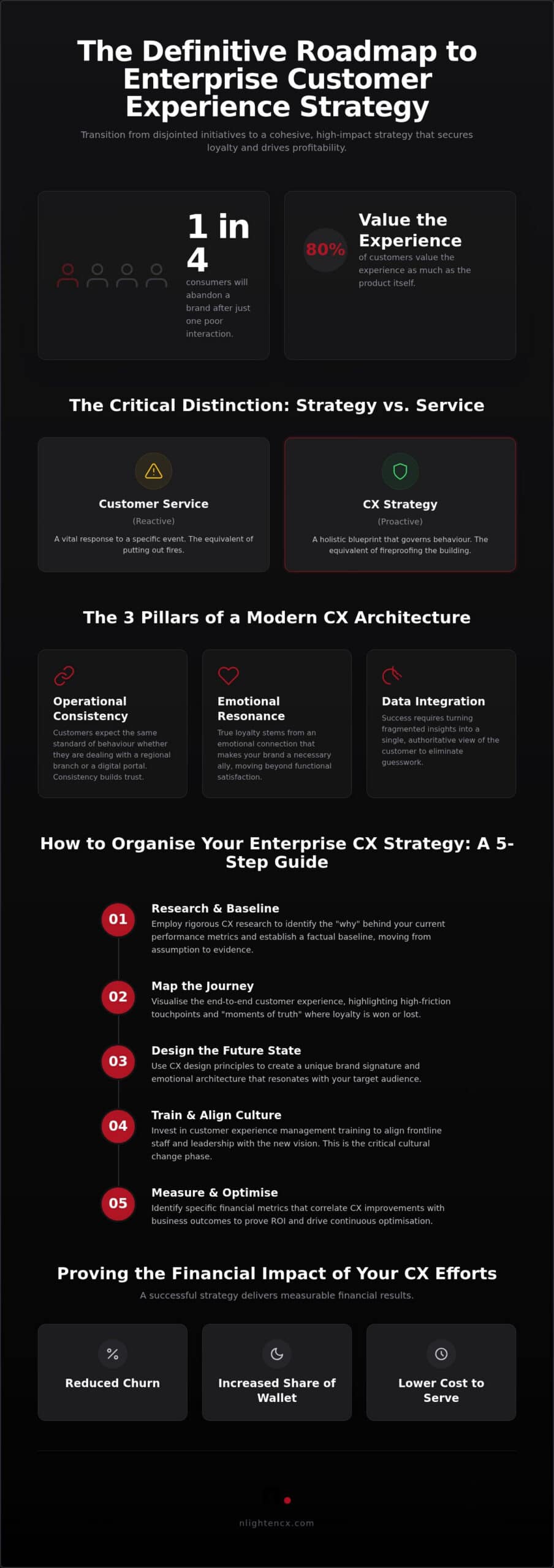
Did you know that one in four consumers will abandon your brand after just a single poor interaction? The margin for error has vanished. In an era where 80 per cent of customers value the experience as much as the product itself, enterprise customer experience strategy development is no longer a luxury; it is a fundamental requirement for survival. You likely feel the friction of siloed data and the quiet resistance of a culture that views CX as a departmental cost rather than a revenue driver. It is notoriously difficult to justify high-level investment when you cannot clearly link a journey map to your bottom line.
We recognise that building a scalable framework requires more than just empathy. It demands a rigorous, logic-driven architecture. This article provides the definitive roadmap to transition from disjointed initiatives to a cohesive, high-impact strategy that secures loyalty and drives profitability. We will examine how to align your departments around the customer journey, dismantle internal silos, and finally prove the financial impact of your CX efforts through precise, measurable results.
Key Takeaways
- Learn to distinguish between reactive customer service and a proactive, organisation-wide architecture that designs every interaction with intent.
- Discover how to establish a factual baseline through rigorous research to pinpoint exactly where friction points are eroding your bottom line.
- Master the core phases of enterprise customer experience strategy development to transition from fragmented data to a unified, customer-centric culture.
- Identify the specific financial metrics that correlate CX improvements with reduced churn, increased share of wallet, and a lower cost to serve.
- Gain access to a structured roadmap for embedding CX excellence into your corporate DNA using professional resources like the CX Handbook.
What is Enterprise Customer Experience Strategy Development?
Enterprise customer experience strategy development is the high-level architecture of every interaction a person has with your organisation. It’s a proactive design, not a reactive fix. Many leaders confuse CX with customer service. Whilst service is a vital response to a specific event, strategy is the holistic blueprint that governs how your brand behaves before, during, and after that event. It’s the difference between putting out fires and fireproofing the entire building.
At an enterprise level, the challenges are magnified by departmental silos and fragmented data. An SME might manage experience through proximity; a large corporation must manage it through a structured framework. Without this, the customer journey becomes a series of disjointed handovers that erode trust. Strategic development at this scale requires a deep understanding of human behaviour, ensuring that every touchpoint reinforces a sense of security and growth for the client.
The Core Pillars of a Modern CX Architecture
Building a resilient strategy requires three foundational elements that bridge the gap between intent and execution:
- Operational Consistency: Customers expect the same standard of behaviour whether they are dealing with a regional branch or a digital portal. Consistency builds the predictability that leads to trust.
- Emotional Resonance: Functional satisfaction is the bare minimum. True loyalty stems from an emotional connection that makes your brand a necessary ally in a competitive market.
- Data Integration: You cannot manage what you cannot see. Success requires turning fragmented insights into a single, authoritative view of the customer to eliminate guesswork.
Why Enterprise CX Fails Without a Strategic Roadmap
Why do so many initiatives stall? Often, it’s because they rely on “random acts of kindness” rather than systematic organisational behaviour. A single helpful agent cannot compensate for a broken process. When departments operate in isolation, the customer feels the friction. This misalignment carries a heavy financial cost. Research indicates that one in four consumers will leave a brand after just one bad experience. High churn and a rising cost to serve are the direct results of a fragmented approach. Without a roadmap to align every division around a singular vision, your enterprise customer experience strategy development will remain a series of expensive, disconnected experiments.
How to Organise Your Enterprise CX Strategy: A 5-Step Guide
Effective enterprise customer experience strategy development requires a methodical transition from anecdotal evidence to empirical data. You cannot build a scalable framework on assumptions. Instead, you must follow a structured path that moves from deep-dive research into cultural alignment. This guide outlines the five essential stages to transform your organisational behaviour and secure long-term stability.
Step 1 & 2: Research and Mapping the Journey
Strategy begins with a factual baseline. You must employ rigorous CX research South Africa to identify the “why” behind your current performance metrics. Why do customers churn at specific intervals? What emotional drivers dictate their loyalty? Understanding these variables is fundamental to enterprise customer experience strategy development. Once you have synthesised the data, you can move to customer journey mapping for B2B. This process visualises the end-to-end experience, highlighting high-friction touchpoints that frustrate users and drain resources. Focus on the “moments of truth”; those critical interactions where a customer decides whether to stay or leave.
Step 3, 4 & 5: Design, Training, and Measurement
Designing the “Future State” experience is about more than just efficiency. It is about emotional architecture. Use CX design for service businesses to create a unique brand signature that resonates with your audience. However, a design is only as good as its execution. This is where many enterprises fail. You must invest in customer experience management training to align your frontline staff and leadership with the new vision. Cultural change is the most difficult phase of the roadmap. It requires consistent reinforcement and clear accountability from the top down.
Finally, establish a continuous feedback loop. Static strategies die quickly in volatile markets. By implementing a True Voice Of Customer Program, you ensure that your organisation remains responsive to shifting expectations. Research confirms that 80 per cent of customers now state that the experience is as important as the product. To keep pace, your measurement must be constant and linked directly to financial outcomes. For practitioners looking to embed these processes permanently, the CX Handbook serves as a vital operational reference for maintaining momentum.
Overcoming Common Obstacles in Enterprise CX Development
Implementation is the crucible where even the most sophisticated plans often disintegrate. Why does this happen? Usually, it is because the organisation fails to account for the inertia of established corporate habits. Successful enterprise customer experience strategy development requires you to confront these structural barriers with the same rigour you applied to your initial research. You must move beyond the “Culture Gap” by transitioning from a product-centric mindset to one that prioritises the customer journey as your primary asset.
Securing executive buy-in is another common hurdle. Leaders often view CX as a “soft” metric until it is presented as a tool for risk mitigation and revenue generation. It is a financial reality that 61 per cent of consumers are willing to pay at least 5 per cent more if they are confident they will receive a good experience. When you frame your strategy around these outcomes, you transform CX from a cost centre into a growth engine. To manage the inevitable data overload, focus only on the metrics that correlate with business growth, such as reduced churn and increased share of wallet. Avoid the trap of tracking every data point; instead, track the ones that move the needle.
Breaking Down Departmental Silos
Silos are the natural enemies of a cohesive journey. To dismantle them, establish cross-functional CX councils that oversee the implementation of your strategy. These groups ensure that marketing, sales, and operations are not working at cross-purposes. Use shared KPIs to incentivise collaboration. When a sales team is measured partly on customer retention, their behaviour shifts. Clear internal communication is the glue that sustains this customer-focused culture, ensuring every employee understands their specific role in the broader architecture.
Navigating the Complexity of National Scale
Maintaining consistency across a national enterprise is a monumental task. You must develop standardised service protocols that ensure a customer in one region receives the same level of care as a customer in another. This does not mean ignoring local nuances, but it does mean establishing a non-negotiable baseline of behaviour. Leverage technology to maintain a “single source of truth” for all customer interactions. This prevents the disjointed experiences that occur when data is trapped in regional databases, ensuring that your enterprise customer experience strategy development remains effective regardless of geography.
Measuring the ROI of Your Enterprise Strategy
Why do many enterprise customer experience strategy development initiatives fail at the board level? It is because they rely on vanity metrics. Net Promoter Scores (NPS) and Customer Satisfaction (CSAT) are useful indicators of sentiment, but they are insufficient for financial reporting. You cannot pay dividends with a high sentiment score. To secure long-term stability, you must correlate these figures with hard financial data. Successful leaders understand that CX is not a soft science; it is a logic-driven framework for profitability.
Mastering customer experience ROI for businesses is the only way to transform CX from a departmental cost into a strategic necessity. By linking journey improvements to specific outcomes, such as reduced churn and a lower cost to serve, you provide the board with a compelling reason for continued investment. If you are unsure where your organisation stands, take our Free CX Quiz to establish a baseline of your current strategic maturity.
The Financial Impact of Reduced Churn
The mathematics of retention are undeniable. Retaining an existing enterprise client is significantly more cost-effective than acquiring a new one. When you calculate the lifetime value (LTV) against the cost of acquisition (CAC), the disparity is stark. Research indicates that a mere 5 per cent increase in customer retention can lead to profit growth of between 25 per cent and 95 per cent. South African enterprises often suffer from “leaky bucket” syndrome, where aggressive sales efforts are undermined by a failure to plug the gaps in the existing customer journey. By focusing your enterprise customer experience strategy development on retention, you protect your revenue base whilst increasing your share of wallet.
Building the Business Case for Continued Investment
Data is your most persuasive tool when requesting budget. By utilising a voice of customer program South Africa, you gather the empirical evidence needed to justify high-level allocation. This data does not just reflect customer feelings; it highlights operational inefficiencies that drain resources. Show the board how employee engagement directly impacts these results. Engaged staff deliver the consistent behaviour that builds trust. When you report success, move away from qualitative stories. Present quantitative results that demonstrate exactly how your CX architecture is mitigating risk and driving sustainable growth.
Partnering for Success: Implementation and Next Steps
The journey of enterprise customer experience strategy development is not a destination but a continuous evolution of organisational behaviour. We have moved from the initial research phase to a structured roadmap of journey mapping and cultural alignment. Now, the challenge lies in embedding these principles into your corporate DNA. It requires a commitment to constant refinement. To support this ongoing effort, practitioners should utilise the CX Handbook. This resource provides the technical depth needed to maintain consistency as you scale your operations and face new competitive pressures.
Do not view this strategy as a static document. It is a living architecture that must adapt as your customers’ expectations shift. By maintaining a long-term perspective, you ensure that your organisation remains resilient against market volatility. Success is found in the small, consistent improvements that, over time, create an insurmountable competitive advantage. You have the roadmap; now you must execute with precision.
Taking the First Step: The CX Maturity Assessment
Where should you begin? Identifying immediate friction points is essential for building momentum. We recommend starting with our Free CX Quiz. This tool provides an instant snapshot of your current strategic standing and highlights areas for immediate intervention. Whilst internal reviews are valuable, they often suffer from institutional bias. An external audit provides the objective perspective required to challenge existing norms and drive meaningful change across the enterprise. For leaders who wish to sharpen their own capabilities, enrolling in a CX Masterclass offers the high-level framework necessary to lead a customer-centric transformation from the front.
The nlightencx Advantage
Scaling a CX strategy across a national enterprise requires a partner who understands the specific dynamics of the market. We utilise our signature True Voice Of Customer Program to provide the deep, actionable insights that generic software often misses. This methodology goes beyond surface-level data to uncover the emotional drivers of your specific audience. As a boutique consultancy, we offer a level of tailored expertise that large-scale firms cannot match. We don’t just provide a report; we provide a partnership that prioritises your business stability. If you are ready to move from fragmented initiatives to a high-impact architecture, the path forward is clear. Book a strategy consultation with nlightencx today to secure the future of your customer relationships and drive sustainable enterprise customer experience strategy development.
Securing Your Competitive Advantage Through CX Excellence
Building a resilient organisation requires a shift from reactive problem-solving to a proactive, logic-driven architecture. We have explored how rigorous research and journey mapping form the bedrock of a scalable framework. By linking emotional resonance directly to hard financial outcomes, you transform CX from a departmental cost into a primary driver of business stability. The path to a truly customer-centric culture is paved with consistent behaviour and informed by the deep insights of a True Voice of Customer Program.
Mastering enterprise customer experience strategy development is a significant undertaking, but you don’t have to navigate this complexity alone. Professional resources like our CX Handbook are designed to provide practitioners with the technical depth needed for sustained success. As a consultancy trusted by national South African organisations, we are ready to help you dismantle silos and build a journey that secures long-term loyalty.
Transform your organisation with a bespoke enterprise CX strategy from nlightencx. The margin for error is shrinking, but with a structured roadmap and the right partner, you can turn every interaction into a moment of strategic growth. Your future starts with the next touchpoint.
Frequently Asked Questions
How long does it take to develop an enterprise CX strategy?
Developing a robust architecture typically requires three to six months of concentrated effort. It isn’t a task you should rush. The process begins with foundational research and moves through the complexities of journey mapping. Whilst the initial roadmap is established quickly, the full embedding of a customer-centric culture is an ongoing journey. It requires continuous refinement to ensure the organisation remains resilient in a volatile national market.
What is the difference between CX strategy and a CRM system?
A CRM is a technological tool for managing data; a CX strategy is the human-centric blueprint for how you use that data. While a CRM records interactions, the strategy defines the behaviour and emotional resonance of those interactions. You shouldn’t confuse the software with the strategy. One is an enabler, while the other is the deliberate design of the entire customer journey across every department of your organisation.
How do we measure the success of our customer experience initiatives?
Success must be measured through financial correlation, not just sentiment scores like NPS. You should track specific outcomes such as reduced churn rates, increased lifetime value, and a lower cost to serve. Linking enterprise customer experience strategy development to these hard metrics is essential for board-level buy-in. Use a True Voice of Customer Program to gather empirical evidence that justifies your strategic investment and proves long-term profitability.
Can a CX strategy help reduce customer churn in a competitive market?
Yes, a well-executed strategy is one of the most effective tools for retention. Research shows that 61 per cent of consumers are willing to pay at least 5 per cent more for a guaranteed good experience. By identifying friction points through journey mapping, you can plug the “leaky bucket” that drains your revenue. A structured strategy ensures that you don’t lose clients to competitors simply because of a disjointed or frustrating interaction.
Do we need a dedicated CX department to implement this strategy?
Not necessarily, but you do need cross-functional accountability. While a dedicated team can lead the charge, the strategy must be embedded across every department from sales to operations. Using a CX council ensures that the architecture is felt at every touchpoint. The goal is to move away from silos and create a unified organisational behaviour that prioritises the customer’s needs and emotional security at every level.
What role does employee training play in CX strategy development?
Training is the bridge between strategic intent and frontline execution. Your staff cannot deliver a consistent experience if they don’t understand the emotional architecture of the brand. Professional CX Training ensures that employees have the skills to handle complex interactions with empathy and precision. Without this alignment, even the most sophisticated journey map remains a theoretical exercise rather than a lived operational reality for your customers.
How can we ensure our CX strategy is consistent across all national touchpoints?
Consistency requires standardised service protocols and a “single source of truth” for customer data. You must implement a rigorous enterprise customer experience strategy development process that sets non-negotiable standards for behaviour. Utilising resources like the CX Handbook helps maintain this level of quality across all divisions. Regular audits and a continuous feedback loop ensure that regional variances don’t erode the national brand identity or damage customer trust.