

Why do most boardrooms still view customer experience as a “soft” cost centre whilst demanding hard evidence of its impact on the bottom line? Understanding the customer experience roi for businesses is no longer a luxury for the visionary. It’s a fundamental requirement for any organisation seeking to thrive in 2026. You’ve likely felt the pressure to justify your budget against departments that offer more obvious, linear returns. It’s frustrating to know your initiatives are working yet lack the analytical bridge to prove it to the board.
We recognise that linking human behaviour to spreadsheets is a complex challenge. This guide transforms your CX initiatives from perceived expenses into measurable engines for growth. We’ll dismantle the silos that hide your most valuable data and provide a structured framework to calculate the financial impact of every customer interaction. You’ll learn how to secure larger budgets by speaking the language of the C-suite and reducing churn through strategic journey mapping. By the end of this article, you’ll possess the logic and the tools to turn customer satisfaction into a verifiable financial asset.
Key Takeaways
- Learn why shifting from a cost-centre mentality to a strategic growth lever is essential for achieving boardroom alignment and long-term stability.
- Master the mechanics of customer experience roi for businesses by identifying how improved service design simultaneously drives revenue and lowers operational costs.
- Discover why traditional vanity metrics like NPS often fail to reflect reality and how to implement forensic metrics that reveal true customer behaviour.
- Gain a practical, five-step framework to quantify the financial impact of your initiatives using existing data and clearly defined business objectives.
- Understand the necessity of a multidisciplinary approach, combining strategy and journey mapping to eliminate high-value friction points within the organisation.
What is Customer Experience ROI and Why is it a Board-Level Priority?
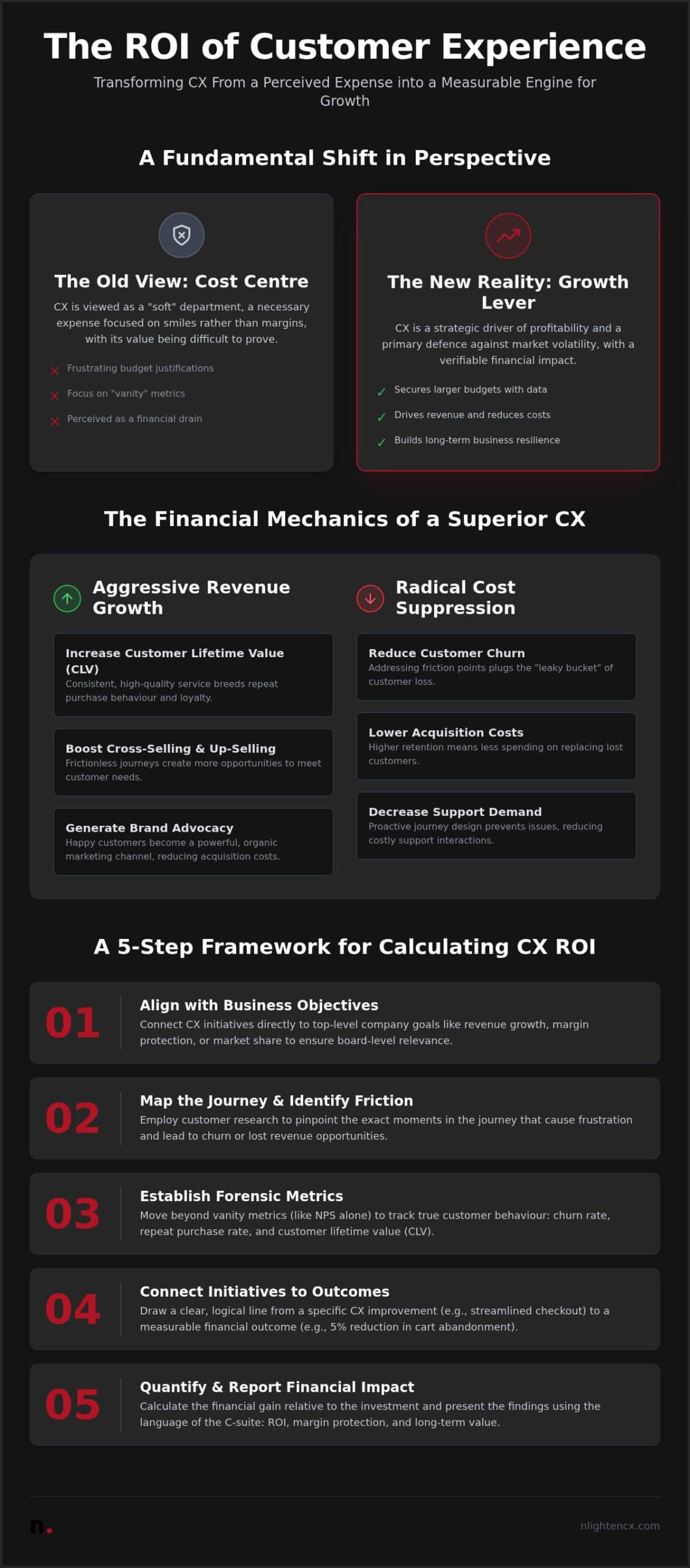
At its core, Customer Experience ROI is the quantifiable financial gain harvested from investments in customer interactions, relative to the capital expended on those initiatives. It serves as the analytical bridge between human perception and the corporate balance sheet. For far too long, executives viewed CX as a nebulous cost centre, a department focused on smiles rather than margins. That era is over. As we approach 2026, understanding the customer experience roi for businesses has become a survival imperative. Market volatility and heightened consumer expectations have turned consistency into a premium commodity that directly impacts valuation.
To understand What is Customer Experience? in a strictly financial context, one must look beyond tactical, short-term gains. A flash sale might boost revenue this quarter, but it doesn’t build the structural stability required for long-term sustainability. True ROI is found in the compounding value of a loyal customer base. It requires a fundamental shift in perspective. You aren’t just spending money on “support”; you’re investing in a strategic growth lever that protects your future market share. Logical business leaders recognise that every touchpoint is an opportunity to either appreciate or depreciate the value of their brand equity.
The Cost of Inaction: Poor CX and Churn
Many South African organisations suffer from what we call “leaky bucket” syndrome. They spend millions on aggressive acquisition whilst ignoring the friction points that cause existing clients to vanish. Poor service quality acts as a direct catalyst for churn. When a customer encounters a fragmented journey, the emotional connection to your brand evaporates. This lack of loyalty isn’t just a marketing problem; it’s a financial drain. Every lost customer represents the total destruction of their potential lifetime value. Businesses that fail to address these gaps find themselves in a perpetual cycle of expensive replacement rather than profitable retention. Implementing a structured reduce customer churn strategy is the most effective way to break this cycle and shift from reactive damage control to proactive relationship management.
Securing Executive Buy-In Through Financial Logic
Securing a budget for CX initiatives requires a departure from “soft” language. The board doesn’t want to hear about “customer happiness” in isolation. They want to hear about risk mitigation and margin protection. By using multidisciplinary customer experience roi for businesses data, you can demonstrate how strategic research and journey mapping directly correlate to profitability. CX is your primary defence against market volatility. It transforms your business into a resilient entity that can weather economic shifts because your customers have a logical and emotional reason to stay. Positioning CX as a financial safeguard makes the case for investment undeniable.
The Financial Mechanics: How CX Drives Revenue and Reduces Costs
Profitability isn’t a happy accident. It’s the result of precision engineering within the customer journey. When evaluating the customer experience roi for businesses, we must look at two primary levers: aggressive revenue growth and radical cost suppression. A well-executed customer experience strategy ensures that every interaction adds value rather than friction. It’s about capturing a larger share of the customer’s wallet by becoming their preferred, frictionless choice. Why settle for a single transaction when you can secure a lifetime of loyalty?
The transition from a neutral customer to a brand advocate creates a powerful multiplier effect. Organic referrals reduce your customer acquisition costs whilst increasing your market penetration. To identify where these opportunities lie, organisations must employ robust customer experience research methodologies. This data-driven approach allows you to pinpoint exactly which service improvements will yield the highest financial return. If you’re serious about scaling, you must view every touchpoint as a potential revenue driver. Strengthening these relationships is the most sustainable way to improve your customer experience roi for businesses.
Increasing Customer Lifetime Value (CLV)
Customer Lifetime Value is the ultimate barometer of CX effectiveness. It’s a simple logic: consistent service quality breeds repeat purchase behaviour. When a journey is mapped correctly, cross-selling and up-selling feel like helpful suggestions rather than intrusive sales pitches. You’re not just selling a product; you’re maintaining a relationship that compounds in value over time. High CLV reduces the pressure on your marketing team to constantly hunt for new leads to replace departing ones. If you want to see where your organisation currently stands, you can evaluate your CX maturity to identify hidden gaps.
Operational Efficiency and the Cost to Serve
Reducing the cost to serve is often the quickest way to improve your margins. Every friction point in your process generates “failure demand”, which manifests as unnecessary support tickets and administrative waste caused by a breakdown in the initial experience. Clear CX design eliminates these bottlenecks. When your team is equipped with the right skills, they resolve issues faster and more effectively. This creates a leaner, more agile organisation where resources are spent on innovation rather than fixing preventable errors. For companies looking to modernise the technical infrastructure that supports these processes, IT Cloud Consulting offers professional guidance on cloud adoption and optimisation. Efficiency is the silent partner of profitability.
Why do so many organisations celebrate a high Net Promoter Score (NPS) whilst their market share continues to dwindle? It’s a dangerous paradox. A positive score can easily mask underlying profitability issues if it isn’t anchored in actual financial behaviour. To truly quantify the customer experience roi for businesses, you must look beneath the surface of automated feedback. Scores are merely indicators; outcomes are what matter to your shareholders. Transitioning from tracking scores to measuring business outcomes requires a forensic approach to data that links sentiment directly to spend.
We advocate for the use of “Forensic Metrics”—data points that track what customers actually do, rather than just what they say they might do. Did the customer who gave you a nine actually increase their share of wallet this quarter? Did the “promoter” successfully refer a new lead? By Proving the ROI of Customer Experience through behavioural evidence, you move from subjective guesswork to strategic certainty. This alignment is what transforms CX from a peripheral activity into a core driver of organisational stability.
The True Voice of the Customer vs. Surface Data
Automated surveys often capture the “noisy middle” or the extreme ends of the spectrum, leaving a massive gap in your understanding of the silent majority. Deep qualitative research is the only way to identify the emotional drivers that actually influence spend. You need to know why a customer chooses a competitor, even when they claim to be satisfied with your service. Utilising specialised CX research South Africa provides the contextual nuance required to validate metric accuracy in our unique market. It’s about finding the high-value friction points that don’t show up on a standard dashboard.
Performance Metrics That Matter to the CFO
Your CFO isn’t interested in “customer happiness” as a standalone concept. They’re interested in margin protection and revenue growth. To secure their support, you must translate your CX data into the language of the balance sheet. Focus on these three critical areas:
- Retention Rates: Linking churn reduction directly to protected annual recurring revenue.
- Referral Rate: Measuring the organic growth generated by your brand advocates to lower acquisition costs.
- Market Share Growth: Analysing how consistent service quality allows you to outpace competitors in stagnant sectors.
Connecting these dots is the only way to prove the customer experience roi for businesses in a way that resonates at the board level. When you can show that a 5% increase in retention leads to a significant boost in profitability, the conversation shifts from “can we afford this?” to “how quickly can we scale it?” For those looking to expand their professional reach through structured referral systems, Network In Action offers a unique opportunity to lead and grow local business referral groups.
Calculating the customer experience roi for businesses requires more than just a cursory glance at your annual turnover. It demands a rigorous, step-by-step methodology that stands up to the scrutiny of any financial director. Without a structured framework, your CX initiatives will always be the first to face budget cuts during economic downturns. You must move from anecdotal evidence to mathematical certainty. Follow this five-step process to build a bulletproof business case for your next strategic investment.
- Step 1: Define the Initiative and Objective. Be specific. Are you implementing a new journey map or launching a True Voice of Customer Program? Clearly state the intended business outcome, such as reducing churn or increasing cross-sell rates.
- Step 2: Establish a Baseline. You cannot measure growth without a starting point. Gather existing financial data and customer metrics from the previous twelve months to create a neutral reference frame.
- Step 3: Calculate the Total Cost of Investment. Include every expense. This covers software licences, external consulting fees, and the internal cost of employee training.
- Step 4: Measure KPI Shifts. Track the change in your primary indicators post-implementation. Look for tangible deltas in retention, average order value, or cost-to-serve.
- Step 5: Attribute Financial Value. Convert those KPI changes into currency. If retention improved by 2%, what is the exact Rand value of those saved accounts? This final figure determines your ROI.
To see how your current initiatives measure up against these steps, you should take our Free CX Quiz to evaluate your organisational readiness.
Attributing Value in a Multi-Channel World
Isolating the impact of CX from broader marketing campaigns or shifting economic factors is a common hurdle. We recommend utilising control groups to validate your findings. By comparing a segment of customers who experienced the improved journey against those who did not, you can accurately isolate the CX effect. Attribution Bias in a CX context refers to the tendency to over-allocate the credit for a positive financial outcome to a single touchpoint whilst ignoring the cumulative impact of the entire customer journey. Precision here is vital for maintaining boardroom credibility.
Accounting for Intangible Benefits
A comprehensive model must also account for the “silent” drivers of profitability. Brand reputation and customer goodwill act as a financial buffer during market volatility, ensuring your business remains resilient when competitors falter. As environmental responsibility becomes a key factor in brand trust, you can learn more about Ekocentric to see how sustainable building certifications support long-term reputation. Furthermore, a strong CX culture significantly reduces employee turnover. High-performing teams are more engaged when they see the tangible impact of their work on customer lives. Quantifying the reduction in recruitment and training costs due to improved staff retention adds another layer of value to your customer experience roi for businesses calculations.
Many organisations fall into the trap of believing that a shiny new CRM or an AI chatbot will automatically solve their profitability woes. It won’t. Software is merely an accelerator; if you accelerate a broken process, you simply lose money faster. Real customer experience roi for businesses is built on a multidisciplinary foundation of strategy and human-centric design. You must align your organisational structure with the actual needs of your clients to see a measurable shift in your margins. Technology should support your strategy, not define it; however, when correctly implemented, solutions from NaviWorld (Thailand) Co., Ltd. can significantly boost procurement efficiency and streamline operations.
Customer Journey Mapping serves as the diagnostic tool to identify high-value friction points that drain your resources. By visualising the path from initial contact to final purchase, we reveal exactly where customers drop off and why. Fixing these gaps isn’t just about “better service”; it’s about reclaiming lost revenue that is currently slipping through the cracks. For organisations operating in complex B2B environments, understanding customer journey mapping for B2B is particularly critical, as the average buying cycle now spans dozens of touchpoints and multiple decision-makers. Our True Voice Of Customer Program takes this a step further by transforming passive organisational awareness into active profit. It provides the clarity required to make data-driven decisions that resonate with your market’s specific needs and expectations. To ensure these efforts are guided by a cohesive framework, a robust approach to strategic customer experience planning is essential for aligning your entire organisation and reducing churn through proven methodology.
Strategy remains a theoretical exercise until your team possesses the skills to execute it. Training is the essential bridge between complex CX research and tangible financial return. When you empower employees to make “pro-customer” decisions, you create a self-sustaining engine of loyalty that requires less managerial intervention. The CX Handbook serves as a foundational resource for this transition, providing practitioners with a consistent methodology to follow. Professional customer experience management training acts as the catalyst, turning your staff into ROI-driven specialists who understand the financial weight of every interaction.
Your Path Forward: Assessment and Implementation
The journey toward a measurable return begins with an honest assessment of your current capabilities. You can use our Free CX Quiz to identify immediate ROI opportunities that may be hidden within your existing operations. From there, we help you develop a strategic roadmap tailored for national business growth. This plan ensures that your investments are targeted where they will have the greatest impact on your bottom line. Don’t leave your 2026 profitability to chance. You can Book a CX Masterclass to begin your ROI transformation and equip your team with the tools they need to succeed in a competitive landscape.
Mastering Your Financial Future Through Strategic CX
The era of treating customer experience as an optional expense has ended. True profitability in 2026 depends on your ability to quantify the customer experience roi for businesses and align your operations with the True Voice Of Customer Program. You now possess the framework to move beyond vanity metrics and bridge the gap between “soft” sentiment and “hard” revenue. Success requires more than just software; it demands multidisciplinary CX consulting and a team equipped with the practical skills to execute your vision. Don’t leave your organisational stability to chance when the tools for precision are within reach.
We invite you to take the next step toward measurable results. You can begin immediately with our Free CX Quiz to pinpoint your current friction points and identify immediate growth opportunities. To truly accelerate your results, secure your business growth with a professional CX Masterclass and transform your initiatives into a measurable engine for long-term profitability. Your organisation has the potential for radical growth and sustainable stability. It’s time to claim your place as a market leader by making every customer interaction count.
Frequently Asked Questions
How do you calculate the ROI of customer experience?
You calculate the ROI by subtracting the total cost of your investment from the financial gains achieved, then dividing that figure by the investment cost. Gains are derived from increased customer retention, higher referral rates, and a lower cost-to-serve. Investment costs must include everything from software to professional training. This formula provides a clear mathematical bridge to prove the customer experience roi for businesses when presenting to your financial director. It’s about precision.
What is a good ROI for a CX program in a service business?
A robust return for a service organisation usually falls between 300% and 500% over a three-year period. Whilst initial returns may be modest, the compounding effect of customer loyalty and reduced acquisition costs drives these figures higher as the programme matures. You should aim for a ratio that justifies the initial capital expenditure whilst providing a buffer against market volatility. Consistency in service delivery is the primary driver of these results. Aim high.
Why is customer experience ROI so difficult to measure accurately?
Measurement is complex because CX impact is often distributed across multiple departments and touchpoints. Attribution bias frequently leads organisations to credit marketing or product changes for gains actually driven by service improvements. Siloed data systems also make it nearly impossible to track a single customer’s financial journey accurately. Overcoming this requires a multidisciplinary approach that links customer sentiment data directly to your organisation’s core financial reporting systems. Logic must drive your measurement strategy.
How does CX research contribute to business profitability?
Strategic research identifies the specific friction points that cause customers to abandon your brand for a competitor. By uncovering these hidden leaks in your bucket, you can prioritise investments that offer the highest potential for recovery. This data-driven approach is essential for maximising the customer experience roi for businesses. It moves your organisation away from subjective guesswork and towards a strategy rooted in verifiable customer behaviour and logical financial outcomes. Accuracy is paramount.
Can improving customer experience really reduce operational costs?
Improving your service design directly suppresses operational costs by eliminating failure demand. This refers to the unnecessary support volume generated when a customer cannot complete a task or resolve an issue on their first attempt. By streamlining journeys and enhancing customer experience management training for your team, you reduce the administrative waste associated with fixing preventable errors. A leaner, more efficient service model naturally leads to improved margins and a more resilient business structure. Efficiency drives profit.
What are the most important CX metrics for the board of directors?
The board prioritises metrics that correlate directly with organisational stability and growth. You should focus on Customer Lifetime Value (CLV), Churn Rate, and the Referral Rate. These figures provide a logical view of your brand equity and its impact on future revenue. Avoid presenting isolated sentiment scores like NPS without linking them to these harder financial indicators. Your goal is to demonstrate how CX protects margins and mitigates market risks. Logic is essential.
How long does it take to see a financial return from CX investments?
Financial returns typically manifest in two stages. Operational efficiencies and cost reductions often appear within three to six months as friction points are removed. However, revenue growth driven by increased loyalty and organic referrals usually requires twelve to eighteen months to reach full maturity. CX is a long-term strategic investment, not a quick tactical fix. Patience and consistent execution are required to build the trust that leads to sustainable profitability. Timing is everything.
What is the difference between vanity metrics and performance metrics in CX?
Vanity metrics, such as Net Promoter Scores, track how customers feel but don’t necessarily reflect their actual spending behaviour. They can be misleading if not paired with harder data. Performance metrics track tangible business outcomes like retention rates and average order value. Whilst sentiment is a useful lead indicator, performance metrics are what ultimately satisfy the board of directors and prove the financial success of your customer experience initiatives. Focus on outcomes.