

Why is it that even with a dedicated service team and the latest software, your customers are still quietly slipping away to competitors? The reality is that reactive support cannot fix a fundamentally broken journey. If you lack a cohesive framework for strategic customer experience planning, you’re merely treating symptoms while the underlying disease of churn persists. You’ve likely felt the frustration of fragmented data and the uphill battle of justifying CX spend to a board that only speaks the language of immediate ROI. It’s a common friction point that stalls growth and creates organisational instability.
This master blueprint for 2026 provides the rigorous, logic-driven structure you need to transform CX from a vague set of slogans into a powerful engine for business security. I’ll share a comprehensive planning template designed to align your entire organisation and reduce churn through proven methodology. We’ll explore how to bridge the gap between department silos, establish a clear roadmap for implementation, and finally prove the ROI of your initiatives. By the end of this guide, you’ll have the tools to ensure your customer strategy is both an analytical triumph and an empathetic success.
Key Takeaways
- Shift from reactive fire-fighting to proactive experience management to ensure long-term business stability.
- Master the four pillars of strategic customer experience planning to ensure every interaction reflects your core brand promise.
- Learn to distinguish between systemic strategic growth and “random acts of kindness” by avoiding the common trap of equating software tools with a complete strategy.
- Discover how to use journey mapping and assessment tools to identify the emotional friction points that drive customer churn.
- Secure necessary executive buy-in by presenting a logic-driven business case that links CX initiatives directly to organisational profitability.
What is Strategic Customer Experience Planning?
What exactly is strategic customer experience planning? It isn’t just a collection of polite interactions or a faster response time on digital channels. It’s the deliberate, cold-eyed design of every single customer touchpoint to meet specific organisational objectives. Most businesses operate in a state of perpetual reaction. They wait for a complaint to surface before they attempt to fix the experience. By 2026, this reactive posture will be a death sentence for growth. Rapid shifts in consumer behaviour, driven by economic volatility and digital fatigue, mean that customers no longer compare you to your direct competitor. They compare you to the best experience they’ve ever had. True strategic planning moves the needle from merely servicing the customer to proactively managing the experience for a sustainable competitive advantage.
The Difference Between Strategy and Service
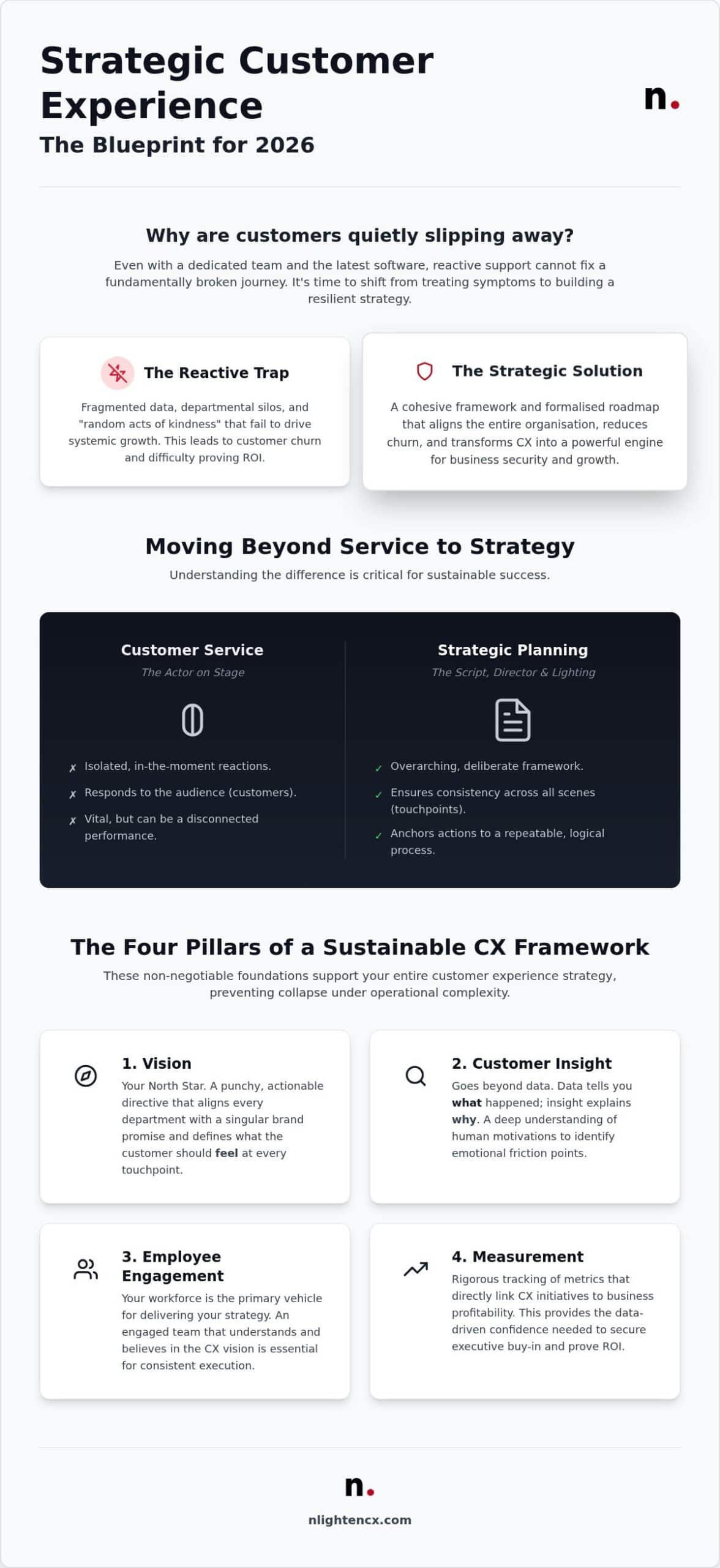
Think of your business as a theatre production. Customer service is the actor on stage, delivering a line and reacting to the audience in the moment. It’s vital, but it’s isolated. Strategic planning is the script, the director, and the lighting rig. It’s the overarching framework that ensures every actor knows their place and every scene leads to the same emotional conclusion. Organisations that focus exclusively on service often find themselves trapped in a cycle of random acts of kindness. These gestures feel good in the moment, yet they fail to drive systemic growth because they aren’t anchored to a repeatable, logical process. Strategy is the governing force that prevents your brand from becoming a series of disconnected performances. Without a script, even the best actors will eventually miss their cues.
Why Businesses Need a Formalised CX Roadmap
In the current South African economic climate, the cost of acquiring a new customer far outweighs the investment required to keep an existing one. High churn rates are a leak in your profitability that no amount of marketing spend can plug. A formalised roadmap acts as a blueprint for consistency. It ensures that a customer visiting a physical branch receives the same level of care as one interacting with your digital portal. This isn’t just about maintaining brand standards; it’s about financial survival. When you map your journey strategically, you can directly calculate the customer experience ROI for businesses by identifying exactly where friction leads to lost revenue. A roadmap provides the board with the data-driven confidence they need to treat CX as a capital investment rather than an operational expense. It aligns your national operations under a single, profitable vision.
The Four Pillars of a Sustainable CX Framework
Success in strategic customer experience planning isn’t accidental. It’s the result of a deliberate focus on four foundational pillars. These pillars act as the structural support for your entire organisation, ensuring that your CX initiatives don’t collapse under the weight of operational complexity. For leaders looking to move beyond traditional extractive models toward nature-aligned practices, Jannine Barron provides the regenerative business mentorship required to anchor these initiatives in long-term sustainability. Without these foundational pillars, your strategy is just a collection of expensive ideas that fail to deliver a return. To build a resilient business, you must ground your efforts in these non-negotiable areas.
- Vision: The North Star that aligns every department with a singular, actionable brand promise.
- Customer Insight: The deep understanding of human motivations that goes far beyond basic data points.
- Employee Engagement: The recognition that your workforce is the primary vehicle for delivering your strategy.
- Measurement: The rigorous tracking of metrics that directly correlate with business profitability and retention.
Defining Your Customer Experience Vision
Avoid the trap of corporate jargon. A vision statement that claims you “strive for excellence” is corporate wallpaper. It’s invisible and useless. Your CX vision must be a punchy, actionable directive that every employee understands. Whether it’s a national retailer or a financial institution, the vision defines what the customer should feel at every touchpoint. If your team can’t explain it in ten seconds, it hasn’t landed. Effective visions turn abstract goals into tangible daily actions; to ensure your vision is underpinned by a robust identity, you can learn more about strategic brand development.
Data tells you what happened, but insight explains why. Relying solely on automated surveys is a mistake. To truly understand your market, you must invest in specialised CX research South Africa that observes actual human behaviour. People often say one thing and do another. Observation reveals the friction points that customers might not even be able to articulate. We define “True Voice of Customer” as a holistic feedback mechanism that captures the emotional and functional reality of the customer journey.
Empowering Your People and Tracking Performance
Your team is the vehicle for your strategy. If they aren’t engaged or empowered, the strategy fails at the first point of contact. You cannot expect premium output from a workforce that doesn’t understand the “why” behind the plan. Simultaneously, you must track metrics that actually correlate with profitability. Don’t just chase satisfaction scores; look at churn rates and lifetime value. These figures provide the logic-driven proof your board requires to justify continued investment. To move beyond surface-level metrics, you must ground your decisions in robust CX research South Africa that uncovers the real drivers of loyalty.
Strategy vs Tactics: Avoiding the Alphabet Soup Trap
Implementing a CRM system is not a strategy. It’s a purchase. Yet, many organisations fall into the trap of believing that installing software or measuring a Net Promoter Score (NPS) constitutes strategic customer experience planning. These are merely tools, the ‘alphabet soup’ of the industry, and without a governing framework, they become expensive distractions. If your board thinks that a dashboard is a strategy, your CX initiatives are already at risk of being defunded when they fail to show immediate, systemic growth.
Why does this matter? Tactics without strategy lead to ‘random acts of kindness’, isolated gestures that feel positive but fail to impact the bottom line. If your marketing team promises a premium experience whilst your support team is incentivised only on call duration, the customer feels the friction. This misalignment creates a fragmented brand perception that erodes loyalty over time. To navigate this complexity, professionals need a structured reference. The CX Handbook for practitioners serves as a vital guide for those looking to bridge the gap between high-level theory and tactical execution.
When Tactics Masquerade as Strategy
A loyalty programme cannot fix a fundamentally flawed product. If the core experience is poor, no amount of ‘points’ or rewards will stop the churn. This is the danger of tactics masquerading as strategy: they offer a veneer of progress whilst the underlying business logic remains broken. You’ll know you’re stuck in a tactical loop if your team spends more time managing software dashboards than they do understanding the human motivations behind customer behaviour. Software-driven CX without cultural change is simply an automated way to frustrate your audience at scale. To facilitate this internal shift, you can check out Culture Of Belonging Global INC. for professional workshops and consulting.
True CX maturity requires a multidisciplinary approach that blends research, design, and training into a single master plan. Large organisations must establish cross-functional ‘CX Committees’ to ensure every department, from finance to logistics, is speaking the same language. This structural alignment ensures your strategy survives changes in leadership and remains a permanent fixture of your organisational DNA. When the entire business is aligned, the ‘alphabet soup’ of metrics finally begins to make sense, as each tactic is anchored to a logic-driven roadmap for sustainable growth; for firms scaling operations across borders, Encor Group offers the global corporate service platform needed to facilitate this expansion.
How do you move from a collection of high-level ideas to a functional, profitable roadmap? A master blueprint requires more than enthusiasm; it demands a structured, logic-driven sequence of actions. This template for strategic customer experience planning serves as your operational guide for 2026. It is designed to strip away the ambiguity and provide a clear path toward organisational alignment. Stop guessing where your customers are dropping off and start building a framework that ensures they stay.
- Step 1: Current State Assessment — Use the Free CX Quiz to establish your baseline maturity and identify immediate friction points.
- Step 2: Journey Mapping — Plot every touchpoint to identify where emotional friction leads to customer churn.
- Step 3: Gap Analysis — Compare your current operational reality against your stated brand promise to find the disconnects.
- Step 4: Implementation Planning — Organise your resources, training schedules, and rollout timelines for maximum impact.
- Step 5: Governance and Scaling — Establish the committees and metrics required to maintain the strategy as your business grows.
Phase 1: Discovery and Assessment
Start by looking in the mirror. You cannot fix what you haven’t accurately diagnosed. This phase involves a deep-dive audit of every customer interaction, from the first digital enquiry to post-purchase support across your national branches. Amongst the noise of standard feedback forms, you must isolate the ‘True Voice’ of your customer. This isn’t just about what they say in a survey; it’s about what their behaviour tells you about their frustrations. Set baseline KPIs for retention and churn now. These figures will be your primary measures of success as the programme matures and you begin to prove the ROI of your strategic customer experience planning to the board.
Phase 2: Design and Training
Once you understand the current friction, you must design the ‘ideal’ journey for your most valuable customer segments. This isn’t a creative exercise; it’s a structural one. You are building the internal playbooks that will govern how your team operates daily. This is where many plans falter. Without proper CX management training, your roadmap is just a document gathering digital dust. Your team needs the specific skills to execute the vision and the authority to resolve customer issues in real-time. Consistent service delivery requires every staff member to be an expert in the script you’ve written. If you’re ready to move from theory to execution, our CX management training provides the practical tools your team needs to drive sustainable growth.
Executing the Plan: From Theory to Profitability
Execution is the graveyard of many well-intentioned plans. To move from theory to profitability, you must secure executive buy-in by presenting a logic-driven business case that prioritises financial stability. Strategic customer experience planning is not a cost centre; it’s a risk mitigation strategy. Frame the discussion around the cost of customer churn, which acts as a silent tax on your growth. During the first 90 days, focus on securing “Quick Wins” to build organisational momentum. Engaging a professional keynote speaker from speakers.com can help galvanise your workforce and ensure the strategy is embraced at every level. These small, visible improvements prove that your methodology works and buy you the political capital needed for larger structural changes. Remember that your strategy is a living document. It must be reviewed quarterly to ensure it remains aligned with shifting market conditions and organisational goals.
Stop obsessing over Net Promoter Scores in isolation. Whilst NPS provides a snapshot of sentiment, it doesn’t always correlate with the bottom line. Your CFO needs a dashboard that links CX metrics directly to financial outcomes such as Lifetime Value (LTV), referral rates, and churn reduction. Creating this link is the hallmark of sophisticated strategic customer experience planning. In a national context, benchmarking your performance against industry standards allows you to identify whether your friction points are unique or systemic. A dashboard that speaks the language of profitability is the only way to ensure CX remains a board-level priority. Understanding how to improve customer loyalty through a structured framework ensures that your retention metrics translate into the long-term revenue growth your board demands.
Next Steps for Leadership
Transforming your organisation requires a partner who understands the friction points of the South African service landscape. Refine your leadership skills by enrolling in a CX Masterclass, where we move beyond theory into the rigorous application of these principles. Consider conducting a formalised journey mapping session with an external facilitator to uncover blind spots your internal teams might miss. This provides the objective perspective needed to dismantle departmental silos. The first step toward clarity is assessment. Take the Free CX Quiz to assess your organisational maturity and discover exactly where your blueprint needs strengthening. nlightencx is ready to act as your strategic partner in this transformation, moving your business from reactive service to proactive growth.
Future-Proof Your Growth with Strategic CX
The window for reactive customer service has closed. By adopting a rigorous approach to strategic customer experience planning, you’re doing more than just satisfying customers; you’re building a resilient, logic-driven framework for long-term organisational stability. We’ve explored how to move beyond the ‘alphabet soup’ of metrics to create a roadmap that actually impacts your bottom line. You now have the template to align your team, understand human motivations through the True Voice of Customer methodology, and prove the ROI of every initiative to your board.
Don’t let these insights remain on the page. Start by identifying your current friction points and then scale your expertise through professional development. Master your strategy at our next CX Masterclass led by industry experts, or take our Free CX Quiz for immediate organisational insights. The path to becoming a market leader in 2026 starts with a single, deliberate step toward structural excellence. You have the blueprint; it’s time to build.
Frequently Asked Questions
What is the first step in strategic customer experience planning?
The first step is a rigorous assessment of your current organisational maturity. You cannot improve what you haven’t measured. Use a tool like the Free CX Quiz to establish a baseline and identify immediate friction points. This audit allows you to move beyond assumptions and ground your strategy in hard data. Once you understand your starting point, you can begin aligning your internal behaviour with the external brand promise you’ve made to your customers.
How long does it take to see results from a new CX strategy?
You should expect to see “quick wins” within the first 90 days of implementation. These early victories build the momentum needed for larger structural changes. However, systemic improvements in customer loyalty and churn reduction typically require 12 to 18 months of consistent execution. Strategic customer experience planning is a long-term investment in business stability. It requires patience to allow cultural shifts and operational refinements to manifest as measurable financial growth on your balance sheet.
Can a small business benefit from strategic CX planning?
Agility is a significant advantage for smaller organisations. Whilst large corporations struggle with departmental silos, a small business can pivot quickly to align its entire team with a new CX vision. Strategic customer experience planning ensures that every limited resource is directed toward touchpoints that drive the highest emotional impact. By designing a deliberate journey early on, you prevent the expensive churn that often stalls the growth of emerging brands in competitive markets.
What is the difference between CX strategy and a CRM?
A CRM is a tactical tool used to store and manage data. A CX strategy is the logic-driven framework that dictates how that data is used to influence human behaviour. Buying software doesn’t fix a broken journey; it merely automates it. Strategy provides the script and the director, whilst the CRM acts as the stage. Without a strategic plan, your CRM will likely become an expensive database of dissatisfied customers rather than a growth engine.
How do you measure the ROI of a strategic CX plan?
ROI is measured by linking experience metrics directly to financial outcomes. Focus on tracking reductions in customer churn, increases in Lifetime Value (LTV), and a rise in organic referrals. By comparing these figures against the cost of your CX initiatives, you can present a logic-driven business case to the board. Successful plans move beyond vague satisfaction scores to prove how improved customer perceptions result in tangible, sustainable revenue growth for the organisation.
What are the most common mistakes in CX planning?
The most frequent error is treating CX as a temporary project rather than a permanent operational shift. Many firms also fail by ignoring employee engagement, forgetting that staff are the primary vehicle for delivering the strategy. Another common mistake is focusing on ‘alphabet soup’ metrics like NPS without understanding the underlying human motivations. If you prioritise software purchases over cultural change, you create a veneer of progress that fails to address the root causes of customer dissatisfaction.
How often should a customer experience strategy be updated?
Your strategy should be a living document reviewed on a quarterly basis. Rapid changes in consumer behaviour and economic conditions mean that a static plan will quickly become obsolete. Conduct a comprehensive annual audit to ensure your roadmap remains aligned with your long-term business goals. This iterative approach allows you to refine your tactics based on real-world feedback whilst maintaining a consistent strategic direction that secures your position in the national market. To shift your retention efforts from reactive damage control to a proactive system, explore our dedicated reduce customer churn strategy for 2026.