

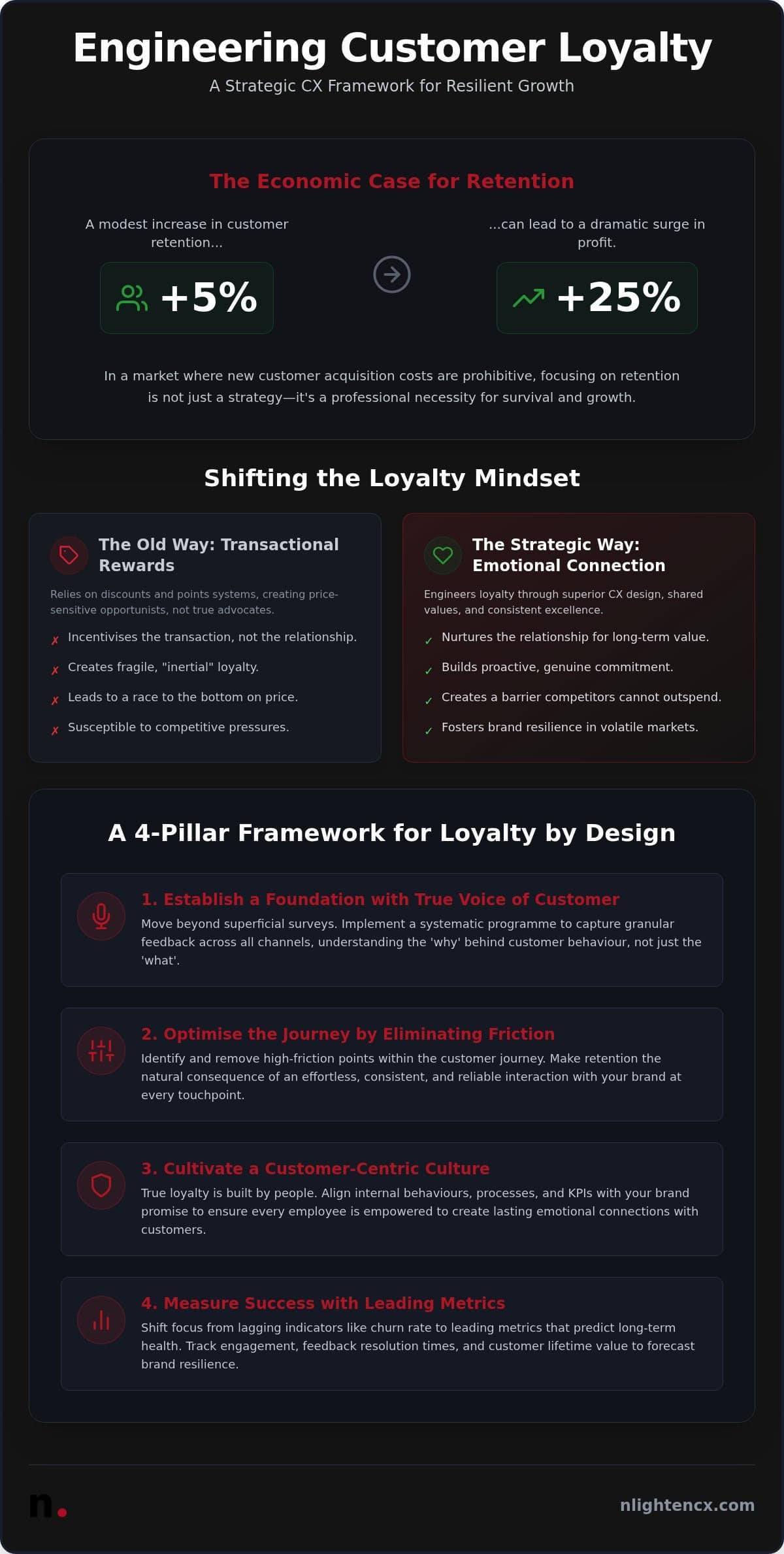
If a 5% increase in customer retention can correlate with a 25% surge in profit, why are so many organisations still pouring capital into the unsustainable cycle of acquisition? You’ve likely noticed that the cost of winning a new lead has become prohibitive, whilst inconsistent service across your channels continues to erode the trust you’ve worked hard to build. It’s a frustrating reality that leaves many leaders wondering exactly how to improve customer loyalty without resorting to aggressive discounting or hollow rewards.
We understand that genuine commitment isn’t bought; it’s engineered through precision and deep insight into customer behaviour. Loyalty is a strategic result. This article provides a professional, logic-driven methodology for transforming casual buyers into committed brand advocates through strategic CX design. We’ll move beyond transactional points systems to explore a framework built on the True Voice of Customer, helping you reduce churn and secure a resilient reputation in an increasingly volatile 2026 market.
Key Takeaways
- Shift your focus from transactional reward systems to a proactive framework that treats loyalty as a strategic result of superior CX design.
- Discover exactly how to improve customer loyalty by implementing a systematic True Voice of Customer programme to uncover deep behavioural drivers.
- Identify and eliminate high-friction points within the customer journey to ensure that retention becomes a natural consequence of effortless interaction.
- Cultivate a customer-centric culture that aligns internal behaviours with your brand promise to create lasting emotional connections.
- Move beyond lagging indicators like churn rate to measure success through leading metrics that accurately predict long-term brand resilience.
Redefining Customer Loyalty in a Competitive Landscape
What does it mean to be truly loyal? In many boardrooms, the term is mistakenly conflated with repeat purchasing behaviour driven by a lack of better options. This inertial loyalty is fragile. True loyalty is a proactive commitment, a conscious choice made by a customer to remain with a brand despite competitive pressures. When we look at Defining Customer Loyalty, we must distinguish between a passive habit and a genuine emotional bond. Understanding this distinction is the first step in learning how to improve customer loyalty in a market where trust is the primary currency.
Traditional reward programmes often fail because they incentivise the transaction rather than the relationship. If your customers only stay because of a 10% discount, they aren’t advocates; they’re price-sensitive opportunists. A strategic approach focuses on emotional loyalty, where shared values and consistent excellence create a barrier to entry that competitors cannot simply outspend. In the high-churn national market of 2026, this emotional hook is what separates resilient brands from those that eventually succumb to price wars.
The Economic Case for Retention Over Acquisition
By 2026, skyrocketing acquisition costs have made churn an existential threat to business stability. It’s no longer feasible to replace lost customers at the same rate they depart. Loyal clients don’t just provide recurring revenue; they lower your operational overhead through reduced service requirements and a higher tolerance for minor friction. Investing in these relationships is a matter of professional survival. This shift in focus underpins the customer experience ROI for businesses, transforming CX from a cost centre into a significant growth driver.
Moving Beyond the Points-Based Mindset
Buying loyalty is a race to the bottom. When you rely on discounts, you train your audience to wait for the next sale rather than value your expertise. Consistency is the real anchor of a resilient brand reputation. Does your service quality remain identical across every national branch or digital channel? If it doesn’t, you’re creating the very friction that drives customers away. To protect your margins, you must identify at-risk segments before they exit. This requires a systematic look at engagement data. Are they opening your communications? Is their purchase frequency slowing? By spotting these signals early, you can intervene with strategic CX design rather than desperate rebates. It’s about proving you understand their needs before they even have to ask.
Establishing a Foundation Through CX Research and the True Voice
You cannot solve a problem you haven’t accurately diagnosed. Many leaders believe they understand their client base because they possess vast quantities of demographic data, yet they still struggle with churn. Why? Because big data tells you what is happening, but it remains silent on the why. To understand how to improve customer loyalty, you must pivot from superficial statistics to “thick data”—the qualitative insights that reveal the human motivations behind a transaction. This requires a systematic CX research South Africa approach that treats every interaction as a data point in a larger narrative of trust and reliability.
Relying on outdated research methods is a risk your business cannot afford. When you lack deep awareness of the customer’s emotional state, your strategy is based on guesswork. A professional research framework identifies the hidden friction points that drive customers toward your competitors, allowing you to build a foundation for long-term retention. It’s about moving beyond what people buy to understanding why they choose to stay—or why they prepare to leave.
Implementing a True Voice of Customer Program
Standard NPS surveys are often too narrow and too late. They provide a snapshot of sentiment, but they lack the nuance required for high-level strategic planning. A True Voice of Customer Program operates differently. It captures granular feedback across multiple national channels, from digital touchpoints to physical branches, whilst synthesising this information into a single, actionable view. It isn’t enough to simply collect data. You must prove you’ve listened. Closing the feedback loop by acting on specific grievances is the most direct way to transform a frustrated buyer into a loyal advocate. If you’re ready to move beyond basic surveys, our True Voice of Customer Program offers the depth required for national scale.
Using Research to Predict Future Behaviour
There is frequently a significant gap between what customers say in a survey and what they actually do at the point of purchase. Human behaviour is rarely linear. Predictive CX research is the ability to anticipate needs before the customer articulates them. By identifying patterns in historical behaviour and emotional drivers, you can intervene with solutions before friction turns into a reason to leave. This proactive stance is essential for maintaining a competitive edge and discovering how to improve customer loyalty before a crisis occurs. If you’re unsure where your organisation stands, taking a free CX quiz can provide immediate clarity on your current maturity level and highlight exactly where your research foundation might be crumbling.
Optimising the Journey: Removing Friction to Drive Retention
Loyalty is frequently the quiet side effect of extreme ease. If your organisation makes it difficult for a client to achieve their goal, they’ll eventually seek a path of less resistance elsewhere. This is the cornerstone of a successful reduce customer churn strategy: you must transition from guessing where the friction lies to conducting a rigorous journey analysis. For national organisations, the greatest threat often comes from siloed departments. When sales, billing, and support operate in isolation, the customer is forced to repeat their story at every turn. In 2026, customers expect channel-agnostic service. They don’t care about your internal structure; they care about a seamless flow from a mobile app to a physical branch.
Consistent service quality is non-negotiable for building trust. If a customer receives expert help in-person but faces a generic, unhelpful chatbot online, the relationship begins to fracture. True loyalty requires a unified experience where every channel speaks the same language and shares the same data. This isn’t just a technological challenge. It’s a fundamental shift in how you organise your teams to serve the human being rather than the department’s key performance indicators.
The Art of Customer Journey Mapping
Journey mapping is far more than a creative workshop. It’s a strategic diagnostic tool that visualises the gap between your intended service and the customer’s lived reality. Within this map, you’ll find “moments of truth”—specific touchpoints where a customer’s loyalty is either solidified or permanently broken. Perhaps it’s the onboarding process or the way a complex complaint is handled. By aligning your internal operations with these external realities, you ensure that your team is focused on the interactions that actually matter. It’s about engineering consistency into every step of the lifecycle.
Identifying and Eliminating Pain Points
Pain points aren’t always catastrophic failures. Often, they’re micro-frictions: a slow-loading page, a confusing invoice, or a three-minute wait for a simple answer. These small irritations accumulate, eroding brand perception over time. You must systematically audit every touchpoint to identify where customers are working too hard. Once identified, prioritise fixes based on their direct impact on retention. This methodical approach is the most effective way to discover how to improve customer loyalty without relying on expensive, superficial perks. You aren’t just fixing a process; you’re protecting your future revenue by making it impossible for them to justify leaving.
Cultivating Emotional Connections and a Customer-Centric Culture
Systems deliver efficiency, but people deliver loyalty. You can’t automate a feeling. Understanding how to improve customer loyalty requires looking beyond the digital interface at the human element that underpins every transaction. A seamless journey is the baseline; the emotional connection is the differentiator. This requires strategic customer experience planning that goes beyond process maps to address the very soul of your organisation. Culture isn’t a slogan or a poster on the wall. It’s the cumulative effect of every decision your staff make when they’re faced with a customer in need.
Leadership must set the standard. A customer-centric culture doesn’t happen by accident; it’s a deliberate outcome of professional development. When your leaders prioritise empathy over rigid adherence to scripts, your front-line teams feel empowered to solve problems in real-time. This autonomy is vital. If an employee can’t “go off-script” to rectify a genuine grievance, the customer feels like a number rather than a valued partner. Rigid systems create robotic interactions, whereas empowered staff create advocates who feel seen and respected.
The Role of CX Training and Masterclasses
Your front-line staff are the true guardians of your brand reputation. They’re the ones who turn a potentially catastrophic service failure into a moment of advocacy. Enrolling these teams in professional CX Masterclasses ensures that service standards are standardised across every national branch. It’s about giving them the tools to succeed. Utilising resources like the CX Handbook for practitioners provides a constant reference point for best practices, ensuring that your culture remains resilient even as your team grows. This consistency is what builds long-term trust amongst a diverse customer base, turning a simple service interaction into a pillar of your retention strategy.
Designing for Emotional Resonance
Service design must account for the psychology of memory. The peak-end theory suggests that customers judge an experience based on how they felt at its peak and at its end. Are you designing these moments? Emotional resonance is the alignment between a brand’s behaviour and a customer’s subconscious needs. Authentic “surprise and delight” moments aren’t about expensive gifts; they’re about showing the customer you’ve actually listened. It might be a follow-up call after a difficult resolution or a proactive suggestion that saves them time. These interactions are a masterclass in how to improve customer loyalty through genuine human connection. If you’re ready to transform your team into a competitive advantage, explore our professional CX Training programmes today.
Measuring Success and Calculating the ROI of Loyalty
How can you manage a relationship that you haven’t quantified? For many organisations, the failure to treat loyalty as a measurable asset is the primary reason their retention efforts stall. Measuring success isn’t just a matter of administrative diligence; it’s a requirement for professional survival. If you cannot demonstrate the fiscal impact of your CX initiatives, you’ll struggle to secure the internal investment needed to scale. Understanding how to improve customer loyalty requires a shift from viewing retention as a “soft” metric to seeing it as the most reliable driver of your bottom line.
What is the actual cost of a lost customer? Most businesses focus on the churn rate, but this is a lagging indicator—it’s an autopsy of a relationship that has already ended. To build a resilient brand, you must prioritise leading indicators like engagement levels and sentiment trends. The ultimate loyalty metric is Customer Lifetime Value (CLV). Research indicates that customers who are emotionally connected to a brand have a 306% higher lifetime value. When you present the business case for loyalty to a board of directors, this is the language you must speak. You aren’t just asking for a budget; you’re proposing a strategy to increase the long-term equity of the company.
Key Performance Indicators for Loyalty
While the Net Promoter Score (NPS) remains a standard, it often lacks the granularity needed for strategic intervention. You should look closer at the Customer Effort Score (CES). This metric tracks how hard a customer has to work to resolve an issue or complete a purchase. Because loyalty is often a side effect of ease, a high effort score is the most accurate predictor of future churn. Additionally, you must track referral rates and organic word-of-mouth growth. Loyal advocates don’t just stay; they recruit. By benchmarking these figures against national industry standards, you can move beyond internal guesswork and see exactly where you stand amongst your competitors.
The Path Forward: Your CX Roadmap
Transforming your organisation is a methodical process that moves from insight to action. It begins with deep research through a True Voice of Customer Program, moves into the elimination of friction via journey mapping, and culminates in a cultural shift through professional training. This isn’t a one-off project; it’s a continuous cycle of refinement. To identify your most immediate opportunities for growth, you must conduct a systematic audit of your current touchpoints. We invite you to take the first step in this journey by taking our free CX quiz to assess your current organisational maturity. Only once you know where the friction points lie can you begin the work of building a brand that customers refuse to leave.
Securing Your Brand’s Future through Strategic Loyalty
Building a resilient organisation requires more than just a points-based reward scheme. True retention is the logical outcome of deep CX research and the systematic removal of friction from the customer journey. You’ve seen that understanding the “thick data” behind human behaviour is the only way to move beyond transactional interactions and create lasting emotional resonance. Discovering exactly how to improve customer loyalty is a professional necessity in a market where acquisition costs continue to climb and competition is relentless.
The transition from a reactive service model to a proactive, customer-centric culture is a journey that demands expertise and a clear roadmap. Whether you’re implementing our signature True Voice Of Customer Program, developing your team through Professional CX Masterclasses, or seeking Expert CX Consulting to refine your journey maps, the goal remains the same: sustainable profitability through reduced churn. It’s time to transform your customer experience into a strategic advantage that your competitors cannot replicate.
Begin your journey to strategic growth with nlightencx and build the brand advocates your business deserves. Your future success depends on the strength of the relationships you engineer today.
Frequently Asked Questions
What is the most effective way to measure customer loyalty in 2026?
The most effective measurement strategy prioritises Customer Lifetime Value (CLV) alongside the Customer Effort Score (CES). While traditional metrics provide a snapshot of sentiment, CLV offers a long-term view of a customer’s total contribution to your profit margins. CES identifies exactly where friction exists within your journey. By combining these with emotional sentiment analysis, you can move beyond simple retention rates to understand the depth of the commitment your brand has secured.
How does customer experience directly impact customer retention?
Customer experience acts as the primary engine for retention by removing the friction points that cause churn. When an organisation delivers a seamless, consistent experience across all national channels, it builds the trust necessary for long-term loyalty. Every positive interaction reinforces the decision to stay, whilst a single high-effort experience can drive a client to a competitor. Strategic CX design ensures that retention becomes a natural side effect of providing extreme ease and value.
Can a small business improve loyalty without a dedicated rewards programme?
Small businesses can certainly achieve high retention by focusing on personalisation and consistent service quality rather than transactional points. Genuine loyalty is often built on the human connection and the speed at which you solve problems. By using a systematic approach to understand your audience, you can create a customer-centric culture that rewards commitment through superior service. This strategy often proves more resilient than a rewards programme that relies solely on aggressive discounting.
What is the difference between customer satisfaction and customer loyalty?
Customer satisfaction is a transient measure of how a specific interaction met expectations, whereas customer loyalty is a long-term, proactive commitment to your brand. A satisfied customer may still leave if a competitor offers a lower price. A loyal customer, however, has an emotional bond that makes them resistant to competitive pressures. Understanding this distinction is vital when researching how to improve customer loyalty, as it shifts your focus from basic service to strategic relationship building.
How often should a company update its customer journey map?
You should update your customer journey map at least once a year, or whenever there is a significant shift in your service model or market conditions. In the rapidly evolving landscape of 2026, consumer expectations change quickly. Regular audits ensure that your internal operations remain aligned with the external reality of your customers’ lives. Constant refinement allows you to spot new friction points and micro-frictions before they impact your overall retention rates and brand reputation.
What role does employee engagement play in building customer loyalty?
Employee engagement is the foundation of any customer-centric culture because your staff are the primary touchpoint for your brand. Engaged employees are more likely to solve complex problems and provide the emotional hook that automated systems cannot replicate. When your team feels empowered and well-trained through professional masterclasses, they deliver a higher standard of service. This consistency is what ultimately transforms a casual buyer into a committed advocate for your organisation.
Is it possible to win back a customer who has already churned?
Winning back a churned customer is possible if you accurately diagnose the reason for their departure and offer a concrete solution to that specific pain point. This requires a systematic look at your True Voice of Customer data to identify where the relationship fractured. A successful win-back strategy isn’t about generic discounts; it’s about proving that you’ve listened and improved your processes. Re-engaging these individuals can be highly profitable, as they already understand your core value proposition.
How do you calculate the ROI of a customer loyalty initiative?
You calculate the ROI by comparing the total investment in your CX initiatives against the measurable increase in Customer Lifetime Value and the reduction in acquisition costs. This involves tracking the profit margins of loyal segments versus new recruits over a specific period. By documenting how to improve customer loyalty through strategic interventions, you can present a clear business case to the board. This logic-driven approach proves that retention is a significant driver of long-term business stability.