

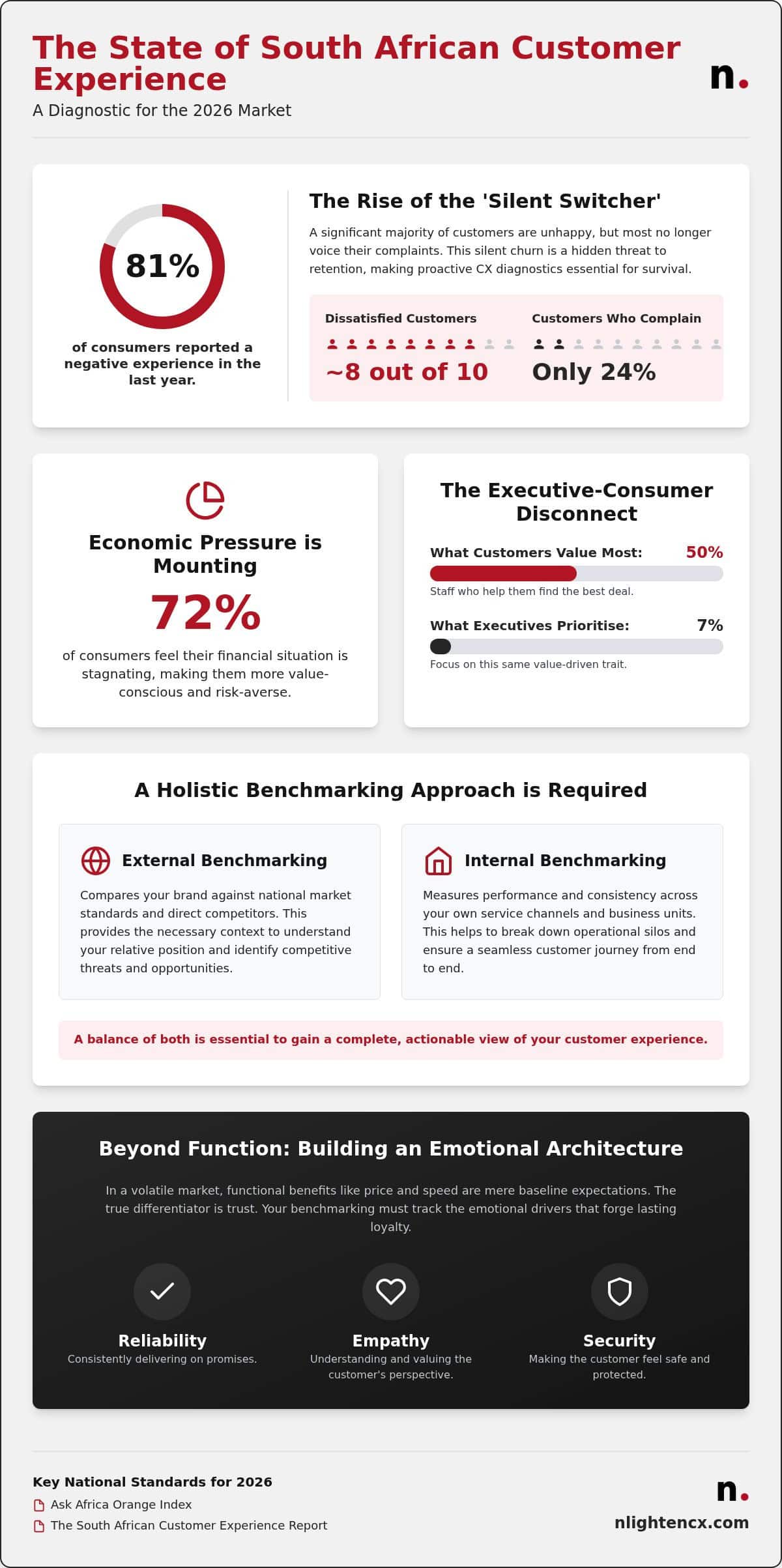
Did you know that 81% of South African consumers reported a negative customer experience in the last year, yet only 24% now bother to complain? This rise of the “silent switcher” means your declining retention rates might remain a mystery until it’s too late to intervene. Effective customer experience benchmarking South Africa is no longer a corporate vanity project; it’s a diagnostic necessity for survival in a market where 72% of your customers feel their financial situation is stagnating. You likely feel the pressure of rising churn whilst facing board members who remain sceptical of CX return on investment. It’s frustrating to track simple survey scores that fail to capture the nuance of emotional loyalty or the value-seeking behaviour defining our current economy.
We’ll show you how to leverage local benchmarks to identify friction points, reduce churn, and outpace competitors. This guide provides the strategic framework you need to transform raw data into a competitive advantage. We’ll explore the 2026 Ask Africa Orange Index and the latest national reports to help you secure your market position. You’ll learn how to balance internal performance against external standards to ensure your strategy pivots are backed by undeniable evidence.
Key Takeaways
- Understand the unique challenges of the local market, such as consumer scepticism and the “neutral score” phenomenon, to ensure your data reflects reality.
- Identify the primary national standards for 2026, including the Ask Africa Orange Index, to accurately contextualise your customer experience benchmarking South Africa efforts.
- Bridge the gap between data collection and business growth by linking your benchmark scores to tangible financial outcomes like ROI and reduced churn.
- Develop a robust internal framework that moves beyond surface-level survey scores to measure the true drivers of emotional loyalty and sustainable retention.
- Learn how to transform raw benchmark data into an actionable strategic roadmap through a diagnostic True Voice Of Customer Program.
Defining Customer Experience Benchmarking in the South African Context
What is benchmarking? At its core, it is the systematic process of measuring your organisation’s performance against industry standards and competitors. In the local market, this practice has evolved from a simple comparison of scores into a critical diagnostic for survival. Effective customer experience benchmarking South Africa requires a nuanced understanding of a consumer base that is increasingly risk-averse and financially strained. You cannot afford to treat data as a trophy; you must treat it as a roadmap for operational stability.
South African businesses face unique hurdles that traditional global models often overlook. One such challenge is the “neutral score” phenomenon. Local consumers frequently provide middle-of-the-road feedback whilst harbouring deep dissatisfaction. This complacency in data is dangerous. Why is this happening? According to the 2026 South African Customer Experience Report, 81% of consumers had a negative experience in the last year, yet they are quietly switching rather than complaining. There is also a stark disconnect in priorities: 50% of consumers value staff who help them find the best deal, yet only 7% of executives prioritise this trait. If your benchmarks only look at surface-level satisfaction, you’re missing the “silent switchers” who are eroding your market share.
Stop measuring just “what happened” and start asking “why it matters” for your profitability. Benchmarking must identify the friction points that lead to churn before they manifest in your financial statements. This shift in perspective informs your broader CX research South Africa efforts, turning raw numbers into strategic growth. By understanding where you stand relative to the 2026 economic reality, you can allocate resources to the areas that drive the highest return.
External vs Internal Benchmarks
External benchmarking compares your brand against the national market or direct competitors. It provides the necessary context to understand your relative position. Internal benchmarking, however, measures consistency across your own service channels and business units. Relying solely on external data leaves you blind to operational silos. Conversely, focusing only on internal metrics ignores the competitive pressure of a market where 72% of consumers feel their financial situation is stagnating. You need a balance of both to gain a holistic view of the customer journey.
The Role of Emotional Connection in Modern Benchmarking
How do you quantify trust? In 2026, trust has become the most critical element of the customer experience in South Africa. Functional metrics like price and speed are now baseline expectations, not differentiators. Consumers are actively vetting brands to mitigate the risk of financial loss or wasted time. Your benchmarking must track emotional drivers like reliability, empathy, and security. This focus is a core component of effective CX design for service businesses. Building an emotional architecture ensures that your brand isn’t just a service provider, but a trusted ally in a volatile landscape.
Major South African CX Indices and Standards for 2026
The landscape of customer experience benchmarking South Africa has shifted from generic satisfaction scores to rigorous, data-driven diagnostics. As of September 2026, the benchmarking season is in full swing, providing the necessary evidence for boards to justify CX investment. You cannot rely on international standards alone to understand the local consumer. South Africa requires a specific lens that accounts for our unique economic pressures and social dynamics. Global metrics like NPS and CSAT have value, but they often fail to capture the nuances of a market where 72% of consumers report stagnating financial circumstances.
The South African Customer Experience Report, released on August 20, 2026, highlights a growing crisis. 81% of consumers experienced a negative interaction in the last 12 months, a rise from 76% in 2024. This data, gathered from 2,000 consumers and 56 business executives, proves that traditional service models are failing. Whilst industry-specific standards in retail, telecommunications, and financial services continue to evolve, the gap between executive perception and consumer reality remains wide. Only 7% of executives prioritise “finding the best deal” for customers, despite 50% of consumers ranking it as a top priority.
Evaluating the Ask Africa Orange Index
Established in 2001, the Ask Africa Orange Index remains the country’s most comprehensive benchmark. For the 2026 cycle, it measures over 200 brands across 27 industries, utilising data from more than 50,000 interviews. It goes beyond functional service quality to measure emotional connection and long-term loyalty. Use these results to identify whether your brand is an industry leader or a laggard. Tracking your performance against these historical shifts allows you to anticipate market movements before they impact your bottom line. If you want to build the internal capability to interpret these shifts, our CX Masterclass provides the strategic tools your team needs.
The “Neutral Score” Trap in Local Surveys
South African surveys are notorious for the “neutral score” phenomenon. Approximately 25% of local respondents provide neutral feedback even when they are deeply unhappy. This creates a dangerous “vanity metric” that masks underlying churn risks. Why does this happen? Many consumers feel that complaining won’t lead to change, so they quietly switch to a competitor instead. You must look past the surface of indifferent feedback to find the “True Voice” of your customer. Relying on inflated satisfaction scores is a recipe for sudden, unexplained market share loss. You need a framework that identifies these silent switchers before they exit your ecosystem.
Why Your Benchmarking Data Often Fails to Drive Growth
Why does your dashboard show improving satisfaction whilst your churn rates tell a different story? Many organisations fall into the trap of treating customer experience benchmarking South Africa as a reporting requirement rather than a strategic lever. You have the scores, but nothing is changing because you’ve prioritised the collection of data over the execution of a strategic customer experience planning roadmap. Data without a path to implementation is just noise. It provides a false sense of security whilst your competitors quietly erode your market share.
The 2026 South African Customer Experience Report reveals a chilling reality: whilst 81% of consumers had a negative experience in the last year, only 24% bothered to post about it or complain. This is a significant decrease from the 50% complaint rate seen in 2023. If you rely solely on automated survey tech, you are measuring a shrinking, vocal minority. You’re ignoring the silent majority who have already checked out. This over-reliance on technology ignores the fundamental human behaviour driving local consumption. Consumers are risk-averse and financially strained; they don’t want to fix your business, they want to find a brand that works. Stop looking at the numbers in isolation and start looking at the people they represent.
Misinterpreting the Customer Journey
Siloed data is the enemy of growth. When your marketing, sales, and service departments each hold a different piece of the puzzle, your benchmarks provide a fragmented, useless view. This is particularly dangerous in complex environments where the path to purchase isn’t linear. Utilising customer journey mapping for B2B is essential to contextualise your benchmarks. It allows you to identify the specific “moments of truth” where a benchmark score actually correlates with a contract renewal or a high-value referral. Without this context, you’re merely guessing which friction points matter most.
The ROI Deficit in Benchmarking
Why does the board remain sceptical of your budget requests? They see CX as a cost centre because you’ve failed to link benchmark improvements to customer experience roi for businesses. A three-point increase in a satisfaction score is a vanity metric if it doesn’t result in reduced churn or increased lifetime value. You must move from cost-centre thinking to profit-centre execution. Start by mapping your benchmark data directly to financial outcomes. If you cannot prove that a better experience leads to a more stable and profitable bottom line, your CX strategy will always be the first to face budget cuts during economic downturns.
Establishing a Robust Internal Benchmarking Framework
How do you move from passive observation to active management? Downloading a national report is merely the beginning. To truly outpace competitors, you must build an internal engine that translates market standards into daily operational actions. A robust framework for customer experience benchmarking South Africa ensures that your organisation isn’t just reacting to trends but is actively shaping its own stability. This requires a disciplined, five-step approach to measurement and iteration.
- Step 1: Define core CX objectives. Align your benchmarks with national business goals, such as sustainability in a stagnant economy.
- Step 2: Select relevant metrics. Look past surface-level satisfaction to find the drivers of actual retention.
- Step 3: Implement a consistent cadence. Measure across all touchpoints regularly to catch friction points before they lead to churn.
- Step 4: Socialise the data. Distribute findings across every department to ensure the entire organisation owns the customer experience.
- Step 5: Iterate based on findings. Use the voice of customer program South Africa to refine your strategy based on real-world feedback.
Selecting the Right Metrics for South Africa
NPS alone is no longer sufficient. You must integrate Customer Effort Scores (CES) and Emotional Value metrics to get a clear picture of loyalty. In a market where 50% of consumers prioritise finding the best deal, measuring how easily they can access value is critical. Weight these metrics based on their direct impact on your financial outcomes. High-effort interactions are the primary drivers of the “silent switcher” behaviour we’ve seen throughout 2026. Ensuring data integrity across a diverse national landscape requires you to filter out vanity scores and focus on the friction that causes customers to exit.
Training Your Team for Benchmarking Success
Data is only as useful as the people interpreting it. Investing in customer experience management training for your internal teams is essential for long-term growth. You need to build a culture that values honest feedback rather than fearing low scores. Use the CX Handbook to standardise measurement practices across different business units. This ensures that everyone speaks the same language and works toward the same benchmarks. When your team understands the “why” behind the numbers, they become proactive problem solvers rather than passive data collectors. Ready to build this capability? Take our Free CX Quiz to identify the gaps in your current internal framework.
Transforming Benchmark Data into Growth with nlightencx
How do you bridge the chasm between a benchmark report and a profitable balance sheet? Data alone cannot fix a fractured customer journey. It requires a partner who understands that customer experience benchmarking South Africa is merely the starting line, not the destination. At nlightencx, we move organisations beyond the passive act of measuring and into the active discipline of mastering the customer experience. We don’t just tell you where you are failing; we design the strategic path to where you need to be.
Our approach is rooted in the reality of the 2026 South African market. We recognise that the “silent switcher” and the “neutral score trap” identified in previous sections are symptoms of a deeper disconnect. Traditional surveys often miss the emotional drivers that dictate whether a customer stays or quietly exits. We provide the diagnostic tools to uncover these hidden friction points, ensuring your CX strategy is built on a foundation of logic and human perception rather than vanity metrics. Our objective is to turn your benchmark gaps into undeniable competitive advantages.
The True Voice of Customer Advantage
Standard surveys often fail to capture the emotional truth of your clients. Our True Voice Of Customer Program is a strategic diagnostic designed to go deeper. We utilise a multidisciplinary approach that combines hard data with an understanding of consumer behaviour to identify exactly why loyalty is eroding. For example, by systematically gathering insights beyond the surface level, we have helped organisations identify “moments of truth” that were previously invisible to automated tech. This systematic insight gathering is the most effective way to reduce churn in a landscape where 72% of consumers are actively vetting brands for better value. We help you find the friction before your customers find a competitor.
Enrol in a CX Masterclass
Strategy is only as effective as the team executing it. We offer specialised CX Masterclasses designed specifically for the complexities of the South African corporate environment. These sessions equip your leadership and management teams with the practical tools required to manage long-term benchmarking programs with confidence. You’ll move from cost-centre thinking to profit-centre execution, learning how to link every CX initiative back to ROI and business stability. Building this internal capability ensures that your organisation remains agile and resilient, regardless of market volatility. Don’t leave your growth to chance. Enquire about our next CX Masterclass to start building a data-backed roadmap for your organisation’s future.
Securing Your Competitive Edge in the 2026 Landscape
The era of treating data as a passive report has ended. To thrive in a market where 81% of consumers have experienced service failures, you must transform your approach to customer experience benchmarking South Africa. This isn’t just about tracking scores; it’s about identifying the emotional friction points that drive the “silent switcher” phenomenon. You need a framework that connects internal performance to tangible financial outcomes and board-level ROI. Success in 2026 requires more than intent; it requires a disciplined methodology that turns insights into action.
As specialists in South African CX strategy since our inception, we know how to bridge the gap between raw data and strategic growth. Whether you are looking for a diagnostic through our True Voice Of Customer Program or need to upskill your leadership with our comprehensive CX Masterclasses, we provide the path to operational stability. Book a Strategic CX Consultation with nlightencx to master your market position today. Your organisation has the potential to lead; it’s time to let the data show you how.
Frequently Asked Questions
What is the most reliable customer experience benchmark in South Africa?
The Ask Africa Orange Index is widely considered the most comprehensive and reliable independent benchmark in the country. Established in 2001, it evaluates over 200 brands across 27 industries using more than 50,000 interviews. For a broader view of consumer sentiment, the annual South African Customer Experience Report provides critical data on market-wide trends. Combining these external indices with internal metrics ensures your customer experience benchmarking South Africa strategy is grounded in national reality.
How often should a South African organisation conduct CX benchmarking?
You should conduct external benchmarking annually to align with major national reports, whilst internal benchmarking requires a quarterly or continuous cadence. This frequency allows you to detect shifts in consumer behaviour before they manifest as significant churn. Given that 81% of local consumers reported negative experiences in 2026, waiting a full year to measure internal performance is a high-risk strategy. Regular pulse checks help you identify friction points that static annual reports might miss.
Can B2B companies use the same benchmarking standards as B2C firms?
B2B organisations cannot rely solely on B2C standards because their customer journeys involve multi-stakeholder decision-making and longer lead times. Whilst high-level metrics like NPS are useful for general comparison, B2B firms require specialised customer journey mapping to contextualise their performance. Effective customer experience benchmarking South Africa for B2B focuses on relationship sustainability and account health rather than simple transactional satisfaction. You must measure the depth of the partnership, not just the speed of the service.
What is a “good” CX score in the South African market?
A “good” score is relative to your specific industry average and your historical performance, but it must be viewed against the 2026 national backdrop. With 81% of consumers reporting poor experiences, simply being “average” means you’re still frustrating a large portion of your base. We define a good score as one that shows consistent upward momentum in emotional loyalty and retention. It’s more important to outperform your direct competitors’ benchmarks than to hit an arbitrary numerical target.
How do we link our benchmarking results to actual business growth?
You link results to growth by mapping benchmark improvements directly to financial outcomes like reduced churn and increased lifetime value. Stop treating scores as vanity metrics and start treating them as lead indicators of profitability. Our CX Strategy services help you build a logical business case that proves how a better experience leads to market stability. If your benchmarking doesn’t result in data-backed evidence for strategy pivots, it’s failing to fulfil its primary purpose.
What is the difference between a CX benchmark and a CX audit?
A benchmark is a comparative measurement against industry standards or competitors, whereas a CX audit is a comprehensive internal evaluation of your own processes and touchpoints. Think of the benchmark as your ranking on a leaderboard and the audit as the diagnostic tool that explains why you’re in that position. Both are necessary for a holistic strategy. A benchmark tells you that you’re lagging; an audit identifies the specific friction points you must fix to move up.
Why do South African consumers often give neutral feedback in surveys?
Many South African consumers give neutral scores because they are sceptical that their feedback will lead to actual change. This “neutral score trap” often masks deep-seated dissatisfaction, leading to the rise of the “silent switcher” who exits without complaining. Research from 2026 shows that whilst negative experiences are up, public complaints are down. This indifference is a dangerous vanity metric. You must look beyond the middle-of-the-road scores to find the emotional truth driving your retention rates.
How can a Voice of the Customer program improve our benchmarking accuracy?
A True Voice Of Customer Program improves accuracy by moving beyond surface-level survey scores to capture the emotional drivers of loyalty. Standard benchmarking often misses the “why” behind the numbers, but a dedicated program provides the qualitative context needed for strategic growth. It helps you distinguish between functional satisfaction and genuine emotional connection. By integrating these insights, you ensure your benchmarking data reflects the actual perceptions of your clients rather than just their responses to a questionnaire.