

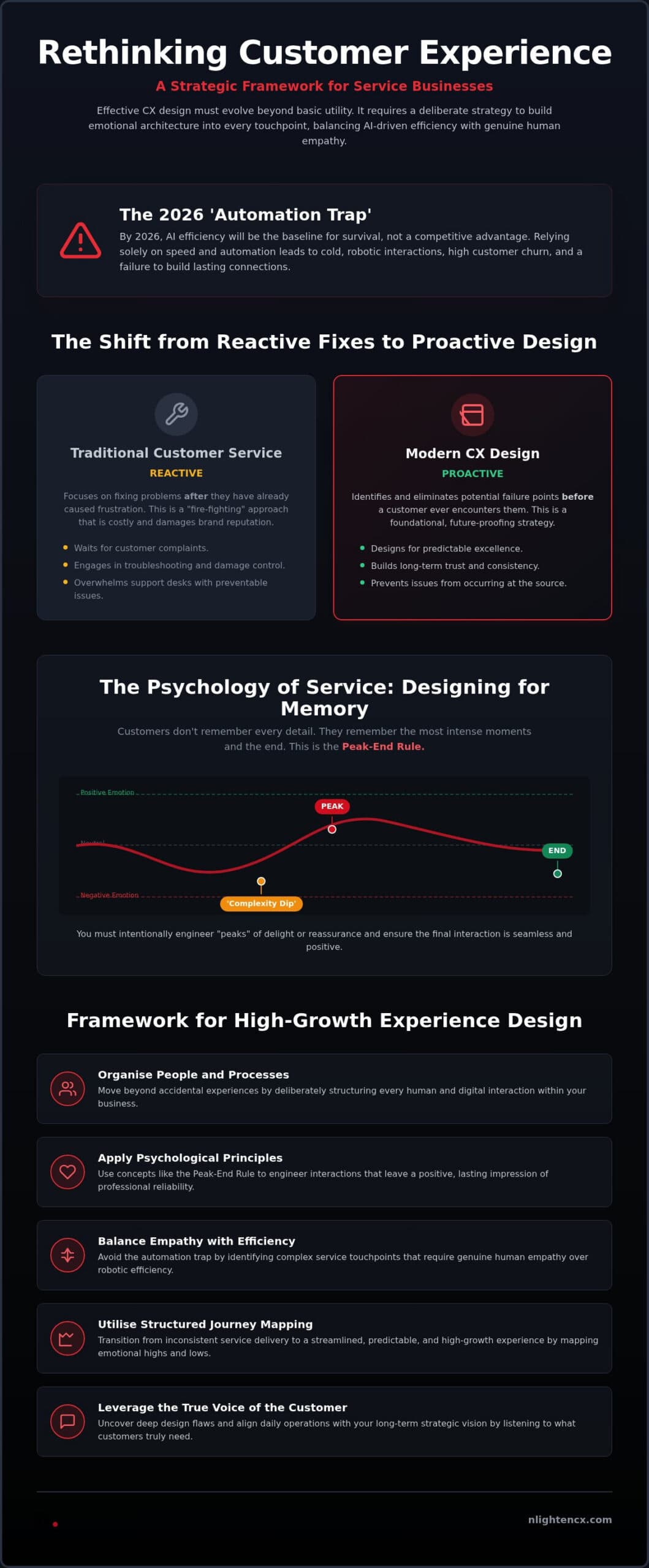
By 2026, the efficiency of agentic AI will be the baseline for survival, not a competitive advantage. If your organisation relies solely on speed and automation, you are likely facing the “automation trap” where interactions feel cold and robotic. High customer churn often persists even when service is technically good because the human element has been engineered out of the process. Effective CX design for service businesses must evolve beyond basic utility; it requires a deliberate strategy to build emotional architecture into every digital and physical touchpoint.
You understand that a seamless journey is essential, yet maintaining consistency across departments remains a constant struggle. We will show you how to organise and design service experiences that transform transactional interactions into lasting emotional connections and sustainable business growth. This article provides a strategic framework for the coming year. It covers the transition to proactive support, methods to quantify the value of your CX investments, and the critical balance between AI-driven efficiency and human empathy.
Key Takeaways
- Recognise that effective CX design for service businesses involves the deliberate organisation of people and processes to move beyond mere transactional utility.
- Apply psychological principles like the Peak-End Rule to ensure every service interaction leaves a positive, lasting impression of professional reliability.
- Avoid the 2026 automation trap by identifying which complex service touchpoints require human empathy rather than robotic efficiency.
- Utilise a structured journey mapping framework to transition from inconsistent service delivery to a streamlined, high-growth experience.
- Leverage the True Voice Of Customer Program to uncover deep design flaws and align your daily operations with your long-term strategic vision.
Defining CX Design for the Modern Service Sector
Service delivery is not a series of fortunate accidents. It is an architecture. For many, the term “design” conjures images of sleek website interfaces or physical product aesthetics. However, true CX design for service businesses is the intentional organisation of people, processes, and props to improve the customer’s journey across every possible touchpoint. It is the invisible scaffolding that supports every interaction your client has with your brand. To grasp the full scope of this discipline, we must look at What is Customer Experience? beyond the digital screen. It encompasses the emotional residue left after a service is completed.
Service design remains distinct from UI/UX or product design because it must account for human variability and the passage of time. A product is a finished object, but a service is a lived performance. This performance relies heavily on “invisible” service elements, such as back-office data flows and internal communication protocols, which silently dictate the customer’s reality. If these elements are fractured, the customer feels the friction, even if they cannot name its source. Ultimately, CX design is the strategic blueprint for every human and digital interaction within a business.
The Shift from Transactional to Relational Design
Does your business focus on the next sale or the next decade? By 2026, the market will have little patience for transactional friction. The shift toward relational design is a response to a landscape where national brand reputation is built on consistency and trust rather than aggressive marketing. Design thinking provides the tools to move away from “accidental” experiences. It replaces them with structured, predictable excellence. When you design for the relationship, you create a defensive moat around your customer base that competitors cannot easily breach.
Service Design vs. Customer Service: The Critical Difference
Stop treating design and service as synonyms. Customer service is reactive; it’s the team that fixes a problem after it has already caused frustration. CX design is proactive and foundational. It identifies potential failure points before a customer ever encounters them. By integrating CX design for service businesses at the strategic level, you move from fire-fighting to future-proofing. Effective design prevents the very issues that typically overwhelm support desks. This transition requires more than just new software. It demands a shift in internal culture where every employee, from the boardroom to the front line, understands their specific role in delivering the designed experience. When the foundation is strong, the human interactions that remain can focus on high-value empathy rather than repetitive troubleshooting.
The Psychology of Service: Designing for Emotional Connection
Service experiences are rarely remembered as a linear sequence of events. Instead, the human brain relies on the Peak-End Rule. This psychological heuristic dictates that customers judge an experience based on how they felt at its most intense point and its conclusion, rather than the average of every moment. In the context of CX design for service businesses, this means you must intentionally engineer “peaks” of delight or reassurance whilst ensuring the final interaction is seamless. If the climax of your service is mediocre, the entire relationship is at risk, regardless of your technical competence.
Designing for “Emotional Architecture” is particularly vital in high-stakes sectors like finance, healthcare, or law. In these environments, customers often arrive with heightened anxiety or a need for professional security. We use sophisticated customer experience research methodologies to uncover the specific emotional drivers that lead to trust. Is it a proactive update before they ask? Is it the tone of a formal document? By identifying these triggers, you can build a service that feels protective rather than purely functional. Understanding these drivers is a core component of a robust CX Strategy. Cultivating a genuine emotional connection in customer service is what separates brands that retain clients from those that lose them to competitors on price alone.
Identifying the ‘Moments of Truth’ in Your Service
A “Moment of Truth” occurs whenever a customer interacts with your brand and forms or changes an impression. These junctions define your brand’s integrity. To master them, you must map the emotional highs and lows of a standard interaction. Consider these critical phases:
- The Onboarding Peak: Does the client feel immediate relief that they chose you?
- The Complexity Dip: How do you support them when the service becomes technical or difficult?
- Service Recovery: Mistakes are inevitable. However, a well-designed recovery process can actually increase loyalty beyond the levels of a flaw-free experience.
The Role of Empathy in Professional Service Delivery
Empathy is not a soft skill; it’s a design requirement. In a market saturated with automated responses, the ability to respond to human emotional cues is your ultimate competitive advantage. This requires moving beyond rigid scripts. You must design processes that allow for human flexibility, empowering staff to deviate from the standard path when a customer’s situation demands it. Integrating human-centered design ensures that your service remains grounded in real human needs rather than just operational efficiency. When your team can recognise frustration or hesitation and pivot accordingly, they transform a cold transaction into a resilient professional relationship.
Efficiency vs Empathy: Avoiding the ‘Automation Trap’ in 2026
By 2026, the novelty of conversational AI has transitioned into a widespread “AI Fatigue” amongst national consumers. Whilst agentic AI can autonomously resolve 80% of common service issues, according to Gartner, an over-reliance on these systems often creates a dehumanised brand experience. The danger lies in over-automating complex interactions that require genuine professional judgement or emotional sensitivity. True CX design in 2026 uses AI to handle data, freeing humans to handle the nuance of complex problem-solving. When technology replaces the human connection entirely, you risk turning a loyal client into a frustrated statistic. Effective CX design for service businesses focuses on using technology to enhance, rather than substitute, the high-value interactions that drive growth.
When to Automate and When to Elevate
Not all touchpoints are created equal. Distinguishing between “low-stakes” queries, such as basic status updates, and “high-stakes” moments, like service failures or complex onboarding, is fundamental to Creating Positive Customer Experiences. Failed automation in a high-stakes moment is a primary driver of customer churn. To prevent this, your design must include seamless hand-offs. An AI agent should recognise when a conversation exceeds its emotional or technical capacity and transition the client to a human consultant with the full context of the interaction already visible. This prevents the customer from having to repeat their story, which is a major friction point in modern service delivery.
Designing for Digital-Human Hybridity
Consistency is the bedrock of professional trust. If your chatbot sounds like a Silicon Valley start-up whilst your human consultants maintain a formal corporate tone, the experience feels fractured. Maintaining a unified brand voice across all digital channels is a core output of strategic CX Design. Beyond voice, you must use data to empower your human staff. Before they pick up the phone, they should have a clear view of the customer’s history and current friction. Refining these automated systems requires a constant loop of feedback. We recommend using the True Voice Of Customer Program to identify where automation feels robotic or obstructive, allowing for precise adjustments that preserve the human element where it matters most. This data-driven approach ensures your technology serves the relationship, not just the bottom line.
A Strategic Framework for Service Journey Optimisation
Strategic CX design for service businesses is not a creative exercise; it is a rigorous operational methodology. It requires a transition from fragmented, department-level thinking to a unified, customer-centric architecture. This framework ensures that your service delivery remains consistent, scalable, and emotionally resonant. Success depends on a disciplined four-step approach that bridges the gap between high-level strategy and daily execution.
- Step 1: Conduct deep CX research. You cannot design a solution for a problem you don’t fully understand. Use qualitative and quantitative data to identify where customers are currently experiencing friction or emotional disconnect.
- Step 2: Map the ‘As-Is’ journey vs the ‘To-Be’ journey. Visualise the current reality alongside your ideal future state. For those operating in complex professional environments, our guide on customer journey mapping for B2B provides the technical depth required for high-stakes service environments.
- Step 3: Align internal operations. Design is useless if your internal systems cannot deliver it. You must reorganise people, processes, and technology to support the new journey.
- Step 4: Implement a True Voice Of Customer Program. Establishing a continuous feedback loop allows you to monitor the health of your design in real-time and make iterative improvements.
Mapping Beyond the Digital Interface
Service design must account for the “Backstage” of your organisation. These are the internal processes, data flows, and employee interactions that the customer never sees but always feels. If your internal service gaps lead to delays or misinformation, the external experience will fail regardless of how sleek your website looks. Your journey map must include physical touchpoints, phone consultations, and even the administrative wait times that occur between steps. Are you ready to identify these hidden friction points? Book a CX Strategy consultation to begin your transformation.
Measuring the Effectiveness of Your Design
Is your design actually working? Moving beyond the Net Promoter Score (NPS) is essential in 2026. You should focus on measuring emotional connection and Customer Effort Scores (CES). High-effort interactions are the primary killers of customer loyalty. By reducing friction, you directly influence your bottom line. It is vital to link these qualitative improvements to customer experience roi for businesses. This data-driven approach ensures that CX is viewed as a profit centre rather than a cost centre, providing the logical business case for sustained investment in service excellence.
Elevating Service Standards with nlightencx Strategic Design
Strategy without execution is a hallucination. Most organisations possess a vague desire to improve their customer interactions, yet they fail because their internal structures remain stubbornly siloed. At nlightencx, we specialise in bridging the gap between high-level theory and the practical reality of daily operations. Effective CX design for service businesses requires more than just a map; it requires a cultural and operational shift that places the customer at the centre of every decision. By implementing our signature True Voice Of Customer Program, we help you identify the specific design flaws that lead to churn and brand erosion before they impact your bottom line.
Professional stability in 2026 depends on leadership that understands the mechanics of perception. This is why we advocate for customer experience management training for executive teams. When leadership speaks the language of CX, the entire organisation follows. We move you away from a siloed approach where marketing, sales, and support operate in isolation, creating instead a seamless, designed experience that builds long-term equity and professional trust.
From Insight to Action: The nlightencx Approach
We don’t rely on surface-level surveys. Our methodology uses multidisciplinary research to inform your business strategy, ensuring every design choice is backed by hard data rather than intuition. Our masterclasses are designed to empower your internal teams, giving them the tools to own the CX design process long after our initial engagement. By redesigning the journey for national service providers, we have seen how targeted interventions at high-friction points can significantly stabilise customer retention rates. We help you turn these insights into a repeatable, scalable process that delivers consistent excellence.
Your Roadmap to National CX Leadership
The path to leadership begins with a blunt assessment of your current state. You must audit your existing touchpoints to find where you are losing trust and where your processes feel robotic. Building a business case for CX design investment in 2026 is no longer about “soft” benefits; it’s about competitive survival and quantifiable growth. It’s about ensuring your organisation is resilient enough to handle the complexities of a digitised market whilst maintaining a human touch. Are you ready to transform your service into a strategic asset? Book a consultation with nlightencx to begin your service redesign and secure your position as a national leader in customer experience.
Designing for Resilience in a Digital-First Economy
Success in 2026 demands more than just operational speed. It requires a deliberate shift from transactional efficiency to a model built on professional trust and emotional resonance. You’ve seen how integrating CX design for service businesses allows you to bypass the automation trap, ensuring that every digital and human touchpoint reinforces your brand’s integrity. By moving beyond siloed departments and adopting a structured framework, you transform inconsistent service into a sustainable engine for national growth.
As a national CX consulting leader, nlightencx provides the specialised B2B journey mapping expertise and signature True Voice Of Customer Program required to bridge the gap between strategy and execution. The risk of business instability is palpable, yet the path to transformation is clear. Are you ready to discover where your organisation stands? Take our free CX Quiz to assess your current service design maturity and begin the journey toward a more resilient, customer-centric future. You have the tools to redesign your reality; it’s time to lead the market with confidence.
Frequently Asked Questions
What is the difference between CX design and UX design for service businesses?
CX design for service businesses encompasses the entire ecosystem of touchpoints, whilst UX focuses specifically on digital interface usability. CX includes the “backstage” operations, physical environments, and human interactions that influence a customer’s perception of your brand. UX is a vital subset, but CX design ensures consistency across every channel. It focuses on the emotional architecture required to build long-term professional trust rather than just the functionality of a single screen.
How do I calculate the ROI of investing in service design?
Calculating ROI requires tracking metrics like Customer Lifetime Value (CLV) and Customer Effort Scores (CES) against your implementation costs. Monitor the reduction in support tickets. Track the increase in referral rates following a redesign. By quantifying the decrease in churn and the subsequent growth in upsell opportunities, you can prove that CX design is a profit centre. This logic-driven approach provides the necessary business case for sustained strategic growth.
Can CX design help reduce customer churn in a B2B service environment?
CX design is exceptionally effective at reducing churn in B2B environments. It addresses the complexity of multi-stakeholder relationships. By identifying hidden friction points in long-term contracts, you prevent dissatisfaction. Designing proactive touchpoints and clear communication protocols strengthens professional bonds. This ensures your service remains indispensable. It makes it significantly harder for competitors to displace your brand during renewal cycles or during sudden market shifts.
Is automation always a bad thing in customer experience design?
Automation is an asset when it enhances efficiency for low-stakes interactions. The “automation trap” only occurs when technology replaces human empathy in high-stakes situations. Strategic design identifies which touchpoints benefit from speed and which require the nuance of human judgement. Use technology to free your staff. Allow them to handle complex problem-solving. This improves the overall quality and resilience of the service experience whilst maintaining a competitive edge.
How long does it typically take to see results from a CX redesign?
Initial qualitative improvements, such as positive customer feedback and improved staff morale, often appear within weeks. However, quantifiable business results like reduced churn and increased profitability typically manifest over three to six months. This period allows for new processes to be fully integrated and for customer perception to shift. Continuous monitoring through a structured feedback loop is essential to refine the strategy and ensure that the redesign delivers sustainable, long-term value.
What are the common mistakes service businesses make when designing their customer journey?
A frequent mistake is treating CX design for service businesses as a surface-level cosmetic project rather than a deep operational reorganisation. Many businesses focus solely on digital interfaces whilst ignoring the “backstage” processes that lead to service failures. Other errors include failing to align internal culture with the new design. Without a multidisciplinary research foundation, organisations often create “accidental” experiences that fail to build lasting professional relationships.
How does the ‘True Voice of Customer’ program integrate with CX design?
The True Voice Of Customer Program acts as the strategic research foundation for any design initiative. It provides the unfiltered data needed to identify where current customer service quality improvement efforts fail to meet customer expectations. Integrate these insights into your design process. Ensure that every change is rooted in real-world human behaviour. This program creates a continuous feedback loop. It allows you to audit and refine your service architecture in real-time for maximum impact.