

In 2026, poor customer service isn’t just a PR headache; it’s a financial drain putting $3.8 trillion in global revenue at risk. You’ve felt the sting of high churn. You’ve struggled with inconsistent service delivery across your national touchpoints. How can a business survive when its service delivery remains fragmented? It’s difficult to justify budgets for customer service quality improvement when you can’t clearly measure the financial impact of your efforts. Demand more than just ‘better’ service; demand a predictable engine for growth.
This strategic guide offers a masterclass in moving your organisation beyond transactional interactions. Master the systematic methodology required to transform every touchpoint into a high-value emotional connection. Align your team culture with a clear brand promise and turn service into a genuine revenue driver. Secure your place in a competitive South African landscape with a roadmap to improve retention and stabilise your bottom line.
Key Takeaways
- Understand why shifting from transactional models to emotional connections is the only way to safeguard revenue and reduce churn in the 2026 South African landscape.
- Learn how to deploy the True Voice of Customer Program to move beyond vanity metrics and identify the real drivers of client loyalty and dissatisfaction.
- Discover how to engineer emotional architecture into every touchpoint by applying psychological principles that dictate how customers remember their service experiences.
- Establish a clear roadmap for customer service quality improvement by conducting a comprehensive audit and defining measurable KPIs that align with your brand promise.
- Build a resilient service culture through strategic CX training that ensures every team member, from the C-suite to the frontline, is equipped to deliver consistent excellence.
Why Customer Service Quality Improvement is a Strategic Imperative in 2026
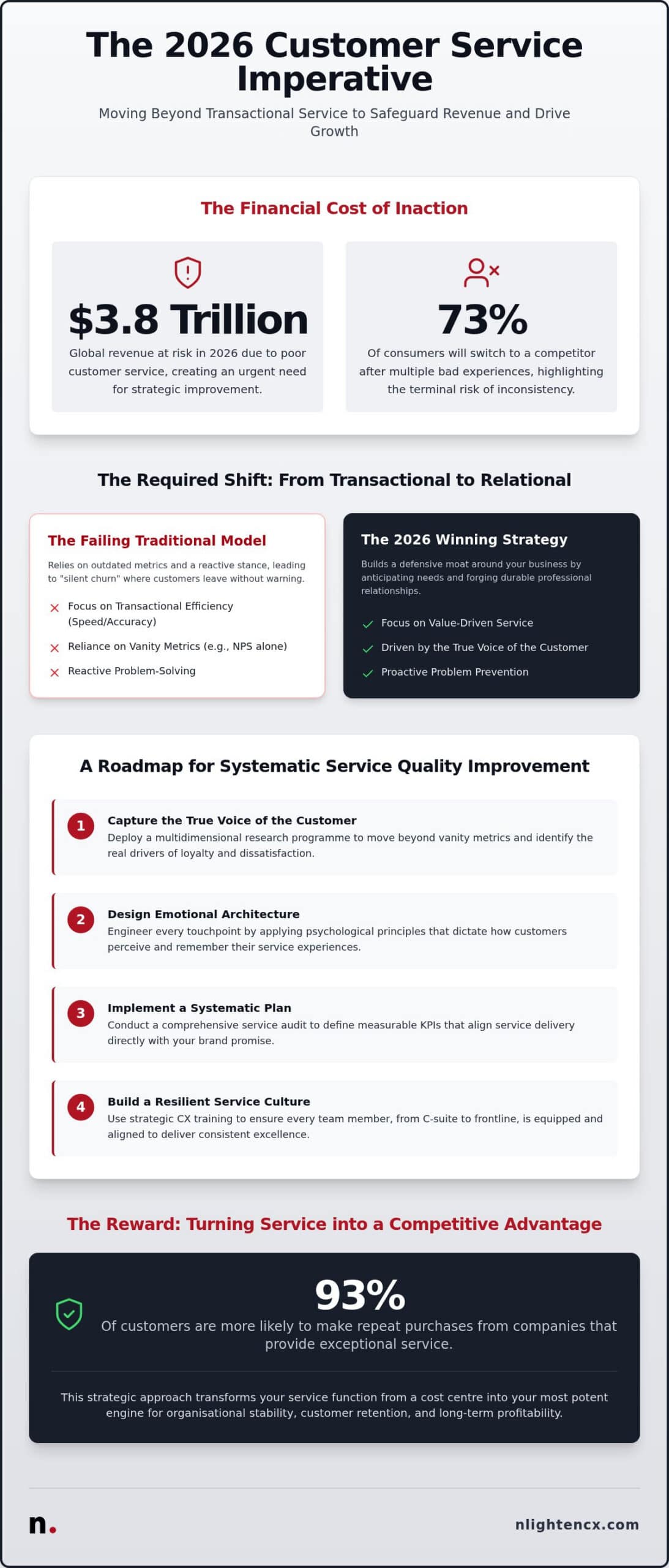
Why is customer service quality improvement no longer a “nice-to-have” for South African enterprises? Because the stakes have fundamentally shifted. In a market where 73% of consumers will switch to a competitor after multiple bad experiences, inconsistency is a terminal diagnosis for a brand. With $3.8 trillion in global revenue at risk due to poor service in 2026, the cost of inaction is too high to ignore. You can’t afford to view service as a cost centre when it’s actually your most potent engine for organisational stability.
Traditional service models are failing because they rely on digital transparency and hyper-competition to mask underlying flaws. Customers today have more choices and louder voices than ever before. If your service delivery doesn’t match your brand promise, the market will find out instantly. This requires a shift in mindset when defining service quality; it isn’t about simply meeting expectations. It’s about exceeding them consistently enough to turn passive satisfaction into active loyalty. Adopting proven customer experience best practices provides the strategic framework needed to move from reactive service delivery to a proactive, loyalty-driven model.
The Hidden Cost of Service Failure
Most leaders focus on the customers who complain. That’s a mistake. The real danger lies in “silent churn,” where customers simply vanish without a word because their expectations weren’t met. When service delivery is inconsistent across national touchpoints, you erode brand equity slowly but surely. This inconsistency makes it nearly impossible to scale effectively. Understanding the customer experience roi for businesses provides a clear tool for strategic growth by quantifying exactly how much every lost customer costs your bottom line. It’s significantly cheaper to keep a customer than to find a new one, yet many businesses continue to pour money into acquisition whilst ignoring the leaks in their retention bucket.
Beyond Transactional Efficiency
Don’t brag about your speed or accuracy. In 2026, those are the baselines. If you aren’t fast, you’re irrelevant. True customer service quality improvement involves moving toward value-driven service that anticipates customer needs before they are even articulated. Does your service team solve problems, or do they prevent them? This proactive shift creates a defensive moat that protects your business against market volatility. When the economy gets tough, customers stick with the brands that provide stability and emotional value. Achieving sustainable business growth through customer experience requires engineering your service to be proactive rather than reactive, transforming a transactional interaction into a durable professional relationship.
Capturing the True Voice of the Customer for Quality Benchmarking
Why do most customer service quality improvement initiatives fail? They rely on skewed data. Standard surveys often produce vanity metrics that flatter the C-suite whilst masking systemic failures. If your data only tells you that customers are “satisfied,” you’re flying blind. Real benchmarking requires a multidimensional research methodology that digs beneath the surface of polite responses. This matters because 93% of customers are more likely to make repeat purchases from companies with exceptional customer service. You cannot achieve that level of loyalty if your data is flawed.
What are vanity metrics? They are the scores that look good in a board report but fail to predict churn. A customer might rate a specific interaction as an eight out of ten because the agent was polite, yet they still intend to cancel their contract because the underlying process is broken. This is the danger of surface-level feedback. By using research as a diagnostic tool, you move from guessing to knowing. You can pinpoint whether a drop in service quality is occurring at the national distribution level or within the digital support channel. This level of granularity is essential for any serious customer service quality improvement strategy.
The Problem with Traditional Feedback Loops
Many organisations suffer from a significant perception gap. You think your team is delivering excellence; your customers think they’re being ignored. Relying solely on Net Promoter Score (NPS) is insufficient for meaningful change because it doesn’t explain the “why” behind the score. To bridge this gap, businesses must leverage specialised CX research South Africa to understand local market nuances. South African consumers have specific cultural and economic drivers that generic global templates simply miss. You need to know what your customers are actually experiencing, not what they think you want to hear.
Implementing the True Voice Program
Scaling a voice of customer program South Africa across national channels requires a structured, methodical approach. It isn’t about collecting more data. It’s about collecting the right data. By establishing a rigorous baseline, you can measure future improvements against hard evidence rather than gut feeling. Transform raw feedback into actionable strategic insights that your leadership team can actually use to drive change. If you are looking for an initial maturity assessment to identify your current friction points, consider starting with a Free CX Quiz to see where your organisation stands.
Designing Emotional Architecture into Your Service Delivery
Psychology isn’t just for therapists; it’s the foundation of every customer interaction. Why do some service failures result in immediate churn whilst others are forgiven? The answer lies in the “peak-end rule,” a psychological principle stating that people judge an experience based on how they felt at its peak and its end, rather than the total sum of every moment. For a meaningful customer service quality improvement, you must engineer these specific touchpoints with clinical precision. You need a structured CX design for service businesses that moves beyond basic operational procedures to create a deliberate emotional architecture.
Engineering “moments of delight” is not about random acts of kindness. It is about identifying the specific points in a transaction where a small, proactive intervention can fundamentally alter a customer’s perception of value. These are the moments that transcend standard procedures and build genuine trust.
Mapping the Emotional Journey
Effective service delivery requires a blueprint. By utilising customer journey mapping for B2B, you can identify the exact stages where emotional friction occurs. Is the transition from digital self-service to human intervention seamless, or does it feel like a jarring disconnect? Aligning internal processes with desired emotional outcomes ensures that your team isn’t just following a checklist. They are delivering a consistent experience that respects the client’s time and emotional state.
The Power of Emotional Connection
Logic makes people think, but emotion makes them act. An emotional connection in customer service remains the most potent driver of long-term retention in the 2026 market. It’s the difference between a client who stays because of a contract and one who stays because they trust your brand. This requires training staff to recognise and respond to subtle emotional cues whilst maintaining a high level of professional distance. You must balance rigorous standardisation with the flexibility to provide personalised service. Without this balance, your customer service quality improvement efforts will feel robotic and hollow.
How to Implement a Systematic Service Quality Improvement Plan
Implementation is where strategy meets reality. Without a structured framework, your customer service quality improvement efforts will remain aspirational rather than operational. Start with a comprehensive audit of every delivery channel. How do your digital touchpoints compare to your telephonic interactions? You must define rigorous, measurable service KPIs that don’t just track volume, but align directly with your brand promise. If your metrics don’t reflect the customer’s actual experience, they’re useless for strategic growth.
Strategy often dies in the transition to execution. Clear internal communication is the bridge. Establish a continuous improvement loop where real-time customer insight informs daily operations. If you aren’t iterating based on what the market tells you, you aren’t improving; you’re just staying busy. This requires a shift from reactive firefighting to proactive system management. It’s a disciplined approach that turns service delivery into a predictable, high-value asset.
Step 1: The CX Maturity Assessment
You can’t fix what you haven’t measured. Utilise a targeted CX quiz to identify your organisational strengths and vulnerabilities before committing significant resources. This assessment allows you to benchmark your service quality against national competitors and global best practices. Once you have a clear picture of your current state, set realistic milestones for the first 12 months. This roadmap prevents team burnout and ensures that every change is sustainable and measurable.
Step 2: Process Optimisation and Standard Setting
Redesign your service protocols to remove friction points that frustrate both customers and staff. Empower your frontline to make decisions that solve problems instantly rather than hiding behind rigid policies. To ensure consistency across your national footprint, document your standards in a bespoke customer experience handbook for practitioners. This isn’t just a manual; it’s a blueprint for excellence. Finally, implement quality assurance checks that look beyond mere compliance to measure the emotional impact of the service delivered. If you want to identify exactly where your service delivery is falling short, take our Free CX Quiz to evaluate your current maturity level and start your journey toward service excellence.
Building a Sustainable CX Culture through Training and Leadership
Why does customer service quality improvement often stall after the initial launch? It’s usually a failure of culture. If your C-suite views service as a secondary support function rather than a core strategic pillar, your frontline will eventually mirror that indifference. You need absolute buy-in from the top down. Shifting from a compliance-based “tick-box” exercise to a purpose-driven culture requires more than a memo. It demands a fundamental realignment of how your organisation perceives value and delivers on its promises.
Shifting employee mindsets is the most challenging phase of the journey. This is where customer experience management training becomes indispensable. It’s not about teaching people to smile; it’s about teaching them to understand the business logic behind emotional connection. Successful customer service quality improvement requires staff to see the direct link between their behaviour and organisational stability. Sustaining this momentum involves regular masterclasses and leadership development to ensure the brand promise doesn’t erode over time.
Empowering the Frontline
Give your team the tools and the authority to act. Professional excellence requires more than just good intentions; it requires emotional intelligence and the permission to use it. When staff feel trusted, they perform better. What about resistance amongst long-serving team members? Address it directly. Show them the data from your True Voice of Customer Program to prove that the old ways are no longer sufficient. Recognise and reward those who adopt the new quality standards. Change is uncomfortable, but irrelevance is a far greater risk.
Strategic CX Leadership
Who sits at the table for the customer in your boardroom? National organisations need a dedicated Chief Customer Officer or a high-level CX lead to maintain strategic focus. This is a financial necessity, as 79% of companies now view customer experience as a primary revenue driver rather than a cost centre. Top-quartile performers who prioritise business growth through customer experience achieve revenue growth six times higher than their bottom-quartile counterparts, which is why you must integrate service quality metrics into executive performance reviews and business planning. If leadership isn’t measured on customer retention, the rest of the organisation won’t be either. Closing the loop means leadership must respond visibly to customer feedback. When the C-suite acts on the True Voice of the Customer, it sends a powerful message that service quality is a non-negotiable priority.
Engineering a Future of Service Excellence
Service delivery is no longer a peripheral concern; it is the cornerstone of organisational stability. You’ve seen how capturing the True Voice of the Customer provides the diagnostic clarity needed to stop silent churn. You understand that designing emotional architecture into your touchpoints is what separates market leaders from those merely meeting a baseline. A systematic customer service quality improvement plan isn’t a one-off project. It’s a continuous commitment to aligning your team’s behaviour with your brand’s highest promise.
The path to sustainable growth requires a partner who understands the nuances of the South African landscape. nlightencx brings an expert multidisciplinary consulting team and a proven track record with national organisations to help you navigate this transition. By utilising our proprietary True Voice Of Customer Program, you can move beyond vanity metrics and secure the financial health of your enterprise. Secure your business growth with an nlightencx CX Masterclass and equip your leadership with the tools to lead a purpose-driven culture. The opportunity to redefine your market position is here. Take the first step toward excellence today.
Frequently Asked Questions
What is the most effective way to measure customer service quality improvement?
The most effective measurement comes from a multidimensional research methodology like the True Voice of Customer Program. Standard surveys often produce vanity metrics that fail to predict churn. You must analyse customer sentiment across every touchpoint to identify systemic friction. This approach allows you to quantify the financial impact of service changes. By measuring emotional resonance alongside operational accuracy, you gain a clear picture of your actual customer service quality improvement and its effect on retention.
How long does it typically take to see results from a service improvement program?
You can identify immediate friction points through a Free CX Quiz or an initial audit. However, systemic cultural shifts typically require six to twelve months to manifest in retention data. This timeline allows for the redesign of service protocols and the completion of intensive CX training for frontline teams. Quick wins often appear in the first quarter, but sustainable profitability gains depend on the consistent application of your new service blueprint over a full annual cycle.
Can service quality be improved without increasing operational costs?
Yes, service quality often improves whilst operational costs decrease by eliminating “failure demand.” This refers to contacts caused by broken internal processes or poor communication. By utilising customer journey mapping, you identify and remove these friction points. Proactive service delivery is significantly more cost-effective than reactive firefighting. When you resolve issues before they escalate, you reduce the strain on your support channels and lower your overall cost per resolution across national touchpoints.
What are the three core pillars of a successful customer service strategy?
A successful strategy rests on three essential pillars: rigorous research, intentional design, and a purpose-driven culture. First, you must capture the True Voice of the Customer to establish a factual baseline. Second, you need a blueprint for CX design that incorporates emotional architecture into every transaction. Finally, you must sustain these standards through professional CX training and leadership buy-in. Without all three, your customer service quality improvement efforts will lack the necessary foundation to drive long-term loyalty.
How do we ensure consistent service quality across multiple national locations?
Consistency across a national footprint requires a centralised source of truth, such as a bespoke CX Handbook. This document ensures that every branch follows the same service protocols and brand promises. You must also implement standardised CX training modules to align employee behaviour with these benchmarks. Regular quality assurance checks and national leadership, such as a Chief Customer Officer, are vital to monitor performance and address regional variations before they erode your brand equity.
What is the difference between customer service and customer experience?
Customer service refers to specific, point-in-time interactions where a client seeks assistance or completes a transaction. It’s often reactive and functional. Customer experience is the broader, cumulative perception of your brand across the entire lifecycle. It includes every touchpoint, from initial discovery to long-term retention. Whilst service focuses on the “what” of a task, experience focuses on the “how” and the emotional residue left behind after the interaction concludes.
How do we re-engage staff who are burnt out or resistant to new service standards?
Re-engagement begins with moving from a compliance-based culture to one driven by purpose. You must provide staff with the tools and authority to solve problems, which reduces the frustration of feeling powerless. Use data from your True Voice of Customer Program to show them the real-world impact of their work. Professional CX training that focuses on emotional intelligence helps employees manage difficult interactions more effectively, reducing the emotional labour that leads to burnout.
Why is emotional connection more important than speed in modern customer service?
Speed is now a baseline expectation rather than a competitive advantage. Whilst efficiency is necessary, it doesn’t build loyalty. The peak-end rule suggests that customers remember how they felt during the most intense part of an interaction and how it finished. An emotional connection creates a “defensive moat” for your business. It ensures that clients stay with you because of trust and rapport, even if a competitor offers a slightly faster or cheaper transactional alternative.