

Did you know that 60% of consumers are now willing to pay a premium for a brand they feel an emotional connection with? Even in 2026, national organisations frequently suffer from high churn whilst maintaining seemingly high service scores. This disconnect occurs because staff often treat service as a checklist rather than a curated experience. Establishing a genuine emotional connection in customer service is no longer a soft skill; it is a rigorous strategic requirement for long-term business stability and professional security.
You probably recognise the frustration of losing price-sensitive clients to the lowest bidder despite your best efforts. It is a common challenge that stems from a lack of depth in the customer relationship. Do you want to move beyond these fragile, transactional interactions? This guide promises to show you how to build high-value emotional bonds that drive retention and growth. We will examine how to integrate emotional architecture into your CX Design, move your team from basic service to meaningful experience, and create a culture that employees are genuinely proud to represent.
Key Takeaways
- Learn to distinguish between transactional satisfaction and emotional loyalty to ensure your brand remains the preferred choice when competitors cut prices.
- Understand how the Peak-End Rule influences customer memory, allowing you to design interactions that prioritise feelings over factual transaction details.
- Discover why establishing an emotional connection in customer service is your most effective defence against market volatility and rising customer acquisition costs.
- Master the process of mapping emotional journeys alongside functional ones by leveraging the ‘True Voice of the Customer’ to identify critical friction points.
- Transition from a checklist-based service culture to a strategic experience model that turns standard clients into high-value brand advocates.
What is Emotional Connection in Customer Service?
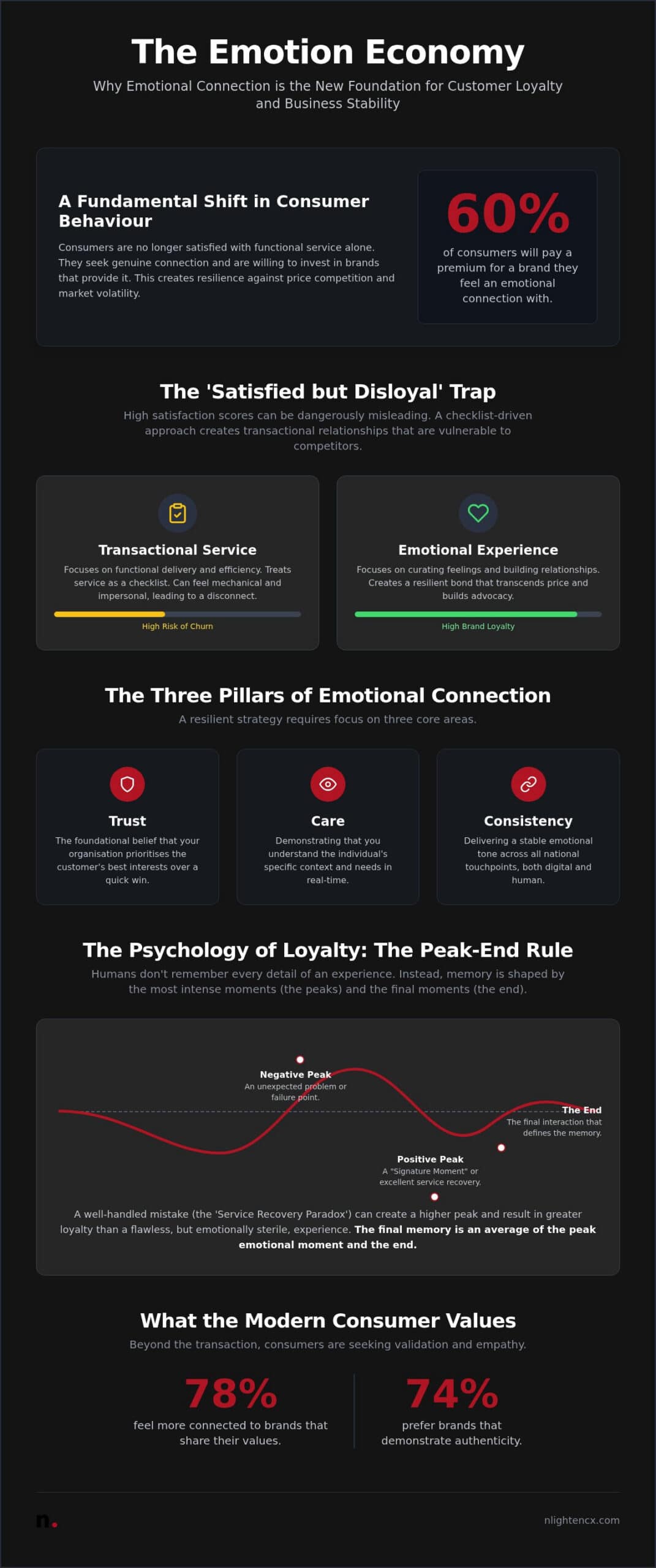
Traditional business metrics often fail to capture the volatile reality of customer retention. Whilst a customer might tick ‘satisfied’ on a survey, it doesn’t mean they won’t switch to a competitor for a minor discount tomorrow. True Brand loyalty is rooted in how a person feels during and after an interaction, not just the utility of the product itself. In 2026, we see a distinct shift where ‘service’, the functional delivery of a solution, is viewed as a basic commodity. ‘Experience’, however, is the strategic emotional architecture of that delivery. It’s the difference between a client receiving a refund and a client feeling truly understood.
Why do 2026 consumers prioritise feeling over price? Research from April 2026 indicates that 78% of consumers feel more connected to brands that share their values, whilst 74% prefer brands that demonstrate authenticity. They aren’t just buying a service; they’re seeking validation and empathy. When you establish a genuine emotional connection in customer service, you move beyond the transaction. You create a relationship that is resilient to market fluctuations and price wars.
The Three Pillars of Emotional Connection
To build a resilient strategy, you must focus on three core areas. First, Trust. This is the foundational belief that your organisation prioritises the customer’s best interests over a quick win. Second, Care. This requires demonstrating that you understand the individual’s specific context and prioritising their needs in real-time. Finally, Consistency. Your national touchpoints must deliver a stable emotional tone. If your digital interface feels warm but your phone support feels cold, the connection breaks. Momentum is lost when the experience is fragmented.
Why Satisfaction Scores Often Lie
High CSAT scores can be dangerously misleading. We call this the ‘Satisfied but Disloyal’ trap. A customer can have a ‘perfect’ transaction on paper, fast, accurate, and efficient, yet still feel entirely disconnected. Why does this happen? It happens because a checklist-driven approach often feels mechanical. If your staff treat an emotional connection in customer service as an optional extra rather than a core requirement, they’re missing the emotional gap. This gap is where price sensitivity lives. When you fail to bridge it, you’re essentially telling the customer that your relationship is purely transactional. They will respond in kind by leaving the moment a cheaper option appears.
The Psychology of Loyalty: Why Emotion Outperforms Price
Price is a race to the bottom. If your value proposition relies solely on being the cheapest, you’ve already lost the loyalty battle. Why? Because human psychology doesn’t prioritise factual transaction details during long-term recall. Instead, the brain relies on emotional memory. We remember how an interaction made us feel, not the specific price point we paid three months ago. This is why a customer will stay with a service provider they like, even when a cheaper alternative appears on the horizon.
The Peak-End Rule is critical to understanding this behaviour. This psychological heuristic dictates that people judge an experience based on how they felt at its peak, the most intense point, and at its end. The rest of the transaction is largely forgotten. If you want to foster a genuine emotional connection in customer service, you must deliberately engineer these moments. Even a failure can be turned into a win through the ‘Service Recovery Paradox’. A well-handled mistake often results in higher loyalty than a flawless, yet emotionally sterile, experience. It proves you care when things get difficult.
Applying the Peak-End Rule to Service Design
Strategic service design requires you to identify ‘Signature Moments’. These are the touchpoints where you can emotionally amplify the interaction. Is it the moment of onboarding? Is it the resolution of a complex query? You must also obsess over the ‘End’. The final 30 seconds of an interaction define the memory of the entire hour. Ensure these peaks are consistent across your national digital and human channels. You can assess your current resonance and identify gaps in your strategy at nlightencx.com.
The Role of Empathy in B2B Service
B2B leaders often fall into the trap of believing their clients are purely rational. This is a myth. Every B2B buyer is an individual taking a personal risk. If they choose your service and it fails, it’s their professional reputation on the line. Empathy in this context means acknowledging that pressure. By using CX design for service businesses, you can map these emotional touchpoints and provide the reassurance they need. Reducing customer effort through cognitive ease is a form of emotional respect. It signals that you value their time as much as they do. This builds a bond that price alone can never break.
Overcoming the Efficiency Trap: Balancing Speed with Empathy
Do your operational metrics reward speed at the expense of relationship stability? Most national organisations fall into the ‘Efficiency Trap’. They prioritise Average Handle Time (AHT) and ticket volume, believing that faster service equals better service. It doesn’t. In 2026, speed is merely the baseline expectation. If you’re fast but forgettable, you’re still vulnerable to churn. True emotional connection in customer service requires a shift from measuring transaction speed to measuring interaction quality. A structured approach to customer service quality improvement provides the systematic methodology needed to make this transition without sacrificing operational efficiency.
Consider the hidden cost of ‘Efficient Churn’. Saving two minutes on a support call might look good on a spreadsheet, but if that brevity leaves the customer feeling like a number, the long-term revenue loss is staggering. You’ve saved pennies but lost thousands in Customer Lifetime Value (CLV). Empowering your staff to use their judgement whilst maintaining operational standards is the only way to escape this cycle. Efficiency should serve the experience, not dictate it.
Small Gestures, Big Impact
Micro-connections are the building blocks of loyalty. It takes less than ten seconds of genuine validation to change the trajectory of an interaction. Simply using a customer’s history to prove you recognise their journey makes them feel seen without being intrusive. Proactive communication is equally powerful. Solving a problem before the customer even feels the pain demonstrates a level of care that reactive service can never match. These small investments yield a disproportionate return on trust.
Training for Emotional Intelligence
Scripting is the absolute enemy of emotional connection in customer service. It creates a mechanical barrier between your team and your clients. To move beyond this, you must develop active listening as a core competency. Your staff need the psychological tools to detect subtle emotional cues and respond with authenticity rather than a pre-approved template. Implementing customer experience management training can transform a rigid, checklist-focused culture into one that prioritises human resonance. This isn’t just about ‘being nice’; it’s about strategic growth. When your team is trained to handle the ‘how’ as well as the ‘what’, your business becomes resilient to the commodity trap that claims so many of your competitors.
Building an Emotional Connection Framework
Ad-hoc empathy is not a strategy. To scale a genuine emotional connection in customer service, you must move beyond occasional kindness and implement a structured framework. This process begins with an audit of your current resonance using the ‘True Voice of the Customer’. Are your clients merely ‘satisfied’, or are they emotionally invested? Once you have this baseline, you can begin the five-step implementation roadmap to ensure your service culture remains resilient and results-oriented.
- Audit current resonance to identify the gap between perceived and actual emotional delivery.
- Map the ‘Emotional Journey’ to understand the psychological state at every touchpoint.
- Identify ‘Emotional Friction’ points where customers feel ignored, undervalued, or confused.
- Design ‘Experience Standards’ that explicitly prioritise human connection over process compliance.
- Measure impact using sentiment data to refine and scale your approach nationally.
Mapping the Emotional Journey
Functional journey maps are often cold and clinical. They track clicks and calls but ignore the human behind the screen. To fix this, you must identify what the customer is feeling at each stage. Are they anxious during a service failure? Are they excited about a new launch? By designing specific ‘Empathy Responses’ for high-stress moments, you ensure your team is prepared to meet the emotional need, not just the technical one. Using customer journey mapping for B2B allows you to visualise these gaps and turn abstract feelings into actionable design requirements.
Measuring the Unmeasurable
Traditional Net Promoter Scores (NPS) often fail to explain the ‘why’ behind the score. They tell you that a customer is unhappy, but they don’t tell you they feel ‘abandoned’ or ‘disregarded’. In 2026, leading organisations use Sentiment Analysis to decode the emotional subtext of customer feedback across all national touchpoints. This allows you to track the direct correlation between positive emotional sentiment and repeat purchase behaviour. By calculating customer experience roi for businesses, you can justify the shift from efficiency-based metrics to emotion-based ones. It transforms CX from a cost centre into a strategic profit driver that secures your market position against more agile competitors.
Begin your strategic audit by taking our Free CX Quiz to identify your organisation’s current emotional gaps.
Transforming Sentiment into Strategic Growth
Is your business resilient enough to survive a sudden price war or a market downturn? Establishing a robust emotional connection in customer service isn’t just about sentiment; it’s about financial security. Data from July 2026 reveals a stark reality: brands in the top quartile for emotional engagement retained 87% of their customers year-over-year, whilst those in the bottom quartile saw retention plummet to 36%. This massive disparity proves that when you move beyond the transaction, you aren’t just making customers happy. You’re building a defensive wall around your revenue. Organisations seeking a structured path to capitalise on this advantage will find that a dedicated focus on business growth through customer experience provides the strategic blueprint needed to transition from reactive service to a sustainable, experience-led model.
Customer advocates are the most cost-effective marketing assets your organisation can possess. Research indicates that 70% of consumers who have positive emotional experiences are likely to recommend the brand to others. These advocates don’t just stay; they recruit. This creates a sustainable competitive advantage that is difficult for competitors to replicate through digital transformation alone. Furthermore, this focus on human resonance improves internal stability. Companies that invest in agent career growth and emotional training hit 23% more of their strategic goals than those that treat staff as mere processors. When your team feels the pride of delivering a genuine experience, their engagement levels rise, creating a virtuous cycle of loyalty and growth.
The Role of Leadership in Emotional CX
Leaders must stop managing processes and start leading experiences. If your leadership team prioritises spreadsheets over sentiment, your frontline staff will mirror that behaviour. Culture precedes connection. You must set the emotional tone from the top, ensuring that empathy is treated as a measurable professional standard rather than an optional personality trait. Investing in high-level resources, such as the CX Handbook for practitioners, provides your management team with the strategic blueprints needed to transition from a rigid service model to a fluid experience architecture.
Next Steps for Your Organisation
Action is the only remedy for stagnation. To begin your transformation, you must first identify where your current emotional gaps lie. Start by taking our Free CX Quiz to pinpoint immediate opportunities for improvement. Once you’ve established a baseline, you can enrol your team in a CX Masterclass to build the tactical skills required for high-level emotional delivery. Finally, you must ensure that this connection remains a permanent fixture of your strategy. Establishing a comprehensive voice of customer program allows you to monitor sentiment in real-time, ensuring your organisation remains agile, empathetic, and consistently profitable in an increasingly volatile national market.
Securing Your Market Position Through Emotional Resonance
The transition from transactional service to emotional loyalty is no longer a luxury; it is a prerequisite for business stability in 2026. You have seen how psychological mechanisms like the Peak-End Rule define long-term memory and how a well-structured framework can turn sentiment into measurable growth. Relying on speed alone is a strategic error that exposes your organisation to price-sensitive churn. By prioritising a genuine emotional connection in customer service, you build a brand that is resilient to market volatility and defended by high-value advocates who ignore the cheapest offer in favour of the best experience.
Execution requires the correct strategic tools and professional guidance. Whether you leverage our specialised CX Masterclasses for strategic leaders, consult the authoritative CX Handbook for practitioners, or deploy our signature True Voice of the Customer Program, the path to sustainable retention is clear. It is time to move beyond the service checklist and start designing experiences that resonate on a human level.
Take our free CX Quiz to see how your organisation’s emotional connection measures up today.
Frequently Asked Questions
How do you measure emotional connection in customer service?
Measurement requires shifting from quantitative scores to qualitative sentiment analysis. Standard surveys often miss the emotional subtext that drives behaviour. By implementing a True Voice Of Customer Program, organisations can decode the specific feelings behind the feedback. This approach identifies whether a client feels valued or merely processed. It allows you to track the strength of the emotional connection in customer service by correlating sentiment with long-term retention data.
Why is emotional connection more important than customer satisfaction?
Customer satisfaction is a baseline metric that tracks the fulfilment of a transaction, whilst emotional connection secures the entire relationship. A satisfied customer is often just one discount away from leaving for a competitor. In contrast, emotionally connected clients demonstrate 52% more value over their lifetime. They prioritise the relationship over price. This bond acts as a strategic buffer against market volatility that simple satisfaction scores cannot provide.
Can automated or AI systems create an emotional connection?
Automated systems in 2026 use emotion-aware AI to detect sentiment and adapt their tone, but they cannot replace genuine human empathy. These tools are most effective when they handle routine enquiries, freeing your staff to focus on high-stakes, emotionally charged interactions. The goal is human-AI collaboration. Technology provides the data and speed, whilst your team provides the nuanced validation that builds a high-value emotional bond.
What is the Peak-End Rule in customer experience?
The Peak-End Rule is a psychological principle stating that customers judge an entire experience based on its most intense moment and its conclusion. Factual details of the middle of a transaction often fade from memory. To leverage this, your CX Design must deliberately engineer ‘Signature Moments’ that provide a positive emotional peak. Ensuring the final interaction is warm and supportive dictates whether the customer returns for their next purchase.
How do you train employees for emotional intelligence and empathy?
Training for empathy requires moving beyond rigid scripts and empowering staff to use their professional judgement. You must develop active listening as a core competency. Enrolling your team in a CX Masterclass provides them with the psychological frameworks to detect subtle customer cues. This transition from ‘checklist service’ to ‘experience delivery’ ensures that every interaction feels authentic and personal rather than mechanical or forced.
Is emotional connection relevant for B2B service businesses?
Emotional connection is vital in B2B because individual buyers often take significant professional risks when choosing a service provider. If the service fails, their reputation is on the line. Empathy in B2B service businesses means providing the reassurance and trust necessary to mitigate that perceived risk. It moves the relationship from a vendor-client dynamic to a strategic partnership rooted in mutual security and long-term growth.
What are the common barriers to building emotional connections?
The most common barrier is the ‘Efficiency Trap’, where organisations prioritise speed and handle times over human resonance. Rigid scripting and a lack of staff empowerment also create a mechanical barrier that prevents genuine connection. When employees are forced to treat emotional connection in customer service as a checklist, the bond breaks. Fragmented touchpoints across different national channels further dilute the brand’s tone, leading to a disjointed and impersonal customer journey.
How does emotional connection impact business profitability and ROI?
Emotional connection directly increases profitability by boosting Customer Lifetime Value (CLV) and reducing the cost of acquisition through advocacy. Emotionally engaged customers spend an average of $632 more annually than those who are merely satisfied. By lowering churn rates, you secure a more stable revenue stream. Calculating the ROI of these connections allows you to justify the investment in professional CX Strategy as a primary driver of business growth. Organisations seeking to quantify and act on these gains will find that a dedicated focus on customer service quality improvement provides the measurable framework needed to turn emotional investment into predictable revenue.