
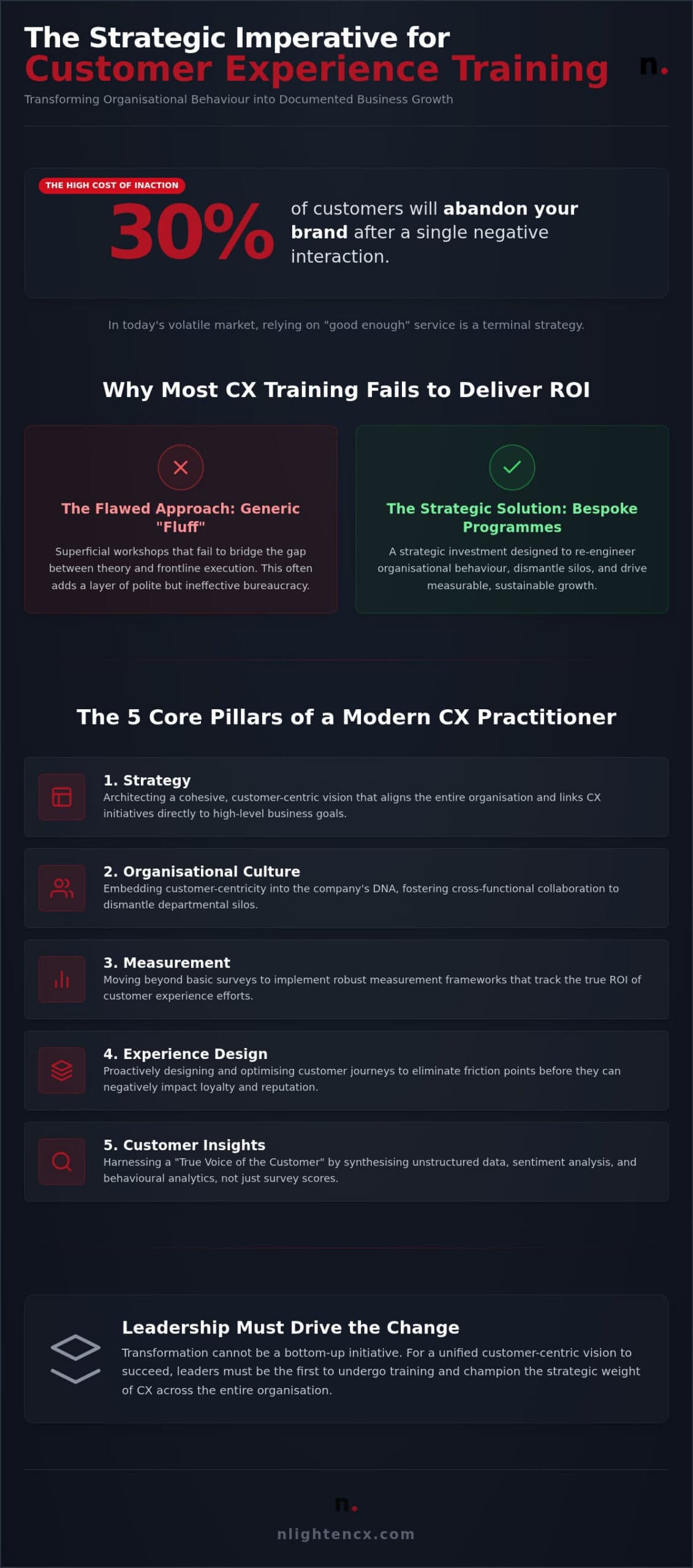
Thirty per cent of your customers will abandon your brand after a single negative interaction. It’s a sobering reality that exposes the fragility of traditional loyalty in a volatile market. Most leaders respond by investing in generic customer experience management training, yet they often find themselves stuck with “fluff” that fails to bridge the gap between theory and frontline execution. Does your current programme actually dismantle internal silos, or does it simply add another layer of polite but ineffective bureaucracy?
You likely recognise that a unified customer view is no longer optional for business stability. We understand the frustration of seeing significant investment vanish into workshops that yield no measurable shift in organisational behaviour. This guide promises to help you master the art of selecting a programme that transforms your culture and drives documented business growth. We’ll examine practical frameworks for journey mapping and research that turn empathy into a strategic asset for 2026.
Key Takeaways
- Understand why CX training must be a multidisciplinary strategic investment rather than a superficial exercise to combat rising customer churn.
- Identify the five core pillars of a modern CX practitioner, focusing on how data-driven empathy transforms every customer interaction.
- Evaluate the ROI of bespoke strategic workshops against off-the-shelf options to ensure your customer experience management training delivers actionable behavioural change.
- Learn how to dismantle departmental silos and align your entire organisation under a single, cohesive customer-centric vision.
- Discover the benefits of specialised CX Masterclasses and proprietary tools like the True Voice of Customer Program for driving sustainable profitability.
The Strategic Imperative for Customer Experience Management Training
Customer experience management training serves as the critical connective tissue between a company’s high-level vision and its daily operational reality. It isn’t merely a series of workshops; it’s a strategic alignment tool designed to re-engineer how a firm perceives its value. In an era where 30% of consumers will abandon a brand after a single negative interaction, the cost of ignoring behavioural change is terminal. Many organisations continue to pour resources into customer acquisition whilst their existing base erodes through the cracks of a fragmented service model. To stop the bleed, businesses must move beyond the surface level.
By 2026, the landscape demands a pivot from transactional efficiency to deep emotional resonance. Whilst AI handles the mundane, your human capital must master the complex. This shift requires a sophisticated understanding of the customer experience ecosystem. When leadership invests in high-level education, they unlock the true customer experience roi for businesses. It’s the difference between a team that follows a script and one that understands the psychological drivers of loyalty.
Why “Good Enough” Service is No Longer Sufficient
Relying on “good enough” service is a dangerous gamble in a hyper-competitive market. We’ve moved past the era where basic service quality was a differentiator. Today, holistic experience management is the baseline for survival. Trained teams develop a keen eye for friction points, allowing them to intervene before a minor frustration escalates into churn. This proactive stance is essential for maintaining a consistent national brand experience. Without structured training, your customer’s journey becomes a game of chance, varying wildly between departments or locations. Consistency builds trust; trust builds profitability.
Linking CX Education to Strategic Growth
Investing in education directly fuels strategic customer experience research. When practitioners are equipped with the right frameworks, they can interpret data through the lens of human behaviour rather than just cold metrics. This maturity allows a business to scale whilst maintaining the emotional connections that drive long-term market share. However, this transformation cannot be bottom-up. Leaders must be the first to undergo the training. If the executive layer doesn’t grasp the strategic weight of CX, the organisation will remain trapped in silos, unable to execute a unified vision that resonates with the modern consumer.
Core Competencies of a Modern CX Practitioner
Expertise in this field is not an accident of personality. It is the result of mastering five core pillars: strategy, organisational culture, measurement, experience design, and customer insights. A practitioner who excels across these domains doesn’t just manage service; they architect business stability. Effective customer experience management training must therefore move beyond soft skills to cultivate these hard strategic competencies. It’s about balancing technical proficiency with the high-level ability to map journeys that actually convert and retain.
Empathy is frequently dismissed as a secondary “soft” skill, but in a results-oriented environment, it’s a data-driven requirement. We don’t guess how customers feel; we use behavioural analytics to prove it. This transition from reactive troubleshooting to proactive experience design is what separates market leaders from those who merely survive. By designing out friction before it reaches the customer, you protect your margins and your reputation simultaneously. Organisations that invest in CX design for service businesses understand that building emotional architecture into every touchpoint is what transforms technically adequate service into genuinely memorable experiences.
Mastering Customer Journey Mapping
Journey mapping is the backbone of strategic experience design. However, B2B customer journey mapping requires a significantly more nuanced lens than B2C models. The stakeholder landscape is complex. Decision-making units are larger. Training should focus on fostering cross-functional collaboration, ensuring that Sales, Marketing, and Operations aren’t just present, but are actively aligning their goals. We must move from static, “one-and-done” visualisations to dynamic systems of experience optimisation that evolve with the market.
Data Literacy and Voice of the Customer (VoC)
Simple surveys are no longer enough to maintain a competitive edge. A “True Voice” approach involves synthesising unstructured data, real-time sentiment analysis, and direct feedback into a coherent, actionable narrative. Practitioners need the literacy to interpret this data to predict future needs rather than just reporting on the past. Validating training outcomes through rigorous CX research ensures that your investment is actually moving the needle on profitability. For organisations operating in the local market, implementing a structured voice of customer program South Africa converts fragmented sentiment data into the strategic intelligence needed to retain high-value clients. If you’re looking for a foundation in these organisational processes, Cornell University’s course on customer experience offers a useful perspective on building a robust service culture. To see how your current team measures up against these global standards, engaging with nlightencx for a preliminary skills audit can provide the clarity you need to move forward.
Evaluating Training Formats: Masterclasses vs. Academic Courses
Selecting the right vehicle for customer experience management training is a high-stakes decision for any executive. Whilst academic programmes offer a broad theoretical foundation, immersive masterclasses are engineered for rapid execution. The choice often boils down to a simple question: do you need your team to pass an exam, or do you need them to solve a churn problem? Traditional academic routes can take months to yield results, which is a luxury many national organisations simply don’t have in a volatile market.
Practitioner-led education carries a weight that purely academic instruction cannot match. When the person at the front of the room has navigated the same friction points your team faces, the learning is immediately applicable. Off-the-shelf training often feels like “fluff” because it lacks the nuance of your specific industry. In contrast, bespoke strategic workshops are designed to dismantle your unique organisational silos. They offer a far higher ROI by addressing the specific behavioural barriers that prevent a unified customer view. If you’re building a national strategy, you need a programme that can scale without losing its practical edge.
The Case for High-Level Masterclasses
Intensive masterclasses are the preferred choice for senior leadership teams who require “implementation-ready” frameworks. These sessions strip away the academic padding and focus on the mechanics of transformation. There is also immense value in networking with other national CX leaders during these sessions, allowing for a cross-pollination of strategic ideas. For those seeking a rigorous academic foundation, Harvard Business School’s Transforming Customer Experiences course provides an excellent systematic approach. However, for immediate organisational shift, a masterclass often delivers the necessary momentum faster. It’s about moving from theory to the “how-to” of daily operations.
Certification vs. Capability Building
It’s easy to fall into the trap of “certificate chasing.” Whilst formal credentials have their place for individual career progression, they don’t always translate into collective organisational change. Capability building is a deeper, more demanding process. It involves identifying specific skill gaps and measuring the success of training through post-programme performance metrics rather than just attendance logs. Are your teams mapping journeys more effectively? Is the churn rate actually dropping? If the training doesn’t change the data, it hasn’t succeeded. Focus on the outcome, not the parchment. True success is measured in loyalty and profitability, not just a badge on a profile.
Embedding a Customer-Centric Culture Through Training
Culture is the silent driver of business stability. Whilst many firms attempt to “gamify” culture with superficial exercises, true transformation requires a structural overhaul. Customer experience management training serves as the primary tool for dismantling the departmental silos that stifle growth. When teams from Marketing, Operations, and Finance share a common methodology, the friction between departments evaporates. This alignment is particularly critical for national organisations where regional teams often operate in isolation. Training provides a unified vision, ensuring that a customer in one part of the country receives the same high-calibre experience as one in another.
Knowledge must not remain trapped within a single cohort. To maintain momentum, organisations need a strategy for cascading insights across the entire hierarchy. This isn’t a “one-and-done” event but a continuous commitment to professional evolution. Knowledge sharing must be intentional, moving from the training room into the daily habits of every staff member. A structured approach to customer service culture training ensures that these behavioural shifts take root at every level of the business, from the C-suite to the frontline.
The Role of Leadership in Cultural Transformation
Strategic shifts fail when the C-suite remains detached. CX training must start at the top to signal that customer-centricity is a core business value, not a frontline checkbox. When leaders understand the mechanics of experience, they can empower employees to make autonomous, customer-centric decisions in real-time. This empowerment reduces the need for constant escalation and speeds up resolution. Crucially, it creates a robust feedback loop. Frontline staff, who interact with the customer daily, must have a clear channel to share insights with strategic planners. Without this dialogue, strategy remains theoretical and disconnected from reality. Investing in customer experience leadership training ensures that executives are equipped to act as strategic architects of loyalty rather than passive observers of service delivery.
Sustainable CX: Making the Change Stick
Sustainability in CX requires more than just initial enthusiasm. It demands the appointment of internal “CX Champions” who act as custodians of the vision within their respective teams. These individuals ensure that the principles learned in training are applied to daily workflows. Providing ongoing support through resources like a CX Handbook gives practitioners a permanent reference point for complex journey mapping or research tasks. Finally, the change must be reinforced by the balance sheet. Set KPIs that specifically reward customer-centric behaviours rather than just operational speed. If you measure it, you can manage it. If you reward it, you will sustain it.
Ready to move beyond superficial fixes? Explore our strategic CX Training to build a culture that lasts.
Elevate Your Organisation with nlightencx Training Solutions
Success in a competitive landscape requires more than a superficial understanding of service. It demands a rigorous, multidisciplinary approach to how your brand interacts with the world. As a boutique consultancy with deep strategic expertise, nlightencx serves as the premier partner for firms ready to move beyond “tick-box” exercises. Our customer experience management training is built on the belief that organisational empathy is a high-yield asset. We don’t just provide education; we deliver the frameworks necessary to secure your business stability and drive sustainable profitability.
We recognise that every organisation faces unique friction points. Our methodology integrates high-level theory with the practical realities of daily operations. By utilising proprietary tools like our voice of customer program South Africa businesses rely on to unify fragmented feedback data, we ensure that your training is validated by authentic data rather than assumptions. This results-oriented focus transforms your team from reactive problem-solvers into proactive architects of the customer journey.
Practitioner-Led Masterclasses for Strategic Impact
Generic courses often fail because they lack the nuance of real-world application. Our specialised CX Masterclass is different. It is a practitioner-led experience designed specifically for corporate growth and senior leadership alignment. We bridge the gap between high-level strategy and frontline execution by providing “implementation-ready” tools that your team can use immediately. Whether you are navigating the complexities of a national market or attempting to dismantle deep-seated internal silos, our masterclasses are customised to address your specific challenges. This isn’t just learning; it’s a strategic intervention designed to re-engineer your organisational behaviour.
Your Roadmap to CX Excellence
The path to maturity begins with a clear understanding of your current standing. We invite you to take the first step by completing our free CX quiz, which provides an immediate snapshot of your organisation’s strengths and weaknesses. From there, we guide you through a structured journey from initial training to full-scale strategy implementation. For ongoing support, our CX Handbook serves as an essential resource for practitioners, providing the practical frameworks needed to maintain momentum long after the initial workshops conclude. Don’t leave your customer relationships to chance. Partner with nlightencx to build a resilient, customer-centric culture that delivers measurable business growth. Your journey toward excellence starts with a single, strategic decision.
Securing Your Strategic Edge in 2026
The transition from a service-led organisation to an experience-led powerhouse requires more than intent; it demands a structural re-engineering of how your team perceives value. You’ve seen that effective customer experience management training isn’t a peripheral expense but a core strategic investment. By mastering the five pillars of the modern practitioner and dismantling departmental silos, you protect your brand against the volatility of rising churn. It’s about moving beyond theory to create a culture where every employee acts as a guardian of the customer journey.
Success in this landscape is achieved through precision and proven methodology. Whether you’re utilising our authoritative CX Handbook for Practitioners or leveraging insights from our True Voice of Customer Program, our expert-led strategic consulting approach ensures your team is equipped for measurable growth. Don’t let your organisation’s stability remain a matter of chance. Take the decisive step toward sustainable profitability and enrol in an nlightencx CX Masterclass today. The future of your brand depends on the strategic choices you make right now, and we’re ready to help you lead the way.
Frequently Asked Questions
What is customer experience management training and why is it important?
Customer experience management training is a strategic discipline designed to align an organisation’s behaviour with its customer-centric vision. It’s vital because it moves beyond surface-level service to address the root causes of customer churn. By 2026, with 30% of consumers prepared to leave after one poor interaction, this training ensures your team can design proactive experiences. It builds the internal capability to protect margins and secure long-term loyalty in a volatile market.
How long does a typical CX management training programme take to complete?
Duration depends on the chosen format and depth of the curriculum. Intensive, practitioner-led masterclasses typically run over two to three days for rapid strategic impact. In contrast, traditional academic certifications or diplomas can span several months. High-level corporate programmes often favour the intensive format to minimise operational downtime whilst delivering implementation-ready frameworks. The focus is on capability building that fits the pace of a modern, national organisation rather than drawn-out theory.
Is CX training suitable for B2B organisations as well as B2C?
Absolutely, though the methodology must be adapted for the B2B environment. High-level CX education focuses on complex stakeholder landscapes and longer, relationship-driven journeys. Unlike B2C’s high-volume transactions, this training emphasises strategic journey mapping for multiple decision-makers. It ensures that account teams and operations align to deliver value across multi-year contracts. This multidisciplinary approach is essential for securing the high-value accounts that underpin B2B business stability and growth.
What is the difference between customer service training and CX management training?
Customer service training is reactive, focusing on frontline interactions and troubleshooting specific complaints. Customer experience management training is a proactive, strategic discipline that designs the entire ecosystem of customer interactions. Whilst service training teaches how to respond, CX training teaches how to engineer out friction before it occurs. It involves cross-functional collaboration, data literacy, and journey mapping. It’s the difference between fixing a broken experience and architecting a consistently excellent one.
How do I measure the ROI of my team’s customer experience training?
Measuring ROI requires looking at both operational data and behavioural shifts. You should track reductions in customer churn rates and improvements in loyalty metrics such as Net Promoter Score (NPS) post-training. Additionally, monitor the decrease in service recovery costs as teams become more proactive. True ROI is reflected in the bottom line through increased lifetime value and higher profitability. Effective training must change the data, not just the team’s internal sentiment or perception.
What qualifications or experience are required to attend a CX masterclass?
Most masterclasses are designed for mid-to-senior level professionals who already possess a foundational understanding of business operations. Whilst formal academic qualifications aren’t always mandatory, three to five years of professional experience is typically recommended. This ensures participants can engage with high-level strategic concepts and apply them to their organisational silos. For those pursuing the Certified Customer Experience Professional (CCXP) credential, specific work experience and degree requirements apply as defined by global standards.
Can CX training help in reducing customer churn in a competitive market?
Yes, it’s one of the most effective tools for churn reduction. By training your team to identify and remove friction points within the customer journey, you eliminate the reasons customers leave. Training provides the frameworks for data-driven empathy, allowing staff to predict and meet needs before they escalate into frustrations. In a market where one negative experience can end a relationship, this proactive capability is essential for maintaining market share and stability.
What are the benefits of practitioner-led training over academic courses?
Practitioner-led training offers implementation-ready frameworks that bridge the gap between theory and daily execution. Unlike purely academic courses, these sessions are taught by experts who have navigated real-world organisational challenges. This format delivers faster results by focusing on practical problem-solving rather than just exam preparation. It allows your team to learn from those who have seen the inner workings of various industries, providing a level of nuanced insight that standard textbooks cannot replicate.