

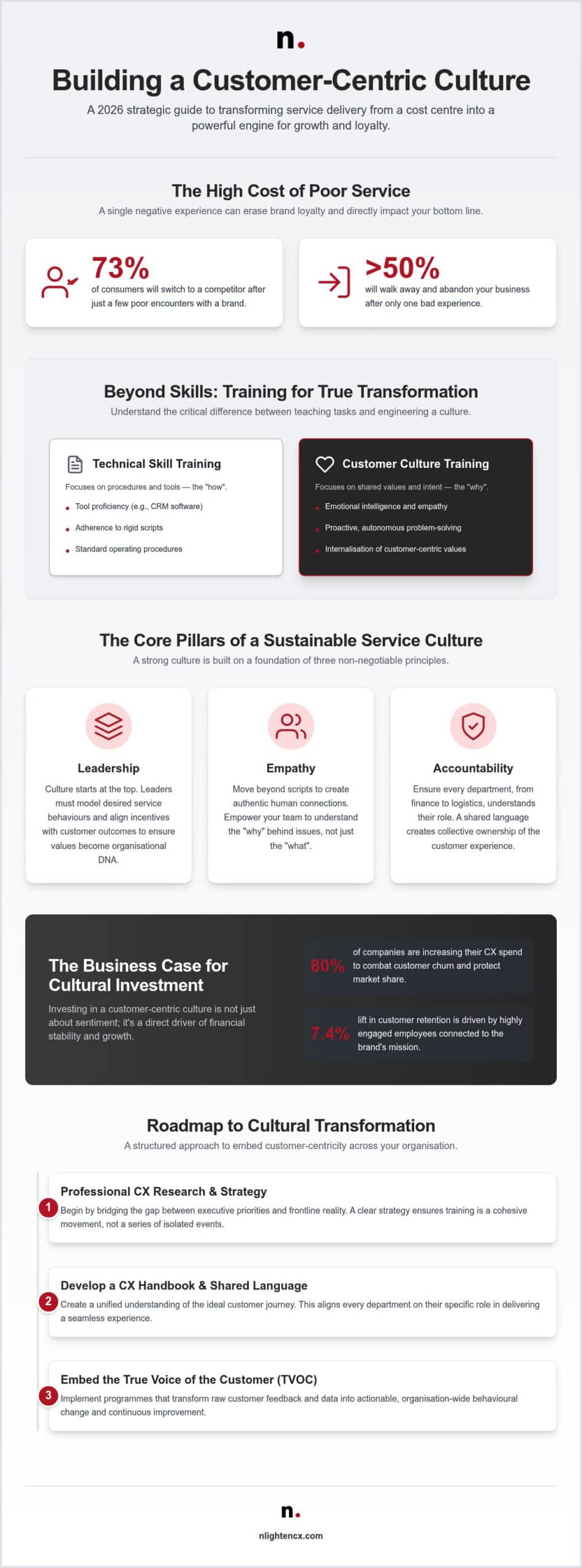
73% of consumers report they will switch to a competitor after only a few poor encounters, and more than half will walk away after just one. You likely recognise the recurring frustration of watching high customer churn erode your bottom line whilst your frontline staff follow rigid scripts that lack genuine empathy. It’s a common friction point where leadership priorities and daily execution simply do not align. To resolve this, you need more than a new handbook; you require a robust approach to customer service culture training that transforms behaviour at every level of the business.
This 2026 strategic guide provides a clear roadmap to help you align leadership, foster emotional intelligence, and transform your service delivery into a sustainable competitive advantage. We will explore how to move from basic transactions to deep, loyalty-driven customer connections that protect your market share. You will learn how to build a workforce that is emotionally connected to every stage of the customer journey, ensuring your brand remains a preferred choice in a volatile market. By integrating real-world insights with strategic training, you can turn your service department from a cost centre into a powerful engine for growth.
Key Takeaways
- Distinguish between technical skill instruction and the deep customer service culture training required to embed empathy and shared values across every department.
- Identify the three non-negotiable pillars of Leadership, Empathy, and Accountability that form the foundation of a sustainable, customer-centric organisation.
- Learn how to bridge the gap between executive priorities and frontline execution using a structured roadmap that begins with professional CX Research.
- Discover how the CX Handbook and the True Voice of Customer Program transform raw data into a shared organisational language and actionable behavioural change.
- Shift your perspective from simple service delivery to engineering a culture that proactively reduces churn and fosters long-term business stability.
What is Customer Service Culture Training and Why Does it Matter?
Customer service culture training is frequently misunderstood as a simple exercise in etiquette or software proficiency. In reality, it is the strategic engineering of shared values and behaviours that ensure the customer remains the central focus of every organisational touchpoint. Whilst technical training teaches an employee how to operate a CRM, culture training defines the empathy and intent behind every interaction. Without this cultural bedrock, even the most sophisticated tools fail to deliver a premium experience.
Does your team follow the script but miss the mark? This is the hallmark of a technical success and a cultural failure. In the South African national market of 2026, where customer expectations have reached an all-time high, the margin for error is non-existent. A single bad experience leads 73% of consumers to consider your competitors. This reality demands a shift from basic service delivery to a comprehensive customer service culture training framework.
- Technical Skill Training: Focuses on tool proficiency, data entry, and adherence to standard operating procedures.
- Culture Training: Focuses on emotional intelligence, proactive problem-solving, and the internalisation of customer-centric values.
The Difference Between Training and Transformation
Transformation is not a one-off event. Workshops often fail because they treat culture as a module rather than a behaviour to be lived. To achieve lasting change, employees must unlearn legacy habits that prioritise internal efficiency over external satisfaction. By moving from a transactional mindset to one of emotional connection, you empower your team to act with autonomy. When staff understand the “why” behind the service, they no longer require a script to provide excellence.
The Business Case for Cultural Investment
The business case for cultural investment is grounded in hard data. 80% of companies are increasing their CX spend this year to combat churn. A unified culture reduces the friction that leads to customer loss, lowering the long-term cost of acquisition. Highly engaged employees who feel connected to the brand’s mission drive a 7.4% lift in retention. This isn’t just about sentiment; it’s about the financial sustainability of your organisation.
Service culture serves as the definitive strategic differentiator for South African firms navigating the complexities of the 2026 economic landscape.
The Core Pillars of a Sustainable Service Culture
A sustainable service culture requires a structural framework. It cannot rely on the sporadic enthusiasm of individual employees. Instead, it must be built on three non-negotiable pillars: Leadership, Empathy, and Accountability. Before initiating any customer service culture training, an organisation must engage in Strategic CX Planning. This prerequisite ensures that the training isn’t a series of isolated events but a cohesive movement towards a defined objective. Without a clear strategy, training becomes a temporary patch rather than a permanent solution.
Does your back office understand their impact? If the finance department doesn’t understand the customer journey, their rigid invoicing processes can undo the goodwill created by the sales team. A shared language ensures that every department, from logistics to IT, understands their role in the customer experience. Centring the organisation around the customer journey requires every employee to see how their specific actions influence the final perception of the brand.
Leadership Alignment and Accountability
Culture is a shadow of the leader. If executives don’t prioritise CX, neither will the staff. Effective training begins at the top. Leaders must model the desired service behaviours in every internal meeting and strategic decision. Linking CX goals to performance management and rewards ensures that these values aren’t just posters on a wall. When incentives are tied to customer outcomes, accountability becomes part of the organisational DNA. For those seeking to bridge the gap between vision and execution, a dedicated CX Masterclass can align leadership teams on these critical priorities.
Emotional Intelligence and Empathy
Scripts are the enemy of authenticity. Whilst they provide a safety net, they often prevent genuine human connection. 82% of service professionals agree that customer expectations are higher than ever. Customers can smell a canned response instantly. Training must focus on Emotional Intelligence (EQ). This involves teaching staff to recognise subtle emotional cues and respond with agility. Using a True Voice Of Customer Program allows employees to hear raw, unfiltered feedback. This data-driven approach builds empathy by grounding customer service culture training in the actual experiences of the people they serve. It moves the conversation from what you do to how you make the customer feel.
Training for Behavioural Change vs. Surface-Level Skills
Most organisations confuse skill acquisition with cultural evolution. Whilst teaching a team how to handle a specific software interface is necessary, it’s merely a surface-level fix. True customer service culture training requires “deep work” that addresses the underlying beliefs and attitudes of your workforce. If you only train for skills, you create a team of automatons who can follow a process but cannot handle the nuance of a human emotional crisis. A script can tell an employee what to say, but it cannot teach them how to care.
Standardising this excellence requires a structured reference point. The customer experience handbook for practitioners serves as this vital resource, providing internal practitioners with a blueprint for professional conduct that transcends basic etiquette. It moves the conversation from “what do I do?” to “who are we to the customer?” This transition is essential for building a brand that feels consistent regardless of the individual staff member involved. When your team shares a common vision of excellence, they no longer need to be micromanaged; they become self-correcting agents of your brand promise.
A common objection amongst executives is the perceived lack of time for long-term cultural shifts. However, this is a dangerous fallacy. Can you afford the cost of a 73% churn rate caused by inconsistent service? The time invested in cultural alignment is significantly less than the time spent constantly replacing lost revenue and disgruntled customers. Effective change must be preceded by Customer Experience Leadership. Without a committed executive team to champion the shift, frontline training is a hollow exercise that will inevitably revert to old habits as soon as the pressure mounts.
The Psychology of Service Excellence
To change behaviour, you must understand the emotional drivers behind customer loyalty. It isn’t just about the product; it’s about the psychological feeling of being valued and heard. Training should focus on identifying friction points in employee behaviour, such as defensive reactions or a lack of active listening. By building resilience, teams can handle complex service recoveries with grace. This ensures they turn potential disasters into moments of brand advocacy rather than permanent exits.
Standardising Quality Across Channels
Consistency is the hallmark of a mature culture. Whether a customer interacts via a digital portal or face-to-face, they should experience the same “True Voice” of your brand. Journey mapping plays a critical role here, as it highlights exactly where training is most urgently needed to fix broken experiences. For a deeper look at how to align these touchpoints, explore our guide on CX Strategy and Journey Mapping. This alignment ensures that your cultural values are not just theoretical but are felt at every stage of the customer lifecycle.
How to Organise an Effective Culture Training Roadmap
Designing a sustainable customer service culture training programme requires more than a series of calendar invites. It demands a methodical, step-by-step architecture that ensures the new behaviours actually stick. Without a roadmap, your efforts will likely dissolve into the “initiative fatigue” that plagues so many corporate environments. You must move from random acts of training to a structured journey of organisational maturation. Does your current plan have the depth to survive the first sign of operational pressure?
- Step 1: Conduct a CX Research audit. You cannot fix what you haven’t measured. Use data-driven research to identify the specific cultural gaps between your brand promise and your service delivery.
- Step 2: Align leadership. Culture is a top-down phenomenon. Use a CX Masterclass to ensure your executive team is not just supportive, but actively driving the transformation.
- Step 3: Develop a bespoke curriculum. Avoid off-the-shelf solutions. Base your training on the True Voice of Customer to ensure the content is grounded in your specific market reality.
- Step 4: Roll out phased sessions. Don’t overwhelm the organisation. Implement training in manageable waves, tied to clear behavioural KPIs that managers can track daily.
- Step 5: Implement feedback loops. Culture is never “finished”. Establish continuous mechanisms where customer and employee feedback refine the training programme over time.
Assessing Your Starting Point
Where does your organisation currently sit on the maturity scale? Using a CX maturity model allows you to benchmark your current service levels against industry standards. This process identifies “culture champions” within your ranks; those employees who already embody your desired values and can act as internal mentors. A CX audit in 2026 serves as the definitive diagnostic tool that strips away internal assumptions to reveal the raw reality of the customer experience.
Measuring the Impact of Training
Stop relying on “smile sheets” that only measure whether employees enjoyed the workshop. Real success is found in behavioural change and financial outcomes. You must track the ROI of Customer Experience post-training to justify the investment to your board. Use actual customer feedback to see if the empathy and resilience taught in the classroom are manifesting on the frontline. If you are ready to stop guessing and start engineering a culture that delivers results, consider how a targeted CX Masterclass can provide the strategic alignment your leadership team requires.
Embedding the True Voice of the Customer into Your Culture
Data collection is a passive exercise. Organisational awareness, however, is a competitive force. To move beyond a superficial implementation, the True Voice of Customer Program must serve as the primary curriculum for your customer service culture training. This proprietary methodology ensures that your staff aren’t merely studying theory; they are responding to the actual requirements and frustrations of your specific client base. By turning raw data into a narrative, you move the organisation from a state of compliance to a state of conviction.
Real customer stories possess a motivational power that KPIs lack. When employees hear the direct impact of their actions through unfiltered feedback, the work becomes personal. This emotional resonance is the catalyst for the final stage of cultural maturity: unconscious competence. At this level, customer-centricity is no longer a conscious choice or a checklist. It becomes an instinctive behaviour that defines every internal and external interaction.
From Research to Action
Turning CX research findings into practical training scenarios is the only way to bridge the gap between insight and execution. The CX Handbook for Practitioners provides your team with a daily reference guide to maintain this standard. It acts as a compass, ensuring that the “unlearning” of old habits discussed earlier is replaced by standardised professional excellence. Closing the loop is vital. You must show employees the direct, positive results of their cultural shift, whether through improved retention data or direct commendations. Recognition reinforces the behaviour you want to sustain.
Partnering for Long-Term Success
Maintaining objectivity is difficult from within the organisational bubble. An external CX consultant provides the necessary distance to identify blind spots that internal teams often overlook. A boutique approach is particularly valuable in the South African market, as it ensures the training is tailored to national dynamics rather than generic global templates. This level of customisation is what separates a successful transformation from a failed experiment. If you are ready to move from basic service delivery to a culture of sustainable excellence, the next step is a structured partnership.
To begin your journey toward a truly customer-centric organisation, Explore nlightencx Training Solutions and discover how a data-driven approach can secure your business stability in 2026.
Engineering a Future of Service Excellence
Building a customer-centric organisation isn’t a task for a single afternoon. It’s a strategic commitment to aligning your leadership, standardising professional excellence as authors of the CX Handbook, and listening to the raw feedback provided by your clients. You’ve seen that technical proficiency is a baseline, yet true differentiation comes from the emotional intelligence and cultural bedrock you establish today.
Investing in comprehensive customer service culture training ensures your team moves beyond scripts to create authentic human connections. As strategic advisors to national South African organisations, we know that business stability in 2026 depends on your ability to reduce churn through superior experiences. By implementing our proven True Voice of Customer methodology, you turn passive data into a powerful engine for growth and loyalty.
Are you ready to transform your service delivery into a sustainable competitive advantage? Master your service culture with nlightencx Masterclasses and join the ranks of leaders who are defining the future of CX. We look forward to helping your organisation reach its full potential.
Frequently Asked Questions
How long does it take to see results from customer service culture training?
Results often manifest as improved employee morale and reduced friction within the first 90 days. However, full organisational maturity typically requires six to twelve months of consistent reinforcement. You’ll see a shift in unconscious competence as staff begin to proactively solve problems without managerial intervention. This timeline depends on your starting maturity level and the depth of leadership commitment. Continuous feedback loops from our True Voice of Customer Program help accelerate this process.
What is the difference between customer service training and customer experience training?
Service training focuses on the “how” of a single interaction, such as technical proficiency or phone etiquette. In contrast, customer service culture training addresses the “why” across the entire customer journey. It transforms the mindset of every department, ensuring that even non-facing staff understand their impact on the final experience. Whilst service is a subset of the experience, culture is the environment that makes consistent excellence possible for every client.
Can a customer-centric culture be built in a remote or hybrid working environment?
Building a customer-centric culture is entirely possible in hybrid settings provided you establish a shared language. Remote teams lack the osmosis of a physical office, so you must be more intentional with digital rituals and training. Using the CX Handbook as a central source of truth ensures that standards remain consistent regardless of geography. Success in 2026 relies on clear documentation and virtual leadership alignment to bridge the physical gap between employees.
How do we measure the ROI of cultural transformation training?
Measuring ROI involves tracking specific financial and behavioural metrics over a sustained period. You should monitor reductions in customer churn, increases in customer lifetime value, and improved referral rates post-training. By comparing these figures against the cost of your customer service culture training, you can calculate a precise return. Effective measurement moves beyond simple satisfaction surveys to show how cultural shifts directly protect and grow your organisation’s bottom line.
Is leadership involvement really necessary for front-line service training?
Leadership involvement is the single most important factor in the success of any training initiative. If executives don’t model the behaviours they expect from the frontline, the culture will inevitably revert to old habits. Leaders must participate in a CX Masterclass to align on strategic priorities and performance rewards. Without this top-down commitment, employees view training as a temporary distraction rather than a fundamental shift in how the business operates.
What are the most common mistakes when implementing a service culture training plan?
The most frequent error is treating culture as a one-off workshop rather than an ongoing evolution. Many organisations also fail because they ignore the True Voice of Customer and rely on internal assumptions instead. Another mistake is excluding back-office departments from the training, which creates silos and broken journeys. Finally, failing to link cultural goals to actual performance management ensures that staff have no long-term incentive to change their behaviour.
How often should culture training be refreshed for existing staff?
Culture training should never be a one and done event. We recommend a deep-dive refresh every twelve months to account for evolving market dynamics and new staff intakes. Between these sessions, you should implement monthly micro-learning moments or CX huddles to keep the principles top of mind. This cadence ensures that your organisational values don’t fade into the background but remain a living, breathing part of your daily operations.
Does nlightencx offer bespoke training for different industries in South Africa?
nlightencx specialises in providing boutique, bespoke solutions tailored specifically to the South African national market. We understand that a one-size-fits-all global template often fails to resonate with local cultural nuances and business challenges. Whether you operate in financial services, retail, or B2B sectors, our CX Training and Masterclasses are designed around your specific industry data. This ensures the training is relevant, actionable, and capable of delivering results for your organisation.