

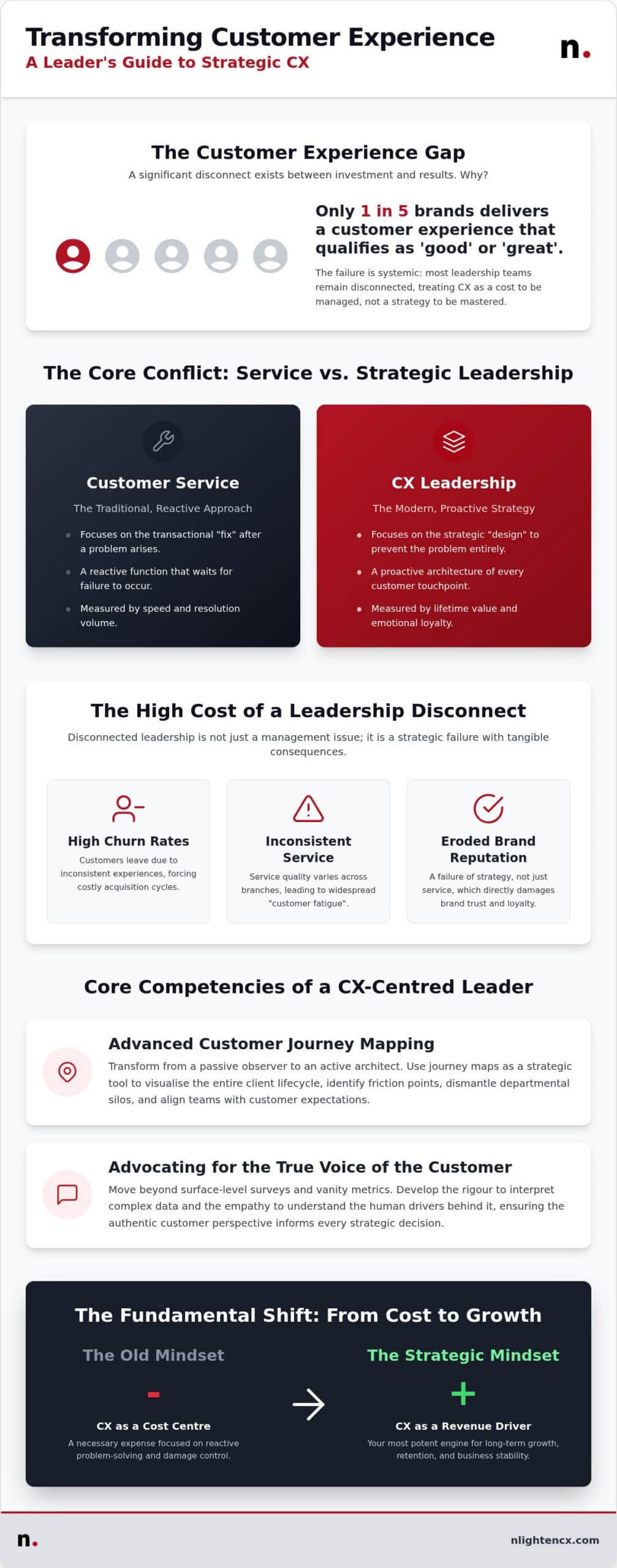
Only 1 in 5 brands delivers a customer experience that actually qualifies as good or great. Why does this gap persist despite millions spent on frontline training? Most organisations struggle because their leadership remains disconnected, viewing customer experience leadership training as a cost centre rather than a primary revenue driver. You’ve likely seen the results: high churn rates and inconsistent service quality that erodes your brand’s reputation across national branches. It’s a systemic failure of strategy, not just a service issue.
This guide provides the roadmap to fix it. Discover how to transform executive behaviour and organisational culture through strategic development that delivers measurable ROI. We promise to move you beyond basic service protocols toward a sophisticated framework for long-term profitability. By the end of this article, you’ll understand how to advocate for the True Voice of the Customer and position your leaders as strategic architects of loyalty. Explore the transition from reactive problem-solving to proactive experience design, ensuring your business remains stable and competitive through 2026. The path to retention starts at the top.
Key Takeaways
- Learn to distinguish between operational service and strategic CX leadership to ensure your organisation prioritises long-term customer retention over reactive fixes.
- Identify the most effective customer experience leadership training models by comparing intensive, results-oriented masterclasses with traditional academic certifications.
- Master the essential competencies of a CX-centred leader, including advanced Customer Journey Mapping to identify friction points and strengthen emotional connections.
- Implement a clear, step-by-step roadmap to assess your leadership team’s maturity and eliminate systemic friction points across national branches.
- Bridge the gap between theory and execution by integrating the True Voice Of Customer Program into your leadership development strategy to drive measurable ROI.
Beyond Customer Service: Defining Customer Experience Leadership Training in 2026
Service is a reactive function; it waits for a failure to occur. Experience is the proactive architecture of every touchpoint. Most organisations fail because they treat customer experience leadership training as a luxury for middle management. It is actually a survival requirement for the board. If your leaders don’t grasp a foundational understanding of customer experience, the frontline has no hope of delivering consistency. Leaders dictate the emotional temperature of the entire firm. When they see CX as a cost, the staff sees it as a burden. Don’t confuse politeness with strategy.
Why does traditional training fail to move the needle on retention? It’s because it focuses on scripts rather than strategy. A scripted apology doesn’t fix a broken journey. Only a strategic architect can do that. High-level customer experience leadership training empowers executives to dismantle silos and rebuild processes around the human being at the other end of the transaction. Consider these critical distinctions:
- Customer Service: Focuses on the transactional “fix” after a problem arises.
- CX Leadership: Focuses on the strategic “design” to prevent the problem entirely.
- Customer Service: Measured by speed and resolution volume.
- CX Leadership: Measured by lifetime value and emotional loyalty.
The Evolution of CX Leadership in South Africa
The 2026 South African market is unforgiving. High churn rates aren’t just statistics; they are symptoms of leadership fatigue. Businesses can no longer rely on reactive problem-solving to protect their market share in a hyper-competitive landscape. The shift toward proactive experience design requires a new breed of executive who understands that loyalty is earned through precision, not just politeness. This demand requires a fundamental shift in how we define executive roles. CX Leadership is the strategic alignment of people, processes, and perception.
The High Cost of Leadership Disconnect
What is the price of a disconnected executive? It manifests as “customer fatigue”, where clients grow weary of inconsistent service quality across national branches. This isn’t just an operational glitch; it is a strategic failure that directly impacts customer experience roi for businesses. Leaders who fail to advocate for the True Voice of the Customer will inevitably see profitability decline as acquisition costs outpace retention gains. Don’t let your leadership team view CX as a cost centre. It’s your most potent engine for long-term growth and business stability.
The Core Competencies of a CX-Centred Leader
Leadership isn’t defined by a title; it’s defined by the ability to influence the customer’s reality. Effective customer experience leadership training focuses on transforming executives from passive observers into active strategists. This shift requires a mastery of specific technical and emotional competencies that go far beyond managing a call centre. Leaders must develop the analytical rigour to interpret complex data whilst maintaining the empathy required to understand the human driver behind every transaction. It’s about moving from intent to execution.
Journey Mapping as a Leadership Tool
Why do so many CX initiatives stall? It’s usually because departments operate in isolation. A leader’s primary tool for dismantling these silos is the journey map. By visualising the entire lifecycle of a client, executives can identify exactly where friction occurs and who is responsible for fixing it. This isn’t just an operational exercise; it’s a strategic framework for growth. For those in complex sectors, understanding customer journey mapping for B2B provides a clear methodology for aligning internal teams with client expectations. Leaders who master this tool can predict churn before it happens.
Advocating for the True Voice of the Customer
Surface-level surveys often mask deeper systemic issues. Leaders must move beyond “vanity metrics” and learn to interpret the True Voice of the Customer. This involves organisational active listening, where feedback isn’t just collected but integrated into the boardroom decision-making process. High-level programmes like MIT Sloan’s Breakthrough CX Strategy emphasise that combining behavioural economics with leadership strategy is the only way to build sustainable loyalty. It’s about finding the “why” behind the “what” to drive real change. Decisions made in a vacuum rarely benefit the end-user.
Strategic resource allocation is the final piece of the puzzle. A CX-centred leader knows that every Rand spent on improving the experience must deliver a measurable return. They don’t just fund projects; they invest in emotional connections that drive lifetime value. If you’re ready to assess your current standing, taking a free CX quiz can highlight where your leadership team needs to focus next. True mastery requires the emotional intelligence to foster deep client connections whilst maintaining a relentless focus on the bottom line. It’s a delicate balance that separates the innovators from the also-rans.
Evaluating Training Models: Certifications, Masterclasses, and Strategic Advisory
Choosing the right customer experience leadership training is a strategic decision that affects your bottom line. Many organisations fall into the trap of purchasing generic, off-the-shelf video modules. Whilst these are convenient, they lack the accountability and contextual application required to transform executive behaviour. You aren’t just looking for a certificate; you’re looking for a shift in organisational culture. If the training doesn’t address the specific friction points of your business model, it won’t deliver the ROI you expect.
Academic diplomas offer theoretical foundations, yet they often move too slowly for the professional urgency of the 2026 market. Professional certifications provide individual validation but don’t necessarily align a leadership team toward a common goal. Similarly, high-cost global programmes offer prestige but often lack the specific nuances of the South African business landscape. Intensive, results-oriented masterclasses provide an environment where theory meets immediate execution. This format is designed for leaders who need to see a tangible impact on customer loyalty and profitability without waiting months for a curriculum to conclude.
Facilitated workshops provide the necessary “friction” for breakthroughs. You need a model that aligns with your organisation’s current CX maturity level. A bespoke approach outperforms generic courses because it allows for strategic resource allocation based on real data. Whether you are a national enterprise or a growing firm, the training must be tailored to your specific customer journey. Generic solutions produce generic results.
Masterclasses: The Fast-Track to Strategic Alignment
Executive teams don’t have months to study theory. They need solutions now. The customer experience leadership training delivered through an intensive CX Masterclass format facilitates immediate problem-solving for real-world issues. It creates a space for peer-to-peer learning amongst high-level leaders. This collective focus is what breaks down departmental silos and ensures every executive is pulling in the same direction. It positions the masterclass as the gold standard for those who value speed and strategic precision.
The Role of Ongoing Mentorship and Consulting
A single workshop is a catalyst, not a cure. Sustaining a culture of excellence requires more than a two-day event. This is where strategic advisory and consulting become essential. By building a long-term relationship with a CX partner, leaders receive the ongoing mentorship needed to navigate complex shifts in customer perception. It ensures that the principles found in the customer experience handbook for practitioners aren’t just read but are actively lived within the organisation. Strategic mastery is a marathon, not a sprint. Consistency is the only way to reduce churn and protect your market position.
Implementing a CX Leadership Roadmap within Your Organisation
Execution is where most strategies fail. A roadmap provides the structure needed to turn high-level theory into operational reality. Implementing customer experience leadership training isn’t a one-time event; it’s a phased deployment of new cultural norms. Start by assessing your current standing. Without a baseline, you cannot measure progress or justify the investment to stakeholders. Leaders must move beyond the “quick fix” mentality and commit to a structured path toward excellence.
Follow these four steps to build your internal roadmap:
- Step 1: Assess Maturity. Determine where your leadership team sits on the spectrum of CX awareness. Are they viewing it as a cost or a primary revenue driver?
- Step 2: Pinpoint Friction. Use journey mapping data to identify the specific moments where customer loyalty is won or lost across your national branches.
- Step 3: Align via Workshops. Organise cross-functional sessions to ensure every department head understands their specific role in the customer journey.
- Step 4: Quantify Impact. Link leadership behaviours directly to financial outcomes through clear, measurable KPIs.
Establishing CX Benchmarks
What metrics actually matter to an executive? Whilst the frontline might focus on resolution times, leaders must track Net Promoter Score (NPS), churn rates, and Customer Lifetime Value (CLV). These are the true indicators of business stability. It’s critical to distinguish between operational metrics and leadership KPIs. Operational data tells you what happened; leadership KPIs tell you why it will happen again. To establish an accurate baseline before your customer experience leadership training begins, use a free CX quiz to identify existing gaps in your strategy.
Fostering a Customer-Centric Culture
Cultural change is a top-down phenomenon. Leaders must model the behaviours they expect from their teams. If an executive ignores the True Voice of the Customer in the boardroom, the frontline will inevitably ignore it on the service floor. Maintain momentum by rewarding and recognising customer-centric actions across the firm. This isn’t about token gestures; it’s about embedding CX into the performance management system. Consistency is the only way to ensure the initial energy of training doesn’t dissipate into old habits. True transformation requires a relentless focus on the long-term emotional connection with your client base. Organisations that invest in customer service culture training alongside leadership development find it far easier to sustain these behavioural shifts across all levels of the business.
The nlightencx Approach: From Masterclasses to Strategic Mastery
nlightencx doesn’t just teach; we transform. Our methodology bridges the gap between academic theory and the daily realities of running a national South African organisation. We’ve seen how disconnected leadership leads to “customer fatigue”, and we’ve built a framework to reverse it. By integrating our signature True Voice Of Customer Program into our customer experience leadership training, we ensure that every strategic decision is rooted in real-world data rather than executive assumptions. It’s about replacing guesswork with precision.
Our approach is built on three pillars: research, training, and strategic advisory. We don’t believe in generic off-the-shelf modules that fail to move the needle on profitability. Instead, we provide the customer experience handbook for practitioners as a foundational resource, ensuring your team has a lifelong guide for maintaining professional standards. Case studies from our national clients show that when leadership alignment is achieved, churn rates drop and loyalty grows. You aren’t just buying a course; you’re investing in the sustainability of your business model.
Our Signature CX Masterclasses
The nlightencx CX Masterclass is the gold standard for South African leaders. We’ve designed a curriculum that specifically addresses local market challenges, focusing on the emotional connections that drive long-term profitability. It isn’t just about learning protocols; it’s about re-engineering behaviour to prioritise the human experience at every touchpoint. If you’re ready to invest in your team’s development, we encourage you to view our full training guide for a comprehensive look at our methodology and outcomes.
Strategic Advisory and Implementation Support
Learning ends in the classroom, but execution begins in the office. We don’t leave you to navigate the rollout phase alone. Our strategic advisory services provide the ongoing support leaders need to ensure their customer experience leadership training translates into measurable ROI. We tailor our CX Design and Journey Mapping services to your specific industry, ensuring your roadmap is both practical and persuasive. Whether you’re dealing with inconsistent service quality or high churn rates, our team acts as a necessary ally in a competitive landscape.
Start your journey toward excellence by identifying your organisation’s current friction points with a free CX assessment today. True leadership starts with the courage to see what’s wrong and the discipline to do it right. We help you move beyond reactive problem-solving toward a future where your brand is a bold innovator.
Leading the Future of Customer Experience
The transition from reactive customer service to strategic experience design is the defining challenge for leaders in 2026. You’ve seen how inconsistent quality across national branches isn’t just an operational failure; it’s a leadership disconnect that directly impacts your profitability. By mastering journey mapping and advocating for the True Voice of the Customer, you move beyond surface-level fixes toward sustainable growth. Investing in customer experience leadership training is the only way to ensure your executive team is aligned with the emotional drivers of your client base.
As an expert South African consultancy and the author of the CX Handbook, nlightencx provides the roadmap you need. Our proprietary True Voice of Customer Program ensures your strategy is backed by hard data, not assumptions. Don’t wait for churn rates to dictate your future. Enrol in an nlightencx Masterclass today to transform your leadership strategy and build a culture of excellence that lasts. Your path to strategic growth begins with a single, decisive step toward mastery.
Frequently Asked Questions
What is the difference between customer service and customer experience leadership?
Customer service is a reactive function that addresses failures after they occur. In contrast, CX leadership is the proactive architecture of the entire customer journey. It involves aligning people, processes, and perception at a strategic level. Whilst service teams follow protocols, leaders who undergo customer experience leadership training learn to design the emotional temperature of the organisation. This distinction is critical for businesses looking to move from transactional fixes to long-term strategic growth.
How long does it typically take to see results from CX leadership training?
Strategic alignment occurs immediately during an intensive CX Masterclass. However, measurable shifts in organisational culture typically manifest within three to six months. You’ll likely see improvements in internal flow and departmental collaboration first. Financial results, such as increased profitability or reduced acquisition costs, generally become evident within one full fiscal cycle. The speed of results depends heavily on how quickly the leadership team implements the roadmap and models new customer-centric behaviours.
Can CX leadership training help reduce our customer churn rate?
Yes, reducing churn is a primary objective of this development. High churn is often a symptom of disconnected leadership that views CX as a cost centre. By identifying core friction points through journey mapping, leaders can remove the systemic barriers that frustrate clients. Training ensures that every executive is an advocate for the True Voice of the Customer. This alignment creates a consistent experience that strengthens emotional connections and significantly improves long-term retention.
Is this training suitable for B2B organisations in South Africa?
Absolutely. B2B organisations in South Africa face unique complexities, such as multi-layered decision-making and long-term contract cycles. These environments require a more sophisticated approach to customer loyalty than retail models. Our training is specifically tailored to help B2B leaders manage these intricate relationships. By aligning your national leadership team, you ensure that service quality remains consistent across all branches, which is vital for maintaining professional trust in the South African business landscape.
What are the most important KPIs for a CX leader to track?
Leaders should focus on strategic metrics rather than operational volume. The most critical KPIs include Net Promoter Score (NPS), Customer Lifetime Value (CLV), and Churn Rate. Additionally, you should track the “Cost of Service Failure” to quantify the ROI of your CX initiatives. Effective customer experience leadership training teaches you how to link these metrics to executive performance. This ensures that the boardroom remains focused on the human drivers that dictate business stability and growth.
Do you provide on-site training for national leadership teams?
We provide comprehensive on-site training for leadership teams across South Africa. Our boutique consultancy is structured to offer national coverage, ensuring that your branch managers and executives receive consistent guidance regardless of their location. Facilitated workshops are often more effective than online modules because they allow for real-time problem-solving of specific business challenges. This hands-on approach is essential for building the professional urgency required to sustain a high-level corporate culture and drive results.
How does the True Voice of Customer program integrate with leadership training?
The True Voice Of Customer Program provides the empirical data required for effective leadership. It ensures that your strategic decisions are based on actual client perception rather than boardroom assumptions. During training, we teach leaders how to interpret this research and translate it into actionable design changes. This integration bridges the gap between raw data and executive execution. It empowers your team to become strategic architects who can confidently advocate for the customer’s needs.
What qualifications or resources are provided, such as the CX Handbook?
Every participant in our Masterclass receives the CX Handbook, which serves as a definitive resource for practitioners. This guide covers essential methodologies for journey mapping, research, and strategic design. Beyond the physical resources, we provide a structured roadmap for implementation and ongoing advisory support. These tools are designed to sustain the momentum of your customer service culture training and broader leadership development. You’ll gain the practical framework needed to lead your organisation toward a more profitable and customer-centric future.