

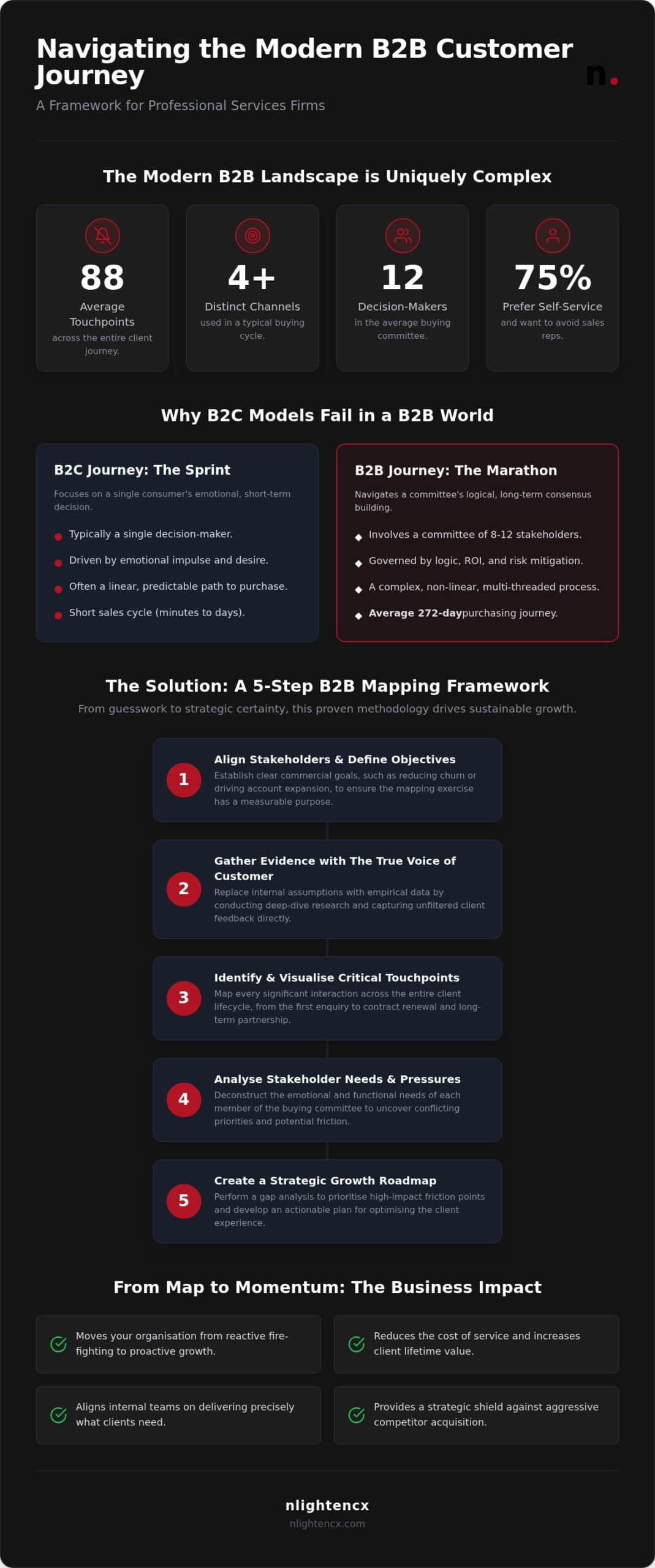
The average B2B customer journey now spans 88 touchpoints across four channels, yet most organisations are still trying to manage these relationships through a single, outdated lens. If your professional services firm is struggling with high churn or a lack of visibility into why clients are losing interest, you aren’t alone. You likely feel that the traditional sales funnel no longer reflects the reality of a buying cycle that now involves up to 12 different decision-makers. It’s a fragmented process. Effective customer journey mapping for B2B is no longer a luxury; it’s a strategic requirement for survival in a market where 75% of buyers would prefer to complete their purchase without ever speaking to a sales representative.
This case study will show you how to deconstruct these complex cycles and organise every interaction to drive sustainable profitability. We’ll explore a clear framework to visualise the client experience from the first touchpoint through to long-term retention. By the end of this guide, you’ll understand how to use the True Voice Of Customer Program to gather evidence and align your internal teams. We’ll demonstrate how strategic mapping serves as the essential precursor to high-level CX training, ensuring your organisation moves from reactive fire-fighting to proactive growth.
Key Takeaways
- Understand why standard retail models fail and how to use customer journey mapping for B2B to visualise complex, multi-layered professional relationships.
- Learn to navigate the multi-stakeholder buying committee by identifying the distinct emotional and functional needs of users, influencers, and decision-makers.
- Discover how to leverage the True Voice Of Customer Program to replace internal assumptions with empirical data during the evidence-gathering phase.
- Prioritise high-impact friction points using a strategic ROI framework to differentiate between minor nuisances and genuine threats to account stability.
- Develop a sustainable path to profitability by integrating continuous feedback loops and professional team training through CX Masterclasses.
The Unique Complexity of Customer Journey Mapping for B2B Organisations
Customer journey mapping for B2B is not merely a flowchart of digital touchpoints. It is the strategic visualisation of a multi-layered relationship. In the professional services sector, where contracts span years rather than minutes, the path to purchase is rarely linear. Whilst B2C mapping often focuses on the emotional impulse of a single consumer, the B2B landscape is governed by logic, risk mitigation, and consensus. If you apply retail-style mapping to a corporate environment, you’ll miss the structural nuances that actually drive a deal.
Why do traditional B2C techniques fail here? They ignore the sheer scale and duration of the decision-making process. The average B2B journey now takes 272 days, according to recent industry data. It’s an asynchronous, multi-threaded marathon. Research highlights that these purchases now involve between 8 and 12 members of a buying group. You aren’t selling to a person; you’re selling to a committee of users, influencers, and gatekeepers. At nlightencx, we define the “True Voice” within this journey by identifying the friction points that affect each stakeholder differently. A solution that delights the end-user might be a technical nightmare for the gatekeeper. Strategic mapping exposes these contradictions before they lead to churn.
The Shift from Transactional to Relationship Mapping
Professional services demand a transition from transactional thinking to a long-term partnership lifecycle. The sale is just the beginning. In this environment, the emotional connection is built on reliability and consistent service quality. If the experience drops off after the contract is signed, the relationship withers. Mapping allows you to see beyond the point of sale, ensuring that every interaction reinforces the client’s decision to stay. It’s about securing future revenue through current excellence. Consistent behaviour across all touchpoints is what separates a vendor from a trusted partner.
The Business Case for Mapping in the South African Market
How does this apply to the national South African landscape? Competition is fierce. In a market where aggressive competitor acquisition is the norm, journey mapping acts as a strategic shield. It provides the clarity needed to identify exactly where clients are losing interest. When you understand the specific behaviours that lead to account expansion or contraction, you can align your internal teams to deliver exactly what the client needs. This alignment isn’t just about morale; it’s about organisational profitability. A clear map reduces the cost of service and increases the lifetime value of every professional relationship. It’s the essential first step before committing to high-level CX Masterclasses or structural changes.
A Case Study in Precision: The nlightencx B2B Mapping Methodology
Precision in customer journey mapping for B2B requires moving beyond generic templates. It’s a five-step discipline designed to replace guesswork with strategic certainty. Without a rigorous methodology, mapping becomes a creative exercise rather than a commercial one. To drive growth, your map must be rooted in the hard reality of your client’s operational environment.
- Step 1: Align stakeholders to define the commercial objective, whether it’s reducing churn or driving account expansion.
- Step 2: Conduct deep-dive research using the True Voice Of Customer Program to gather unfiltered client feedback.
- Step 3: Identify critical touchpoints across the entire lifecycle, from the initial enquiry to long-term contract renewal.
- Step 4: Analyse the emotional arc of the decision-making unit to understand the conflicting pressures on different stakeholders.
- Step 5: Perform a gap analysis to create a strategic roadmap that fixes friction points and drives sustainable growth.
Phase One: Gathering Authentic Client Insights
Internal assumptions are the primary obstacle to account stability. Your sales team might believe a client is satisfied whilst the procurement department is already vetting competitors. We solve this by using the True Voice Of Customer Program to capture empirical evidence directly from the client’s perspective. This evidence-gathering phase is critical for effective customer journey mapping for B2B, ensuring we don’t just hear what we want to hear; we hear what the client actually experiences. Multidisciplinary research ensures that every department’s perspective is validated against actual client behaviour.
Phase Two: Visualising the Complex Interaction Web
Visualising the B2B interaction web involves organising touchpoints into four distinct stages: Awareness, Evaluation, Onboarding, and Growth. This isn’t a static chart. It’s a living document that identifies “Moments of Truth,” those specific interactions where loyalty is either solidified or shattered. In a professional services context, a moment of truth might be the transition from a sales representative to a project manager. When you visualise these stages, you can see where the ball is being dropped between departments. This clarity allows your teams to execute with a unified purpose. If you’re unsure where your current client relationships stand, taking a Free CX Quiz can provide a necessary baseline before you begin the mapping process.
Analysing the Multi-Stakeholder Buying Committee
The B2B buying committee is a labyrinth of competing priorities. You aren’t just selling to a single point of contact; you’re navigating a group of 8 to 12 individuals, each with their own definition of success. If your customer journey mapping for B2B doesn’t account for these distinct personas, your strategy will fail at the first sign of internal friction. How do you reconcile these differences? It requires a unified brand experience that speaks to every role simultaneously. This is where CX research South Africa becomes indispensable. It allows you to move beyond generic personas and understand the specific cultural and operational nuances of the national market.
- The User: Focuses on functionality, daily ease of use, and technical reliability.
- The Influencer: Shapes requirements and compares your solution against industry benchmarks.
- The Decision-Maker: Prioritises commercial ROI, long-term sustainability, and strategic alignment.
- The Gatekeeper: Procurement or legal teams tasked with risk mitigation and budget compliance.
Synchronising the journey for these diverse roles ensures that no stakeholder feels ignored. When you map conflicting needs within a single client organisation, you identify the exact moments where a “yes” from a user might be met with a “no” from procurement. Addressing these gaps early prevents deals from stalling in the final stages. It’s about building a narrative of reassuring expertise that satisfies the sceptic whilst empowering the advocate.
Mapping the Evaluation and Trust Building Phase
B2B buyers are increasingly self-sufficient. In fact, 75% of buyers prefer to complete their entire journey without ever speaking to a sales representative. They are self-educating through your digital touchpoints long before you’re even aware of their interest. Recent data shows that the average buyer completes 57% of the decision-making process before engaging a supplier. This makes consistent messaging across every channel vital. Your authoritative content must act as a silent consultant, building trust through strategic advisory and proven results. If your digital presence lacks depth, you’ll be eliminated before the first meeting is even booked.
Overcoming the “Consensus Gap” in B2B Sales
Buyers spend only about 17% of their total buying time meeting with potential suppliers. The rest of that time is spent in internal discussions, trying to reach a consensus. Your job is to provide the internal champion with the tools they need to sell your solution upwards. This means identifying touchpoints that reduce friction during the procurement and legal stages. Use your journey data to anticipate the concerns of Gatekeepers. By providing clear, risk-mitigated documentation and transparent ROI frameworks, you bridge the consensus gap. This proactive approach shortens a buying cycle that, whilst dropping to 10.1 months in 2026, still requires immense patience and precision to navigate successfully.
From Map to Momentum: Identifying High-Impact Friction Points
Identifying friction points is the primary diagnostic function of any strategic map. However, not all friction is created equal. To protect your bottom line, you must distinguish between a minor “Nuisance” and a “Relationship-Ending” failure. A nuisance might be a slightly delayed response to a non-critical enquiry. A relationship-ending failure is a breakdown in core service delivery that violates the client’s trust. To ensure your interventions drive growth, apply the customer experience roi for businesses framework to prioritise your fixes. This allows you to allocate resources where they will have the most significant impact on account expansion and stability.
Customer journey mapping for B2B often exposes “Silent Killers.” These are the subtle inconsistencies that drive churn without ever triggering a formal complaint. Lack of proactivity is a prime example. If your team only reacts when a client reaches out, you’ve already lost the strategic high ground. A rigorous customer touchpoint analysis helps you systematically evaluate every interaction to uncover these hidden emotional gaps before they escalate into account losses. You can validate these findings through a comprehensive customer experience audit for businesses. This audit provides the empirical data needed to turn a visual map into a practical roadmap for change, ensuring your strategy is rooted in operational reality rather than internal optimism.
The Onboarding Critical Window
The first 90 days of a B2B relationship are the most volatile. This is the window where the “Value Promise” made during the sales cycle is tested. If the transition from the sales team to account management is fragmented, trust evaporates instantly. Mapping this handoff ensures that the client feels the momentum of their decision immediately. It prevents buyer’s remorse and sets the stage for long-term loyalty. When onboarding is seamless, it establishes a baseline of reliability that carries the relationship through future challenges.
The Role of Technology in Scaling the Human Touch
Technology should scale the human touch, not replace it. CRM systems and CX tools are essential for monitoring journey health in real-time, but personal behaviour remains the ultimate differentiator in professional services. Use automation for the routine, but ensure your team is trained to handle the complex, emotional drivers of your client base. To understand where your organisation stands before implementing these tools, taking the nlightencx CX Quiz is an essential baseline step. It identifies whether your internal culture is ready for the shift toward a client-centric model.
Is your organisation ready to reduce churn and secure its future? Assess your organisational readiness with our professional CX strategy services.
Optimising the B2B Journey for Long-Term Loyalty
A static map is a liability. Why? Because the B2B landscape is in a state of constant flux, with buyer behaviours shifting as rapidly as the technology they use. To maintain a competitive edge, customer journey mapping for B2B must transition from a one-off project into a strategic habit. It requires the implementation of a continuous feedback loop through the voice of customer program South Africa organisations rely on to convert raw sentiment into actionable intelligence. This ensures that your map remains an accurate reflection of the client’s current reality rather than a historical record of what once worked. When you measure success through reduced churn and increased referrals, the commercial value of this habit becomes undeniable.
Execution is where most strategies fail. You can have the most precise map in the world, but if your teams aren’t equipped to deliver on it, the exercise is futile. This is why we prioritise professional development through CX Masterclasses. These sessions bridge the gap between high-level theory and daily operational behaviour. They empower your staff to recognise the “Moments of Truth” identified in your mapping and act with the necessary authority to secure the relationship. Training transforms the map from a document on a wall into a living culture of excellence. To ensure you select a programme that delivers measurable results rather than generic theory, our customer experience management training buyer’s guide provides the strategic framework needed to evaluate and choose the right development investment for your organisation.
Driving Expansion and Advocacy
How do you move a client from mere satisfaction to active advocacy? It starts by mapping the path to expansion. A well-mapped journey identifies specific triggers for upsell and cross-sell opportunities that feel like natural progressions rather than forced sales pitches. When you understand the client’s lifecycle, you can anticipate their needs before they even articulate them. This level of service doesn’t just increase lifetime value; it significantly reduces the cost of acquisition for new clients through high-quality referrals. Advocacy is the ultimate proof that your journey is optimised for long-term loyalty.
Your Strategic Roadmap to CX Maturity
Moving from visualisation to organisational transformation requires a clear roadmap. Are you ready to lead this change? Assessing your current position with the nlightencx CX Handbook for practitioners provides the framework needed to guide your team through the complexities of CX maturity. Leadership buy-in is non-negotiable. Without a commitment from the top, journey optimisation remains a departmental initiative rather than a core business strategy. Your next steps involve taking the insights gained from customer journey mapping for B2B and embedding them into every process, policy, and person within the organisation. This is the path to sustainable growth and undisputed market leadership.
Securing Your Strategic Advantage Through CX Maturity
The complexity of the modern B2B buying group won’t decrease. With cycles extending and stakeholders multiplying, the only way to ensure sustainable growth is to replace guesswork with empirical evidence. We’ve seen how deconstructing the multi-layered client relationship allows you to identify the “Silent Killers” of loyalty before they impact your revenue. Effective customer journey mapping for B2B isn’t just a visualisation exercise; it’s a commitment to understanding the True Voice of your client through specialised research.
By aligning your internal teams and addressing high-impact friction points, you move from reactive fire-fighting to proactive account expansion. As trusted CX advisors to national organisations, we provide the True Voice Of Customer methodology and expert-led Masterclasses needed to turn data into a strategic roadmap. It’s time to move beyond the map and start delivering consistent excellence across every touchpoint. For a deeper understanding of how to structure this process, our guide to mapping customer interactions provides the actionable framework needed to turn fragmented data into decisive leadership.
Begin your journey to CX excellence with nlightencx consulting and secure the long-term stability your business needs to thrive. You have the tools; now it’s time to lead the way.
Frequently Asked Questions
What is the primary difference between B2B and B2C customer journey mapping?
B2B mapping focuses on the multi-layered relationship rather than a single impulse purchase. Whilst B2C journeys are often emotional and rapid, customer journey mapping for B2B accounts for 8 to 12 decision-makers across a cycle that can exceed 270 days. The primary distinction lies in the complexity of stakeholder needs. You aren’t just mapping a transaction; you’re mapping a consensus-driven partnership. This requires structural alignment and risk mitigation across various corporate departments.
How long does a typical B2B customer journey mapping project take to complete?
A comprehensive mapping project typically requires four to twelve weeks to complete. This timeline accounts for the evidence-gathering phase, where we utilise the True Voice Of Customer Program to collect authentic client insights. Speed depends on the complexity of your organisational structure and the availability of stakeholders for alignment workshops. Rushing the process often results in a map based on internal assumptions rather than empirical data, which compromises the strategic value of the final roadmap.
Who should be involved in the journey mapping process within a B2B firm?
Success requires a multidisciplinary team representing every stage of the client lifecycle. You should involve senior leaders from sales, marketing, customer service, and operations to ensure a unified perspective. Including frontline staff is equally vital as they witness daily friction points that executives might overlook. This collaborative approach ensures internal alignment on client needs and prevents the siloed thinking that often leads to inconsistent service delivery and increased account churn.
Can customer journey mapping really help reduce customer churn in professional services?
It directly addresses churn by exposing the “silent killers” of client loyalty. By identifying exactly where professional services clients lose interest or experience friction, you can implement proactive fixes before they seek a competitor. Mapping provides the clarity needed to transition from reactive problem-solving to a strategic, relationship-focused model. This visibility allows teams to deliver the reassuring expertise that B2B stakeholders demand, significantly strengthening account stability and driving long-term profitability.
How often should a B2B organisation update its customer journey map?
Organisations should treat their map as a living document and update it at least annually. You must also revisit the journey after significant shifts, such as launching a new service or entering a different market segment. Regular reviews ensure your strategy remains relevant to current buyer behaviours. Treating customer journey mapping for B2B as a strategic habit rather than a one-off project allows your firm to maintain agility in a competitive landscape. It’s about staying ahead of the curve.
What data sources are required to create an accurate B2B journey map?
Accurate maps require a blend of qualitative and quantitative data. You should integrate CRM interaction logs and service metrics with direct feedback from the voice of customer program South Africa businesses use to unify fragmented sentiment data into strategic intelligence. Internal interviews with sales and service teams provide context, but they must be validated against actual client perceptions. Relying solely on internal data is a common mistake; you need empirical evidence of how stakeholders experience your brand to identify genuine friction points and opportunities for growth.
How do we measure the ROI of a customer journey mapping initiative?
You measure ROI by tracking specific commercial outcomes linked to the mapping initiative. Key metrics include a measurable reduction in churn rates, an increase in account expansion revenue, and a higher volume of qualified referrals. Additionally, look for improvements in internal efficiency as teams align around a clear framework. When you reduce the cost of service whilst increasing the lifetime value of each client, the financial case for strategic journey optimisation becomes indisputable.
Is journey mapping suitable for small B2B companies or only large organisations?
Journey mapping is essential for organisations of all sizes. Whilst large corporations use it to manage vast stakeholder groups, smaller B2B firms benefit from the extreme clarity it provides for limited resources. If you have fewer staff, you can’t afford to waste energy on the wrong touchpoints. Mapping ensures that every interaction counts. It provides small businesses with a professional framework to compete against larger rivals by delivering a more synchronised and personal client experience.