

Most businesses don’t actually lose customers during a transaction. They lose them in the silent, unexamined spaces between those transactions where expectations meet reality and fail. If you’re struggling with high churn without a clear cause, your current approach to customer touchpoint analysis is likely missing the emotional gaps that drive behaviour. It’s not enough to simply list where you talk to people. You must understand the psychological weight of those interactions and how they influence the long-term health of your professional relationships.
You’ve likely felt the frustration of inconsistent service quality across departments or the difficulty of proving the ROI of your CX initiatives to a sceptical board. It’s a common challenge that threatens business stability in an increasingly competitive landscape. This guide provides a strategic framework to systematically evaluate every interaction, allowing you to eliminate friction and foster genuine loyalty. We’ll explore how to build a clear map of your entire customer ecosystem and establish a structured way to prioritise the investments that drive measurable growth for 2026. By the end of this article, you’ll have the tools to transform fragmented data into a cohesive strategy for sustainable success.
Key Takeaways
- Recognise why customer touchpoint analysis serves as the fundamental DNA of your organisation’s experience. It provides the essential building blocks for every client journey.
- Shift your perspective. Categorise interactions according to the customer’s logic rather than your internal organisational chart.
- Identify the critical “Moments of Truth” where lasting brand opinions are formed. Use the Peak-End Rule to influence customer behaviour.
- Execute a systematic two-step process for inventorying every contact point and mapping the reality of the customer experience across all departments.
- Translate analytical insights into strategic growth by fostering team buy-in and driving meaningful organisational change.
What is Customer Touchpoint Analysis? Defining the Foundation of CX
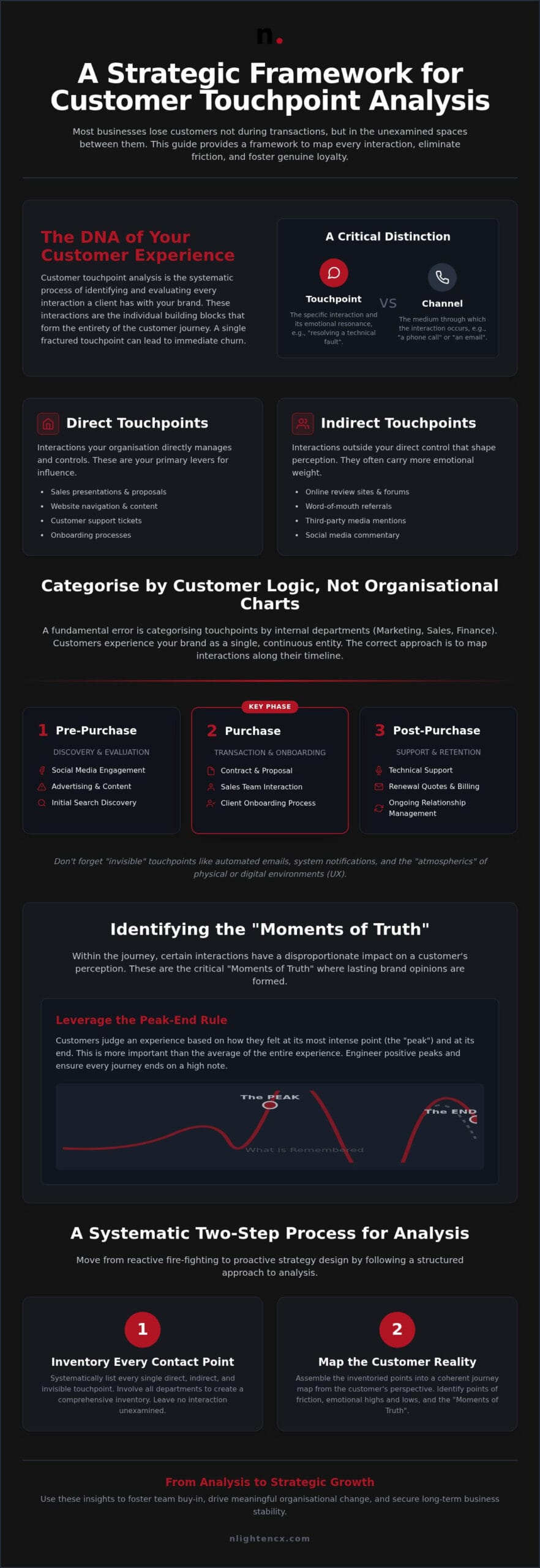
Customer touchpoint analysis is the systematic process of identifying and evaluating every interaction a client has with your brand. Think of these interactions as the DNA of your customer experience. They are the individual building blocks that, when combined, form the entirety of the customer journey. Every interaction is a pulse check on your brand’s health. By 2026, the margin for error in professional services will have vanished. In this hyper-competitive landscape, a single fractured touchpoint can lead to immediate churn. If a customer encounters friction during a billing query or finds your onboarding process opaque, they won’t wait for you to fix it; they will simply leave.
Organisations often confuse “touchpoints” with “channels”. This is a strategic error that leads to wasted investment. A channel is the medium, such as a phone call, an email, or a LinkedIn message. The touchpoint is the specific interaction that occurs within that medium, such as “receiving a renewal quote” or “resolving a technical fault”. Confusing the two leads to a focus on technology rather than human behaviour. True customer touchpoint analysis looks past the screen or the handset to examine the emotional resonance of the exchange itself.
The Strategic Importance of Analysing Interactions
Effective analysis is the bridge to achieving customer experience roi for businesses. Without it, you are operating with significant blind spots. You might see a drop in retention rates but lack the granular data to understand which specific moment caused the disconnect. By conducting a thorough customer touchpoint analysis, you move from reactive fire-fighting to proactive strategy design. You stop guessing where the friction lies. Instead, you start engineering moments of clarity that secure long-term business stability. Data is useless without this context.
Direct vs. Indirect Touchpoints
Not all interactions occur within your direct control, yet all influence the final outcome. Direct touchpoints are those your organisation manages, such as sales presentations, website navigation, and support tickets. These are your primary levers for influence. Indirect touchpoints include review sites, word-of-mouth, and third-party mentions. Whilst you cannot control these entirely, you must account for them in your framework. Indirect interactions often carry more emotional weight because they are perceived as more authentic. A single negative review on an industry forum can negate months of polished marketing effort if your internal processes aren’t aligned to handle the fallout.
Categorising Your Customer Interactions: From Digital to Physical
Most organisations make a fundamental error: they categorise interactions according to their internal organisational chart. Marketing owns social media; sales owns the contract; finance owns the invoice. This approach is flawed because customers do not experience your brand in silos. They see a single, continuous entity. To perform a truly effective customer touchpoint analysis, you must categorise interactions based on the customer’s logic and timeline. This requires a shift in perspective that moves away from departmental boundaries and toward the lived experience of the client.
We utilise a temporal framework to organise these points: Pre-purchase, Purchase, and Post-purchase. Within this structure, you must also identify “invisible” touchpoints. These are the functional interactions that often fall through the cracks, such as automated billing cycles, system-generated delivery notifications, or password reset emails. Whilst these feel like background noise to your operations team, they are significant moments of interaction for the customer. If an automated invoice is confusing or a notification is delayed, it creates friction that erodes trust. You must also distinguish between “Atmospherics” in physical environments and “User Experience” (UX) in digital ones. Is your reception area professional and welcoming? Is your client portal intuitive? Both require equal strategic scrutiny. A structured approach to mapping customer interactions ensures that these invisible touchpoints are captured and evaluated alongside your more visible contact points.
Pre-purchase: The First Impression
This phase is defined by discovery and evaluation. It encompasses social media engagement, advertising, and initial search discovery. You must assess the clarity and emotional resonance of these early-stage interactions. Are you projecting authority or merely adding to the noise? To understand what truly drives initial interest in a local context, robust CX research South Africa is essential. It allows you to move beyond assumptions and base your pre-purchase strategy on verified customer behaviour and expectations.
Post-purchase: The Loyalty Engine
The sale is not the conclusion of the journey; it is the commencement of the relationship. The onboarding phase is arguably the most critical touchpoint for long-term retention. Any perceived drop in quality during the transition from sales to service creates immediate “buyer’s remorse”. To prevent this, organisations should implement a customer experience handbook for practitioners to standardise behaviour across all service teams. This ensures that the promise made during the sales process is actually delivered during the service phase. Unsure if your current journey is meeting these standards? You can take our Free CX Quiz to assess your organisational maturity.
Identifying the Moments of Truth Within Your Organisation
Not all interactions carry the same weight. Whilst your initial customer touchpoint analysis might reveal dozens of contact points, only a handful will determine whether a client remains loyal or seeks a competitor. These are your “Moments of Truth”. They are the specific instances where a customer forms a lasting, often irreversible, opinion of your brand. Are you equipped to identify them before they result in churn? If you treat every interaction with equal priority, you risk exhausting your resources on trivialities whilst neglecting the points that actually drive retention.
To understand these moments, you must apply the Peak-End Rule. This psychological principle suggests that people judge an experience largely based on how they felt at its peak and its end. If your final delivery is delayed or cold, it will overshadow weeks of excellent preliminary work. Your analysis must distinguish between “hygiene factors” and “delight factors”. Hygiene factors are the functional necessities: the invoice must be accurate; the phone must be answered. If these fail, you lose the customer. However, getting them right doesn’t build loyalty. Loyalty is forged through delight factors, the proactive insights and personal touches that exceed expectations and prove your value as a strategic partner.
The Emotional Connection in Service Design
Efficiency is a baseline, not a strategy. A logic-driven customer touchpoint analysis often focuses on speed and accuracy, yet it misses the underlying emotional resonance. How does a client feel after speaking with your support team? Do they feel empowered or merely processed? Measuring the “feeling” of a touchpoint requires qualitative depth, often achieved through our True Voice Of Customer Program. A strong emotional connection acts as a psychological buffer that protects your brand from the fallout of occasional service failures. It creates the grace period you need to rectify mistakes without losing the client’s trust.
Friction Points vs. Value Drivers
Before you can innovate, you must repair. Friction points are “pain points” where the customer is forced to exert unnecessary effort to achieve their goal. Conversely, value drivers are the interactions that justify a premium price and differentiate you from the market. You must prioritise fixing friction before attempting to design new “delight” moments. A customer will not appreciate a personalised gift if your basic service delivery is consistently flawed. Focus on your organisation’s stability by securing the foundation first. Our CX Masterclasses are specifically designed to equip your teams with the skills to navigate these friction points and turn them into opportunities for growth.
How to Organise a Systematic Touchpoint Analysis: A Step-by-Step Guide
Execution is the ultimate differentiator. Many leaders understand the theory of interaction, yet they fail to implement a rigorous customer touchpoint analysis that actually changes organisational behaviour. To move from abstract concepts to measurable results, you must follow a structured methodology that leaves no room for departmental ambiguity. Stability is built on the precision of your process.
- Step 1: Inventory. Collate every possible point of contact across all departments, from marketing collateral to final debt collection letters.
- Step 2: Experience Mapping. Walk the path of the customer whilst documenting the reality of each interaction. Don’t rely on your internal assumptions; witness the friction firsthand.
- Step 3: Impact Assessment. Rank touchpoints based on their influence on the final purchase decision. Focus your resources where they will yield the highest return.
- Step 4: Gap Analysis. Compare the intended experience with the actual customer feedback. Where is the disconnect between your promise and their reality?
- Step 5: Action Plan. Assign ownership for each touchpoint to ensure accountability. A touchpoint without an owner is a failure waiting to happen.
Gathering the Right Data
Validating your internal map requires more than just guesswork. You must employ sophisticated customer experience research methodologies to ensure your data reflects the client’s reality. Combine quantitative metrics like NPS with qualitative “deep dives” that uncover the psychological drivers behind the numbers. Crucially, interview your frontline staff. They manage these touchpoints daily and often possess the most accurate insights into where your processes are failing and where customers are becoming frustrated.
Mapping Interactions Across Channels
In a world of fragmented communication, omni-channel consistency is non-negotiable. Does your brand sound the same on WhatsApp as it does in a boardroom presentation? A fractured voice suggests a fractured organisation. For those managing complex sales cycles, a customer journey mapping for B2B approach is essential to visualise how different touchpoints interact over months or years. This visual map becomes a powerful tool for aligning internal stakeholders and securing the budget for necessary improvements. Ready to transform your insights into a competitive advantage? Contact our team to begin your CX Strategy development.
Beyond Analysis: Turning Touchpoint Insights into Strategic Growth
Data alone doesn’t change a business. A customer touchpoint analysis is merely a diagnostic tool; the cure lies in organisational evolution. If your leadership team doesn’t champion a customer-first culture based on these findings, the analysis will simply gather dust. You must integrate these insights into your broader CX strategy and design to ensure every interaction reflects your brand’s standards. Professional urgency is required here. A strategic partner knows that insights are only as valuable as the actions they trigger. To translate your findings into a high-revenue engine, investing in customer journey optimization services provides the structured framework needed to align every interaction with both customer emotion and business logic. Unsure where your organisation stands? Take our Free CX Quiz to benchmark your current maturity and identify the gaps that require immediate attention.
Training for Touchpoint Excellence
Identifying a fractured interaction is easy; fixing it requires skilled execution. Staff need professional CX Masterclasses to execute the redesigned touchpoints effectively. There’s often a significant gap between “knowing” what is wrong and “doing” what is right at the frontline. Training provides the necessary bridge. It reduces the variability of service quality across your organisation, ensuring that a client receives the same high standard of care regardless of which department they contact. Consistency is the foundation of trust. Without a standardised approach to behaviour, your touchpoint map is just a piece of paper.
Continuous Optimisation and the True Voice of Customer
Markets shift and customer expectations evolve. A customer touchpoint analysis is not a “one-and-done” project but a continuous cycle of refinement. You must establish a permanent mechanism to monitor these interactions. Our True Voice Of Customer Program allows you to maintain an ongoing pulse on the emotional resonance of every contact point. This proactive approach ensures you detect friction before it leads to churn, allowing for strategic adjustments in real-time. It moves your organisation away from guessing and toward a logic-driven model of sustainability.
Are you ready to transform your customer interactions from fragmented points of contact into a cohesive engine for growth? To secure your business stability and foster deep loyalty amongst your client base, you must take the next step. Enrol in our next CX Masterclass to gain the strategic framework your business requires for 2026.
Securing Your Competitive Advantage Through Strategic Interaction
Mastering customer touchpoint analysis is no longer a luxury for businesses seeking stability; it’s a foundational requirement for the 2026 landscape. By shifting your perspective from internal silos to the customer’s lived logic, you can identify the Moments of Truth that define your brand’s reputation. We’ve explored how a systematic inventory and a commitment to emotional intelligence allow you to bridge the gap between service delivery and client expectation. This process requires more than just raw data. It demands a cultural shift led by authoritative expertise and a relentless focus on logic-driven results.
As a True Voice of Customer Program specialist, we provide the tools necessary for this transformation. Whether you utilise our authoritative CX Handbook for practitioners or enrol your staff in our expert CX Masterclasses for national corporate teams, the path to strategic growth is clear. It’s time to move beyond reactive fixes and toward a proactive strategy that secures your professional relationships. Benchmark your business today with our Free CX Quiz and begin the journey toward excellence. You have the framework; now it’s time to lead with confidence.
Frequently Asked Questions
What is the difference between a customer touchpoint and a customer journey?
A touchpoint represents a single, specific moment of interaction between a client and your brand. In contrast, a customer journey is the end-to-end sequence of these moments from initial discovery to long-term advocacy. Think of touchpoints as the individual frames in a film, whilst the journey is the complete narrative. Effective customer touchpoint analysis requires you to examine these frames in isolation to ensure each one contributes to a seamless and persuasive overall story.
How many touchpoints should a business typically analyse?
There is no universal number, as complexity varies by industry. However, focus on identifying the “Moments of Truth” rather than listing every trivial contact. Most organisations find that whilst they may have over 100 potential interactions, only 10 to 15 truly dictate the customer’s final decision. Prioritise these high-impact points first. Analysing too many at once leads to operational paralysis and dilutes your ability to execute meaningful strategic changes.
Can touchpoint analysis help reduce customer churn?
Yes, it’s one of the most effective ways to combat high churn rates. By systematically identifying friction points, you can intervene before a customer’s frustration becomes terminal. Churn often happens in the silent gaps between transactions where expectations aren’t met. A rigorous customer touchpoint analysis reveals these vulnerabilities, allowing you to strengthen the emotional bond and secure the business stability required for sustainable growth in a competitive market.
Is touchpoint analysis relevant for B2B companies in South Africa?
It is critical for South African B2B firms dealing with complex sales cycles and multiple stakeholders. In the B2B sector, professional relationships are the primary currency. A single fractured interaction with a technical support team or a confusing billing process can jeopardise a multi-million rand contract. Analysis ensures that every department is aligned with your brand promise, protecting your reputation amongst local industry peers and fostering the deep loyalty necessary for long-term success.
What tools are needed to perform a touchpoint analysis?
You don’t need expensive software to begin. Visualisation tools like Miro or Lucidchart are excellent for mapping, whilst data collection requires a robust True Voice Of Customer Program. The most important tool is a structured methodology that involves both quantitative metrics and qualitative deep dives. Avoid the mistake of relying solely on CRM data. You must combine hard statistics with the lived reality of your customers to gain a complete and actionable picture.
How often should we update our customer touchpoint map?
Your map should be a living document, not a static file. Review your analysis at least once a year or whenever you introduce a new product, channel, or service process. Markets evolve and customer expectations shift rapidly; a map from two years ago is likely obsolete today. Regular audits ensure your strategy remains relevant and that your teams are always trained to handle the most current version of the customer experience.
How do we measure the success of touchpoint improvements?
Success is measured through a combination of leading and lagging indicators. Monitor changes in Net Promoter Score (NPS) and Customer Satisfaction (CSAT) for immediate feedback on specific interactions. For long-term business impact, track your customer retention rates and the overall ROI of your CX initiatives. If your improvements are effective, you should see a measurable reduction in service costs and a significant increase in the lifetime value of your professional relationships.
What is the most common mistake in touchpoint analysis?
The most frequent error is mapping interactions based on your internal organisational chart rather than the customer’s logic. Customers don’t care which department owns a specific process; they only care about the quality of the interaction. When you map by department, you miss the handovers where most friction occurs. Always walk the path of the customer. Ensure your analysis reflects their reality, not your internal convenience, to drive genuine strategic growth.