

Most organisations treat customer feedback as a post-mortem rather than a preventative measure, effectively watching their revenue leak away whilst they wait for the next quarterly report. It’s a costly mistake. If your budget is being swallowed by research that yields no actionable insight, you’re not just wasting money; you’re losing market share. Adopting the right customer experience research methodologies is no longer a luxury for the few, but a survival requirement for any South African business aiming for long-term stability and professional growth.
You’ve likely felt the frustration of having plenty of data but no clear picture of why customers are leaving. This article provides the strategic framework you need to bridge that gap. We’ll examine how to transform raw feedback into a robust strategy that aligns emotional needs with your bottom line. From selecting the correct research tools to dismantling data silos, you’ll gain a clear path toward ensuring every Rand spent on research translates into increased loyalty and high-level profitability.
Key Takeaways
- Shift your focus from vanity metrics to the systematic study of customer behaviour to safeguard your revenue and mitigate churn.
- Master the selection of advanced customer experience research methodologies to ensure your data collection aligns perfectly with your specific business objectives.
- Implement a mixed-methods approach that balances quantitative data with qualitative insights to understand the emotional drivers behind customer loyalty.
- Use the Free CX Quiz to evaluate your current organisational maturity and identify the friction points preventing a seamless customer journey.
- Build a robust implementation roadmap that transforms research insights into a high-performance culture and sustainable profitability.
Why Strategic Customer Experience Research Methodologies Matter
Research is not a luxury; it’s a diagnostic requirement. Many organisations view feedback as a series of scores to be reported in board meetings, yet they fail to understand the underlying drivers of those numbers. True customer experience research methodologies involve the systematic study of human perception and behaviour at every touchpoint. It’s about moving beyond the surface to understand why a customer chooses your competitor despite your competitive pricing. Without this level of rigour, you’re essentially steering a ship in the dark, hoping the lighthouse is where you think it is.
Are you chasing vanity metrics or strategic insights? A high Net Promoter Score might look impressive on a slide deck, but it’s meaningless if your market share is shrinking. Strategic insights provide the context that numbers lack. They reveal the “why” behind the “what.” In the South African market, where consumer loyalty is increasingly fragile, relying on anecdotal feedback or gut feel is a high-risk strategy that invites disaster. Sophisticated research ensures your business remains sustainable by aligning your internal operations with the actual reality of the Customer Experience (CX).
The High Cost of Customer Churn
Retention is the engine of profitability in 2026. It’s far more cost-effective to keep an existing client than to acquire a new one in a crowded marketplace. Research identifies the specific friction points, such as complex onboarding or inconsistent service delivery, that lead to customer defection. Churn is a direct consequence of unaddressed customer pain points. By using rigorous customer experience research methodologies, you can spot these issues before they result in a lost contract or a closed account.
Research as a Risk Mitigation Tool
Data allows you to predict market shifts before they erode your bottom line. Instead of reacting to a crisis, a research-led approach enables a proactive service culture. It provides the evidence needed to make bold strategic moves with confidence. This is particularly vital for national organisations managing multiple service channels. Consistent quality isn’t an accident; it’s the result of using evidence to ensure every branch and digital platform delivers the same high standard. You don’t just solve problems; you prevent them from occurring in the first place.
Quantitative vs Qualitative: Balancing the What with the Why
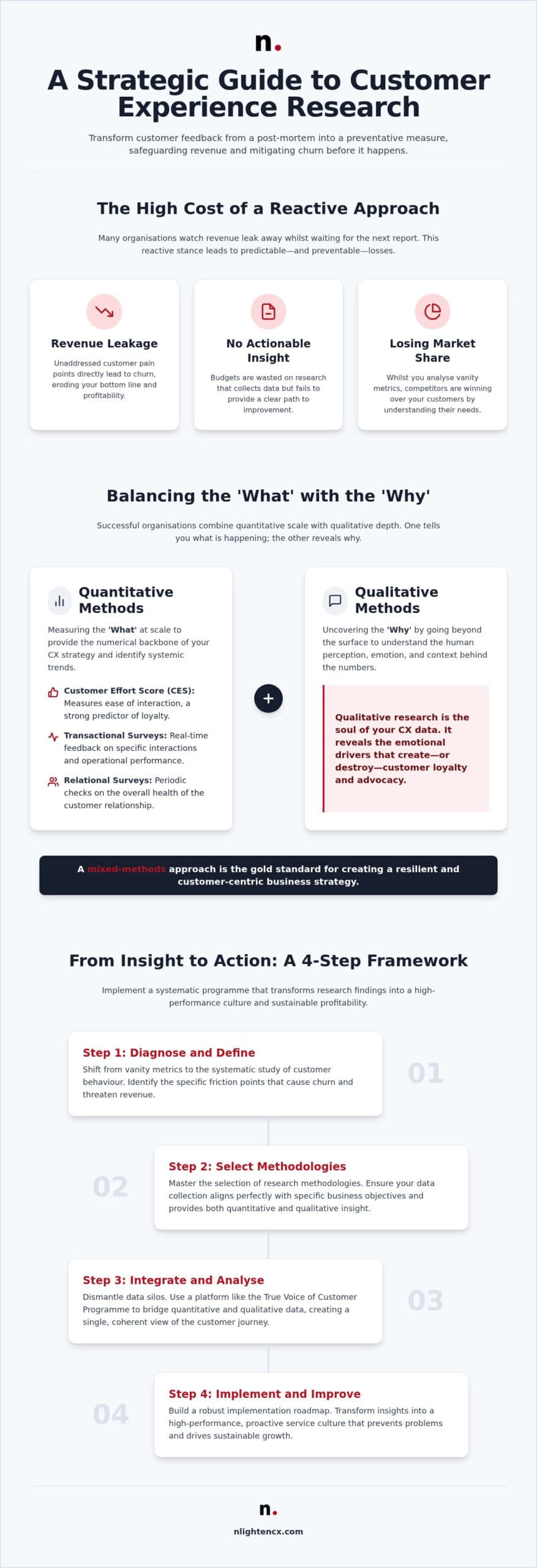
Why do so many organisations fail to move the needle on loyalty despite having mountains of data? The answer lies in the imbalance between scale and depth. Relying solely on a Net Promoter Score (NPS) or CSAT tells you the “what” but leaves the “why” entirely to guesswork. When evaluating sophisticated customer experience research methodologies, the most successful leaders avoid the trap of “either/or” thinking. They understand that a mixed-methods approach is the gold standard for creating a resilient business strategy. Quantitative data identifies the trends; qualitative data reveals the emotion. nlightencx’s True Voice Of Customer Program serves as the essential bridge between these two worlds, ensuring your strategy is both statistically sound and emotionally resonant.
Quantitative Methodologies: Measuring at Scale
Quantitative research provides the numerical backbone of your CX strategy. It relies on standardised surveys to gather data from a large enough sample to ensure statistical significance. By employing these specific customer experience research methodologies, you can identify patterns that indicate systemic issues rather than isolated incidents. This data is vital for benchmarking and tracking progress over time.
- Customer Effort Score (CES): Often a more accurate predictor of loyalty than NPS, CES measures how easy it is for a customer to interact with your brand.
- Transactional Surveys: These occur immediately after a specific interaction, providing real-time feedback on operational performance at the coalface.
- Relational Surveys: These are conducted periodically to assess the overall health of the customer relationship, independent of recent transactions.
The goal here is precision. You need to know exactly where the friction is occurring across your national operations to allocate resources effectively.
Qualitative Methodologies: Uncovering Emotional Drivers
If quantitative data is the skeleton, qualitative research is the soul. It involves going beyond the surface of customer complaints to uncover the underlying psychological drivers of their behaviour. In-depth interviews allow for a level of nuance that a Likert scale simply cannot capture. Whilst focus groups in 2026 have shifted largely to digital environments, the core objective remains the same: observing customer sentiment in a semi-structured setting.
Effective qualitative research uncovers the emotional connection that drives long-term growth. It’s about understanding the “unspoken” needs of your South African client base. By integrating these insights into your broader organisational culture, you move from merely satisfying customers to building genuine advocates who will defend your brand in a competitive landscape. True Voice research ensures that the human element is never lost in the pursuit of statistical targets.
Advanced Methodologies for Modern Service Organisations
Chasing perfection in service delivery requires a deeper look into the customer’s world. Static surveys often fail to capture the dynamic nature of service consumption. To truly master customer experience research methodologies, one must look beyond the questionnaire. Advanced techniques like diary studies allow organisations to capture the “in-the-moment” reality of service usage over extended periods, whilst sentiment analysis leverages AI to decode the emotional tone of thousands of interactions across call centres and social media. These tools don’t just provide data; they provide a narrative of the customer’s life with your brand.
Sophisticated Customer Journey Mapping
Visualising the end-to-end experience is essential for both B2B and B2C environments. However, a journey map is useless if it remains a piece of art on a wall. It must be linked to operational KPIs to ensure accountability across departments. Identifying critical junctures, where loyalty is either won or lost, is the core of CX Research South Africa: Turning Customer Data into Strategic Growth. By mapping these interactions, you can pinpoint exactly where the experience breaks down and who is responsible for fixing it. For organisations managing complex multi-stakeholder relationships, understanding customer journey mapping for B2B across all touchpoints is essential to preventing the fragmented client experiences that drive churn.
Ethnography and Observational Research
What customers say often differs from what they actually do. Ethnographic research solves this by observing customer behaviour in their natural environment. In service environments, this might involve “shadowing” a client through a physical branch or watching a user navigate a digital portal. These unobtrusive techniques identify hidden friction points that the customer might not even realise exist. This level of observational rigour ensures your customer experience research methodologies are grounded in reality rather than just perception.
A Strategic Selection Framework: Choosing the Right Methodology
Choosing from the vast array of customer experience research methodologies shouldn’t feel like a game of chance. It’s a calculated business decision. Many organisations fail because they pick a method based on what’s popular rather than what they actually need to solve. Start by defining your core business problem. Are you bleeding revenue through churn? Is your growth stagnant despite a high marketing spend? Once the problem is clear, you must assess your organisational maturity. You can’t run a multi-channel ethnographic study if you haven’t yet mastered basic transactional surveys. Take the Free CX Quiz to establish your baseline before committing resources.
Determine the required depth against your available timeline. A strategic overhaul requires months of deep-dive qualitative insight, whilst a tactical fix might only need a week of targeted CES data. Always select a methodology that balances emotional drivers with hard metrics. By refining your selection of customer experience research methodologies, you ensure that every insight is actionable. Finally, plan for implementation before a single data point is collected. If you don’t know who will own the insights, don’t start the research. This structured approach prevents wasted budget and ensures your data is actually useful.
Matching Methodology to Business Maturity
Beginners should focus on standardising feedback through simple, repeatable surveys. This builds the muscle for data collection without overwhelming the team. Conversely, established market leaders require advanced, multi-channel programmes that track the customer across every digital and physical touchpoint. Using a CX Handbook is vital here to ensure that every department follows the same rigour and terminology. Consistency is the only way to scale a customer-centric culture across a national footprint.
Budgeting and Resource Allocation
From Insight to Action: Implementing a Systematic Programme
Insight without action is merely an academic exercise. Many South African firms invest heavily in sophisticated customer experience research methodologies only to let the results gather dust in a digital folder. Why does this happen? Usually, it’s a lack of a clear implementation roadmap. Data should be a catalyst for change, not a final destination. To bridge this gap, your teams must be equipped to interpret findings through specialised training like our CX Masterclasses. This upskilling ensures that high-level strategy translates into daily operational improvements at every touchpoint.
The True Voice of Customer Program provides the necessary framework to turn these insights into a living strategy. It’s the ultimate tool for moving from theory to practice. By embedding research into the very fabric of your organisation, you create a culture that values evidence over opinion. This isn’t just about fixing what’s broken; it’s about proactively designing experiences that foster deep-seated loyalty. You don’t just want to know what happened; you want to control what happens next. A professional framework for systematic customer insight gathering ensures your data moves beyond silos and becomes a structured strategic asset that proves customer experience ROI for businesses to stakeholders.
Organising for Success
Continuous Improvement and Benchmarking
CX research is a perpetual programme, not a one-off project. Markets shift. Competitors evolve. Your customer experience research methodologies must adapt to these changes to remain relevant. Setting internal benchmarks allows you to measure the efficacy of your CX design over time. Are you actually reducing friction? Is the emotional connection with your brand strengthening? Regular assessment is the only way to guarantee long-term sustainability in a competitive landscape. Take our Free CX Quiz to assess your organisational maturity today.
Securing Your Strategic Advantage
Data without direction is a liability. By adopting sophisticated customer experience research methodologies, you transition from reactive troubleshooting to proactive market leadership. You’ve learned that the true value of research lies in its ability to mitigate risk and protect your bottom line. Balancing quantitative metrics with the emotional depth of qualitative insight isn’t just a best practice; it’s a requirement for any South African organisation aiming for long-term sustainability. The friction points you identify today are the revenue leaks you’ll stop tomorrow.
Now is the time to turn these insights into a systematic programme for growth. Whether you begin by assessing your baseline with our Free CX Quiz or choose to upskill your leadership through expert-led CX Masterclasses, the path to profitability is clear. Our True Voice of Customer Program provides the implementation roadmap needed to ensure your research findings result in tangible service improvements. Partner with nlightencx for professional CX research and strategy fees to align your operations with customer reality. Take the first step toward a more resilient, customer-centric future today.
Frequently Asked Questions
What is the most effective customer experience research methodology for B2B?
In-depth interviews and journey mapping are the most effective tools for B2B environments. Because these relationships are high-value and involve complex decision-making units, you need to understand the strategic needs of multiple stakeholders. Standard surveys often miss the nuances of long-term contract renewals. Combining qualitative interviews with relational tracking ensures your strategy remains aligned with your key accounts’ business goals and prevents unexpected churn. Our B2B customer journey mapping case study demonstrates exactly how this approach translates into sustainable profitability across complex buying cycles.
How often should a national organisation conduct CX research?
National organisations should conduct transactional research continuously and strategic research at least quarterly. Continuous monitoring allows you to catch operational failures in real-time across different South African regions. Quarterly deep dives provide the necessary pause to evaluate broader market shifts. This rhythm ensures your leadership team isn’t making high-stakes decisions based on stale data, allowing for more agile responses to competitor moves and changing consumer behaviour.
Can we rely solely on NPS for measuring customer experience effectiveness?
No, you cannot rely solely on NPS to measure effectiveness. NPS is a lagging indicator that tells you how a customer feels but doesn’t explain the underlying cause. To get a complete picture, you must integrate various customer experience research methodologies, such as Customer Effort Score and qualitative sentiment analysis. Using a single metric creates a dangerous blind spot that often hides burgeoning risks until it’s too late to intervene.
What is the difference between UX research and CX research?
UX research focuses on the specific interaction with a product or interface, whilst CX research covers the entire end-to-end relationship with the brand. UX is a subset of the broader customer journey. If a customer loves your digital app but finds your billing process or call centre service frustrating, your CX is failing. CX research looks at every touchpoint to ensure the brand promise is kept throughout the relationship.
How do I justify the ROI of CX research to the board?
Justify ROI by linking research findings directly to revenue retention and the reduction of acquisition costs. Present the board with the “Cost of Ignorance,” showing how unaddressed friction points lead to measurable churn and lost market share. Use your data to predict how even a small increase in loyalty impacts your bottom line over time. When research is positioned as a risk mitigation tool, the business case becomes undeniable. For a structured approach to making this case, explore our guide on customer experience ROI for businesses and how to prove its profitability.
What are the most common mistakes in customer experience research?
The most common mistake is collecting data without a clear implementation roadmap. Many organisations suffer from “survey fatigue” because they ask for feedback but never act on it. Other errors include relying on biased samples or failing to break down data silos between departments. Without a systematic approach to customer experience research methodologies, you’re merely gathering numbers that provide no strategic direction or genuine competitive advantage.
How does the True Voice of Customer Program differ from standard surveys?
The True Voice of Customer Program goes beyond surface-level metrics to uncover the emotional drivers of loyalty. Standard surveys are often rigid and fail to capture the nuance of human behaviour. Our program creates organisational awareness by linking feedback to specific operational changes. It’s an implementation tool designed to foster a customer-centric culture, whereas standard surveys are often just a box-ticking exercise that results in no real change.
What tools are required to start a systematic customer insight gathering programme?
You need a combination of survey software, a centralised CRM, and a robust analytical framework like the CX Handbook. Successful programmes also require qualitative tools, such as recording software for interviews and journey mapping platforms. However, the most important “tool” is a trained team capable of interpreting data. Investing in a CX Masterclass ensures your staff can turn raw customer insight into a sustainable and profitable growth strategy. Complement this foundation with a structured customer experience audit checklist to systematically identify friction points and validate that your operational consistency matches your brand promise.