

Why does your business continue to lose customers even when your support desk is hitting every performance target? If you’re struggling with high churn despite a dedicated team, the problem isn’t your staff; it’s your lack of visibility. Most South African leaders treat a customer experience audit checklist as a departmental tick-box exercise. In reality, it is a strategic autopsy of your brand’s emotional resonance and operational consistency. You’ve likely felt the frustration of fragmented data across departments, making it nearly impossible to prove the ROI of your CX initiatives to the board.
You understand that a “good” experience isn’t enough to secure loyalty in a competitive market. You need a structured framework that identifies friction points before they become revenue leaks. This article promises to help you master the CX audit to foster deep emotional connections and drive measurable business growth. Examine the essential components of a modern audit with us, from strategic journey mapping to the implementation of a consistent organisational service culture.
Key Takeaways
- Distinguish between reactive service audits and proactive CX evaluations to identify hidden friction points before they impact your bottom line.
- Ensure absolute brand consistency across every South African communication channel by aligning your CX strategy with core business objectives.
- Utilise a structured customer experience audit checklist to map every stage of the journey, moving from initial awareness to long-term advocacy.
- Apply a prioritisation matrix to your audit findings to calculate the cost of inaction and focus resources on high-impact touchpoints.
- Bridge the gap between data and emotional resonance through professional CX training that embeds a high-performance service culture across your organisation.
Beyond the Surface: Why Your Organisation Needs a Strategic Customer Experience Audit
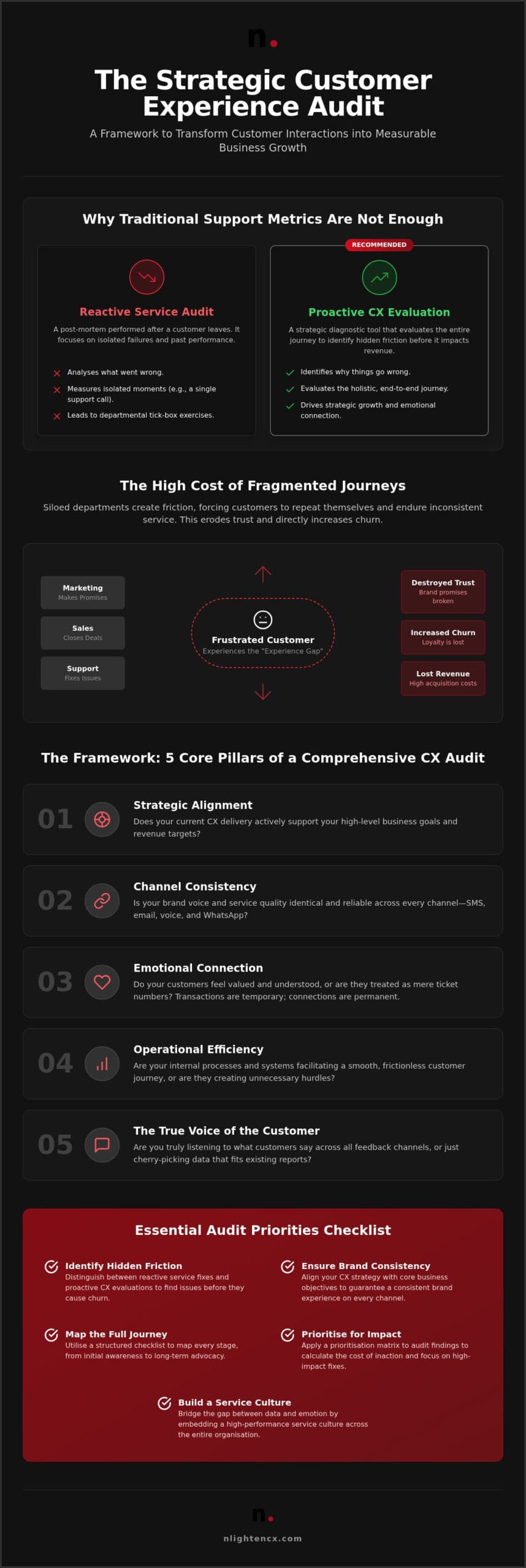
A CX audit isn’t a post-mortem performed after a customer leaves. It’s a proactive diagnostic tool. While a customer service audit reacts to failures, a strategic customer experience audit evaluates every emotional trigger before the relationship sours. Implementing a comprehensive customer experience audit checklist allows you to see the business through the eyes of the person paying the bills. It uncovers the hidden friction points that your internal teams have likely become blind to over time.
Most organisations suffer from a widening “Experience Gap”. This is the chasm between what your marketing team promises and what your operations team actually delivers. If your brand positioning suggests premium care but your billing process is a labyrinth of confusion, you aren’t just losing a sale; you’re destroying trust. In 2026, the financial reality for South African businesses is stark: retaining a client is significantly more cost-effective than acquiring a new one. Loyalty isn’t bought; it’s earned through consistent, frictionless delivery across every single department.
The High Cost of Fragmented Customer Journeys
Siloed departments are the silent killers of brand loyalty. When marketing, sales, and support don’t share data, the customer feels the friction immediately. They’re forced to repeat their story, wait for internal handovers, and endure inconsistent service levels that vary by department. In a market where “good enough” is the bare minimum, businesses that fail to unify these touchpoints, potentially by using integrated communication systems like Nexdial, see a direct spike in churn. Friction is expensive. It drains operational resources and erodes your reputation in a landscape where word-of-mouth travels faster than ever.
Moving from Metrics to Meaningful Insights
Are your NPS and CSAT scores misleading you? High scores often mask underlying rot because they measure isolated moments, not holistic journeys. A score of 9 on a single transaction doesn’t tell you if the customer is planning to switch to a competitor tomorrow because of a cumulative lack of connection. To find the truth, you must look deeper. Utilising customer experience research methodologies helps establish a baseline of reality. This isn’t a compliance task to satisfy the board; it’s a tool for strategic growth. A customer experience audit checklist provides the structure needed to move from surface-level data to deep, actionable intelligence that secures your business’s future.
The nlightencx Framework: 5 Core Pillars of a Comprehensive CX Audit
Success in the South African market requires more than just reactive support; it demands a rigorous, structured approach to every interaction. The nlightencx framework moves beyond surface-level metrics to examine the structural integrity of your brand. When you use a customer experience audit checklist, you must evaluate these five essential pillars to ensure your business remains resilient and profitable:
- Strategic Alignment: Does your current CX delivery actually support your high-level business goals and revenue targets?
- Channel Consistency: Is your brand voice identical and reliable across SMS, email, voice, and WhatsApp?
- Emotional Connection: Do your customers feel valued, or are they treated as mere ticket numbers?
- Operational Efficiency: Are your internal processes facilitating a smooth journey or creating unnecessary hurdles?
- The True Voice of Customer: Are you listening to what they actually say, or just what fits into your existing reports?
Evaluating the Emotional Resonance of Your Brand
Transactions are temporary; emotional connections are permanent. While many businesses focus on speed, few audit the emotional impact of their touchpoints. Does a customer feel relieved after a call, or merely exhausted? Measuring this resonance requires qualitative analysis that goes beyond a simple star rating. Emotional loyalty outlasts transactional satisfaction because it builds a psychological barrier against competitors. If you’re unsure where your brand stands, taking a Free CX Quiz can provide an immediate baseline for your current maturity level. Integrating empathy into your audit process ensures you aren’t just efficient, but also humanly relevant.
Operational Auditing: Tools, Systems, and People
Your tech stack should be an invisible enabler, not a visible obstacle. A critical part of any customer experience transformation involves assessing whether your CRM empowers your agents or forces them into “system says no” apologies. Friction often stems from outdated tools that prevent staff from accessing the full customer history. This operational check must also review employee training; even the best software cannot fix a lack of service culture. This is where systematic customer insight gathering becomes vital. By auditing your internal systems alongside your external delivery, you ensure that your people have the resources they need to meet the standards defined in your customer experience audit checklist.
The Essential Customer Experience Audit Checklist for 2026
Execution is where strategy either thrives or dies. While the previous sections established the theoretical pillars, this customer experience audit checklist provides the tactical steps required to dismantle friction. A successful audit isn’t a passive observation; it’s an active interrogation of every business process that touches the customer. In the South African corporate environment, where consumer expectations are rising faster than service delivery, this structured approach ensures no detail is overlooked.
Stage 1: Pre-Audit and Strategic Scoping
Success begins with clear boundaries. Before you examine a single touchpoint, you must define what success looks like for this specific exercise. Identify the Key Performance Indicators (KPIs) you intend to move, such as customer lifetime value or churn rates. Assemble a cross-functional team including representatives from marketing, sales, and support to ensure a 360-degree view. Finally, write a single, punchy goal for the audit. For example: “This audit will identify and eliminate the primary friction points within our digital onboarding process to improve 90-day retention by 15%.”
Stage 2: Journey and Touchpoint Evaluation
Review every stage of the journey from initial awareness to long-term advocacy. You must identify the “Moments of Truth”—those critical interactions where a customer decides to stay or leave. Test your “Path to Purchase” rigorously on both mobile and desktop, as South African users frequently switch between devices. Does the experience feel seamless, or is there a jarring shift in tone? Don’t stop at the sale. Audit the post-purchase experience, including billing clarity, onboarding speed, and the ease of accessing support. Friction in these quiet moments is often the leading cause of silent churn. A comprehensive CX strategy and journey mapping framework ensures that every stage of this evaluation is aligned with your broader business objectives and brand promise.
Stage 3: Voice of the Customer and Employee Feedback
Data without context is just noise. To find the truth, you must look at qualitative insights from your True Voice of Customer Program. Compare these external realities with internal employee feedback to identify where your systems are failing your staff. Often, internal bottlenecks like slow CRM interfaces or rigid approval processes are the root cause of poor service. Analyse the gap between how your board perceives service quality and how your frontline teams actually experience it. Closing this perception gap is the first step toward building a sustainable, high-quality service culture across your organisation. A structured customer feedback strategy consulting approach ensures that the insights gathered from both employees and customers are operationalised into meaningful improvements rather than left trapped in departmental silos.
From Data to Strategy: Analysing Your Audit Results for Maximum ROI
Data without action is an expensive distraction. Once you’ve completed your customer experience audit checklist, you’re left with a mountain of observations that require ruthless prioritisation. You cannot fix everything at once. Instead, you must use a Prioritisation Matrix to plot every identified issue on an Impact versus Effort axis. High-impact, low-effort items are your “quick wins”. These small victories build the internal momentum and political capital needed to tackle larger, more complex CX initiatives later.
Don’t just present a list of grievances to your board. Directors speak the language of profit, risk, and sustainable growth. Instead of reporting that “customers are frustrated with the wait time,” show them the cost of inaction. If a specific high-friction touchpoint is causing a 5% churn rate in your premium segment, calculate the exact revenue loss in Rands. When you frame CX as a protector of business stability and a driver of measurable ROI, you move from being a cost centre to a vital strategic partner.
Building Your CX Improvement Roadmap
A roadmap is a disciplined schedule of improvements, not a vague wish list. Set short-term goals for your quick wins, mid-term goals for process re-engineering, and long-term goals for total structural shifts. Allocate your budget where the friction is most corrosive to your bottom line. Understand that an audit is not a one-off event; it is a continuous cycle of refinement. If your organisation requires a high-level strategic partner to translate these findings into a scalable plan, our CX Strategy services provide the expert framework needed to bridge the gap between data and delivery.
Bridging the Gap Between Research and Action
Validation is the final step before execution. Utilising professional CX research in South Africa allows you to verify that your proposed roadmap aligns with actual consumer behaviour in the local market. Assign clear accountability for every touchpoint improvement. If no one owns the remedy, the friction will inevitably remain. Finally, measure the success of every change through targeted follow-up audits. This creates a rigorous feedback loop that proves the value of your customer experience audit checklist and secures future investment for your CX programmes.
Elevating Your CX Maturity: Beyond the Checklist
A customer experience audit checklist is a diagnostic tool; it is not the cure itself. Many South African organisations fall into the trap of purchasing expensive CRM software expecting it to resolve deep-seated cultural friction. It won’t. Tools merely amplify your existing processes. If those processes are broken, or if your team lacks the empathy to use them effectively, you’ve simply automated your inefficiency. True maturity requires moving beyond the “service” mindset, where you merely fix what is broken, to a “customer-centric” culture where you anticipate needs before they arise.
Success is found in the people who manage the touchpoints. You must transition from a reactive posture to a strategic one. This involves looking at the hard data through an empathetic lens to understand why a customer behaves the way they do. Just as Black Sky Tactical emphasises the importance of disciplined training and situational awareness in high-stakes environments, your staff must be equipped with the skills to navigate complex customer interactions. When your staff understands the emotional drivers behind a complaint, they stop following scripts and start solving problems. This shift is what separates market leaders from those who are merely surviving.
Maintaining this standard of excellence requires every part of the organisation to function reliably. For businesses looking to optimise their physical environments for performance and compliance, you can learn more about Eco Light Services and their fully managed Lighting-as-a-Service solutions.
Masterclasses and Professional Development
Professional development is the engine of this cultural shift. Structured CX Training ensures that every member of your team understands their role in the customer journey. For organisations looking to bolster their technical capabilities, the Achieve With Nate Movement provides personalised digital confidence coaching and technology training. Our CX Masterclass sessions go a step further, empowering your internal teams to lead their own audits with confidence and precision. For daily operational consistency, the CX Handbook serves as a musical reference guide for practitioners, providing the frameworks needed to sustain high-quality delivery. By building a network of internal CX champions, you ensure that the standards identified in your audit are maintained long after the initial exercise is complete.
Next Steps: Assessing Your Current Position
Where does your organisation stand today? Before committing to a full structural overhaul, you need an immediate, high-level assessment. We invite you to take our Free CX Quiz to identify your current maturity level. Whilst internal audits are valuable, they often suffer from organisational blindness. A professional, third-party audit provides the objective clarity needed to dismantle long-standing friction points and build a resilient brand. It’s time to stop guessing and start growing. If you are ready to secure your brand’s future and drive measurable loyalty, enquire about a strategic CX audit for your business today. Using a customer experience audit checklist is the first step toward a total transformation of your service culture.
Securing Your Brand’s Future Through Strategic Clarity
Mastering your customer experience audit checklist is the first step toward reclaiming lost revenue and building unshakeable loyalty. You’ve seen how fragmented data and siloed departments erode the brand promise; now you have the framework to bridge that gap. By prioritising high-impact friction points and calculating the cost of inaction, you transform CX from a vague concept into a measurable driver of business growth. A successful audit doesn’t just find faults; it creates a logical path toward organisational stability.
Stability in a volatile market isn’t guaranteed by software alone. It requires the deep insights provided by our True Voice of Customer Program and the cultural shift fostered through expert-led CX Masterclasses. With our extensive national consulting experience, nlightencx provides the objective expertise needed to turn your audit findings into a sustainable service culture. Don’t leave your reputation to chance. Secure your strategic CX audit with nlightencx today and begin the journey toward total excellence. Your customers are waiting for a brand that truly listens.
Frequently Asked Questions
What is the primary goal of a customer experience audit?
The primary goal is to identify every friction point and emotional trigger that influences a customer’s decision to stay or leave. It provides a strategic roadmap for closing the gap between your brand promise and actual delivery. By using a customer experience audit checklist, you move beyond surface-level metrics to uncover systemic issues that hinder long-term profitability and business stability.
How often should a business perform a CX audit?
Most organisations should conduct a comprehensive audit at least once a year. However, if you’re launching a new product line or expanding into new South African provinces, an immediate audit is necessary to ensure consistency. Regular check-ins prevent “organisational blindness” where internal teams become accustomed to friction that customers find intolerable. Continuous monitoring ensures your strategy evolves as fast as consumer expectations.
What is the difference between a CX audit and a customer service audit?
A CX audit is proactive and holistic, whereas a customer service audit is reactive and departmental. Service audits focus on ticket resolution times and agent performance. In contrast, a CX audit examines the entire journey from initial awareness to post-purchase advocacy. It evaluates how every department, not just the support desk, contributes to the customer’s emotional state and overall perception of your brand.
Which departments should be involved in the audit process?
Success requires a cross-functional team including Marketing, Sales, Operations, and Customer Support. Siloed audits fail because they ignore how one department’s choices create friction for another. For instance, a marketing campaign might promise a level of service that operations cannot deliver. Involving leadership from every touchpoint ensures the audit results lead to unified, organisation-wide improvements rather than isolated departmental fixes.
Can a small business perform a CX audit without external help?
Small businesses can certainly begin the process internally, but they often struggle with subjective bias. It’s difficult to critique a journey you built yourself. Whilst a customer experience audit checklist provides a solid starting point, external expertise offers the objective clarity needed to see what your team has missed. For growing South African enterprises, the investment in a third-party audit usually pays for itself through rapid churn reduction.
How do you measure the ROI of a customer experience audit?
You measure ROI by tracking changes in customer retention rates, lifetime value (LTV), and operational efficiency after implementing audit findings. If the audit identifies a friction point in your billing process that was causing 5% of your churn, the revenue saved by fixing it is your direct return. Additionally, reducing the volume of support queries through better journey design leads to significant, measurable cost savings for the organisation.
What are the most common friction points found during an audit?
Common friction points include inconsistent brand messaging across channels, complex digital onboarding, and siloed data that forces customers to repeat their stories. In South African markets, slow mobile performance and lack of payment flexibility are also frequent barriers. These issues often stem from internal systems that were designed for administrative ease rather than customer convenience. Identifying these points allows you to re-engineer processes for maximum resonance.
How does the True Voice of Customer program enhance an audit?
The True Voice of Customer program provides the qualitative “why” behind your quantitative data. While standard metrics tell you what is happening, this program captures the raw, unfiltered emotions of your customer base. It enhances an audit by revealing the psychological drivers of loyalty and frustration. This depth allows you to build a strategy rooted in human connection rather than just statistical averages. To ensure these insights translate into lasting change, pairing your audit with a robust high-impact customer feedback strategy consulting framework ensures that every piece of customer sentiment is actioned and communicated back to your audience effectively.