

Why does a South African firm spend millions on marketing only to lose customers the moment a service failure occurs? It’s a frustrating reality for many executives who watch churn rates climb despite heavy investment in brand awareness. You likely recognise that your departments are siloed, often failing to share the vital insights needed to create a unified experience. Without a cohesive CX strategy and journey mapping framework, your brand promise remains just that; a promise, rather than a delivered reality.
Strategy defines the promise. Execution delivers it. You’ve likely struggled to prove the ROI of your experience initiatives whilst fighting against inconsistent service quality across different channels. This 2026 reference guide provides the roadmap you need to align your business goals with the actual customer journey. We’ll examine how to bridge the gap between high-level intent and ground-level execution to eliminate operational friction. You’ll learn how to capture the True Voice of the Customer and transform fragmented interactions into a sustainable engine for growth and loyalty.
Key Takeaways
- Learn how to align high-level business objectives with operational delivery by mastering the synergy between CX strategy and journey mapping.
- Identify the specific “moments of truth” where your organisation either secures customer loyalty or risks significant churn.
- Replace internal assumptions with customer-validated data to ensure your journey maps reflect the actual experience rather than a corporate ideal.
- Discover how the True Voice of Customer acts as the essential data layer for making strategic decisions that drive measurable ROI.
- Recognise why professional training is the catalyst for breaking down silos and building the capability required to sustain a customer-centric culture.
The Strategic Imperative: Why CX Strategy and Journey Mapping Matter in 2026
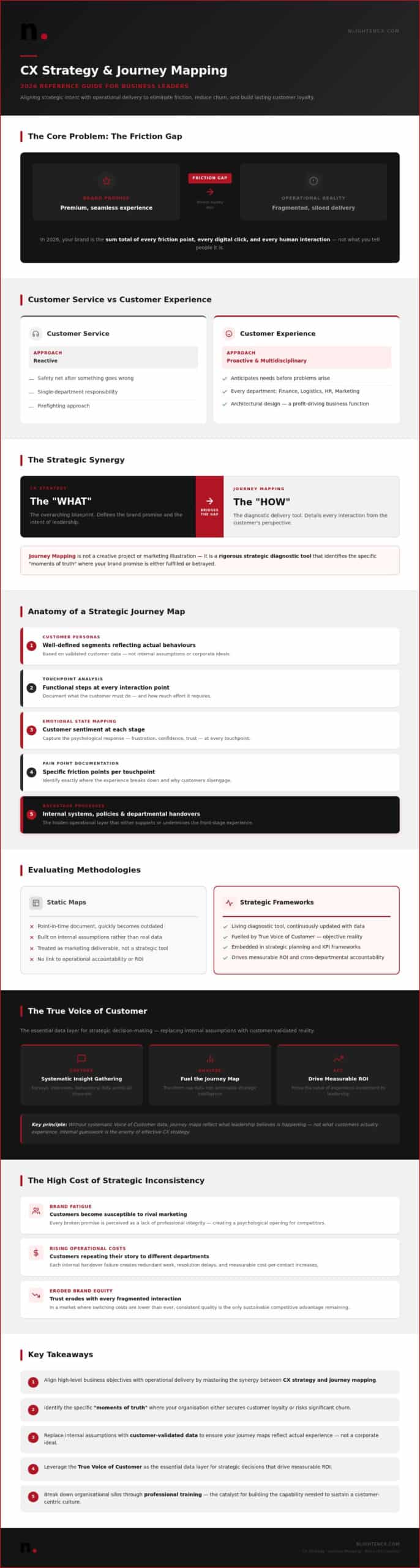
In 2026, your brand is no longer what you tell people it is; it’s the sum total of every friction point, every digital click, and every human interaction a customer has with your organisation. A robust CX strategy acts as the overarching blueprint for these interactions, ensuring that the strategic intent of the leadership team actually reaches the end user. Without this alignment, a dangerous gap opens between your brand promise and the actual experience delivered. This friction gap is where customer loyalty dies and where your competitors find their opening.
Strategic misalignment isn’t just a boardroom headache. It’s the primary driver of customer churn. When a South African firm promises premium service but delivers a fragmented, difficult-to-navigate process, customers don’t just complain; they leave. In a market where switching costs are lower than ever, consistent service quality has become the only sustainable competitive advantage left. Success requires the disciplined application of CX strategy and journey mapping to ensure that every touchpoint is intentional rather than accidental, a principle essential for high-end service providers like African Luxe Travel.
The High Cost of Strategic Inconsistency
Fragmented experiences do more than just irritate customers; they erode the very foundation of trust. Every time a customer has to repeat their story to a different department, your operational costs climb and your brand equity falls. This inconsistency triggers a psychological response in the consumer, where broken promises are perceived as a lack of professional integrity. It creates a sense of “brand fatigue” that makes the customer more susceptible to marketing from rivals. To understand where your organisation stands, you should utilise a customer experience audit checklist to identify these hidden friction points before they lead to permanent churn.
Moving Beyond Customer Service to Customer Experience
Many businesses mistakenly conflate customer service with customer experience. Customer service is reactive; it’s the safety net that catches a customer after something has already gone wrong. Experience, however, is proactive and multidisciplinary. It requires the active participation of every department, from finance and logistics to marketing and HR, to ensure the journey is seamless from the first touchpoint to the last. Effective CX strategy and journey mapping, supported by enterprise-grade communication platforms like Stratelegy, allow you to move from firefighting to architectural design. By anticipating needs before they become problems, you build a resilient relationship that transcends price. Ultimately, a well-executed CX strategy is a profit-driving business function that secures long-term stability.
Defining the Synergy: How Journey Mapping Operationalises Strategy
If strategy is the “what” of your business vision, journey mapping is the “how” of its delivery. Why do so many South African organisations struggle to translate boardroom directives into frontline excellence? The answer lies in the gap between high-level intent and ground-level execution. Journey mapping serves as the visual and analytical tool that bridges this divide. It brings your strategy to life by detailing every interaction from the customer’s perspective, ensuring that your operational reality matches your strategic ambition.
True success in CX strategy and journey mapping requires a shift in mindset. You must view the map not as a creative project or a marketing illustration, but as a rigorous strategic diagnostic tool. It identifies the specific “moments of truth” where your brand promise is either fulfilled or betrayed. To be effective, this process cannot rely on internal guesswork. It demands systematic customer insight gathering to fuel the map with objective reality rather than corporate assumptions. Before you begin the mapping process, it’s often useful to take a free CX quiz to establish your organisation’s current baseline of maturity.
The Anatomy of a Strategic Customer Journey Map
A strategic map goes beyond a simple list of touchpoints. It starts with well-defined personas that reflect actual customer segments and their unique behaviours. For each touchpoint, you must document the functional steps, the emotional state of the customer, and the specific pain points they encounter. Crucially, you must also map the “backstage” processes. These are the internal systems, policies, and departmental handovers that support the front-end experience. If the backstage is broken, the front-end experience will inevitably fail, regardless of how well-designed your marketing materials or professional video assets from 3DUX Media Hub might be.
For a service provider like Gas2Home, the “backstage” involves the complex logistics of LPG delivery, where any failure in the internal chain directly impacts the customer’s safety and satisfaction.
Strategy as the Compass for Mapping
Strategy dictates priority. You cannot optimise every touchpoint simultaneously without diluting your resources and impact. Your CX strategy serves as the compass, telling you which moments in the journey are most critical for driving loyalty and growth. This creates a “strategy-to-execution” loop: you map the current state, measure the performance against strategic goals, improve the high-impact areas, and repeat the cycle. Without this alignment, you risk wasting Rands on fixing minor inconveniences whilst ignoring the major friction points that cause churn. A map without a strategy is merely a souvenir of current problems; it offers no path toward a better future.
Evaluating Methodologies: Static Maps vs Strategic Frameworks
A static journey map is often a colourful illustration that gathers dust in a boardroom. Whilst these visualisations might look impressive, they frequently lack the analytical depth required to drive actual business growth. To move from a mere picture to a performance-driving engine, you must adopt a research-led approach to CX strategy and journey mapping. This involves moving beyond traditional “outside-in” views to integrate deeper, data-driven frameworks that account for the complexities of human behaviour and operational constraints.
Accurate mapping requires a commitment to rigorous customer experience research methodologies. Without this foundation, your map is based on conjecture rather than reality. Success also hinges on organisational buy-in; you need cross-functional teams from finance, operations, and marketing to validate every step. When these departments collaborate, the resulting map becomes a shared strategic asset rather than a siloed marketing project. It ensures that everyone in the organisation understands their specific role in delivering the brand promise.
The Pitfalls of Internal Assumption Mapping
Why do so many South African organisations fail to see results from their mapping efforts? It’s often because they fall into the “Confirmation Bias” trap. Leadership teams frequently create maps based on what they think happens, or what they want to happen, rather than the actual customer reality. This internal assumption mapping ignores the friction points that customers experience every day. It’s a dangerous exercise that validates existing inefficiencies instead of solving them. Engaging external consultants can provide the neutral, objective perspective needed to challenge these internal narratives. An outside expert doesn’t carry the baggage of “the way we’ve always done things,” allowing them to identify the structural gaps that internal teams might overlook.
Selecting a Framework for Growth
Choosing the right methodology depends on your specific business objectives. High-level “Executive Maps” are excellent for aligning leadership on the broad customer vision, but they lack the granular detail needed for operational fixes. If your goal is to eliminate friction in a complex service delivery, a “Service Blueprint” is more appropriate. This framework maps the customer journey alongside the specific internal processes and systems that support it. To ensure these frameworks remain relevant, you must integrate a robust customer feedback strategy consulting approach. This ensures that as market conditions and customer expectations shift, your strategic framework evolves with them. A static map is a snapshot of the past; a strategic framework is a roadmap for the future.
Implementing the True Voice of Customer in Your CX Framework
Data is the lifeblood of any successful experience initiative. Without a rigorous mechanism for listening, your CX strategy and journey mapping efforts are based on boardroom conjecture rather than customer reality. The True Voice of Customer (VoC) acts as the essential data layer that bridges this gap. It transforms a static, one-dimensional journey map into a dynamic strategic tool that reflects the shifting needs and emotional drivers of your client base. You can’t manage what you don’t measure, but more importantly, you can’t improve what you don’t understand.
While many South African firms rely solely on quantitative metrics like NPS or CSAT, these numbers only tell part of the story. They indicate that a problem exists, but they rarely explain why. A multidisciplinary approach to VoC captures sentiment across all channels, combining hard data with qualitative emotional insights. This holistic view allows you to see the journey through the customer’s eyes, identifying the specific friction points that lead to churn. By integrating these insights directly into your strategic framework, you ensure that every operational change is backed by the authentic voice of the person paying the bills.
The Signature True Voice of Customer Program
A formalised VoC program is not a suggestion; it’s a strategic necessity. Our signature True Voice of Customer Program is designed to identify the root causes of friction that general surveys often miss. It moves your organisation beyond the passive act of gathering data to the active pursuit of strategic action. This transition requires executive leadership to champion the insights discovered. When the C-suite treats customer feedback as a critical business intelligence asset, the entire culture shifts toward accountability and excellence. It’s about creating a system where the customer’s reality dictates the company’s priorities.
Translating Insights into Strategic Action
How do you decide which part of the journey to fix first? The answer lies in the impact of the VoC data. By prioritising improvements based on where they will most significantly reduce friction and drive loyalty, you ensure the highest possible ROI for your CX initiatives. Before embarking on this transformation, it’s vital to establish a baseline. You can use our Free CX Quiz to assess your current organisational capability and identify where your listening gaps currently lie. Finally, remember that the most critical part of this process is closing the feedback loop. When you tell a customer that you’ve heard them and made changes based on their input, you don’t just solve a problem; you build a lasting emotional connection.
Elevating Organisational Capability: Training and Masterclasses
A sophisticated CX strategy and journey mapping framework is only as effective as the people tasked with its delivery. You can design the most seamless process in the world, but if your operational teams lack the mindset or capability to execute it, the friction gap will remain. Organisational capability is the final piece of the strategic puzzle, and you can explore Bespoke eLearning Content Design to help build the necessary internal expertise. It transforms theory into a living, breathing culture of excellence. Without this internal alignment, even the best-laid plans eventually succumb to the gravity of old habits and departmental silos.
Professional CX Masterclasses act as the necessary catalyst for this transformation. They bridge the divide between leadership’s vision and the frontline’s daily reality. To ensure this momentum doesn’t fade after the initial consulting phase, the CX Handbook serves as a vital reference for maintaining consistency. By establishing a permanent internal standard, you protect your investment and ensure that service quality remains high long after the project concludes. It’s about moving from accidental experience to intentional delivery.
Building Internal CX Excellence
Generic training courses often fail because they don’t account for the specific nuances of your business model or the unique dynamics of the South African market. Specialised training, however, fosters a shared language and a unified methodology across your entire organisation. It breaks down the silos that prevent customer insights from flowing where they’re needed most. For service-driven businesses, such as a bespoke travel agency dubai, training focused on emotional connection is a critical differentiator. It teaches teams to look beyond the transaction and understand the human behaviour driving the interaction. This shift in perspective is what turns a standard service encounter into a memorable brand experience that drives long-term loyalty, often supported by external resources like the educational ebooks from Lumina that explore the nuances of travel and wellbeing.
Your Roadmap to CX Maturity
Achieving CX maturity is a methodical process that requires discipline and a structured approach. It begins with rigorous research to capture the True Voice of Customer, moves into the design of a robust strategy, and is operationalised through detailed CX strategy and journey mapping. The final stage is the elevation of your people through continuous training and development. If you’re unsure where to start, diagnostic tools like our Free CX Quiz can help you identify your specific training needs and capability gaps. Organisations ready to stabilise their growth and eliminate operational friction should explore the full nlightencx suite of services. From strategy development to practitioner handbooks, we provide the structured path your business needs to thrive in an increasingly competitive landscape.
Securing Your Competitive Advantage in 2026
The path to business stability in South Africa’s market requires more than just intent; it demands operational discipline. You’ve seen that success lies at the intersection of CX strategy and journey mapping, where the brand promise is finally matched by consistent delivery. By moving beyond static maps and embracing a multidisciplinary consulting approach, you can eliminate the friction that erodes your margins and drives churn. Every interaction is an opportunity to either secure or lose a customer’s trust.
Sustainability depends on your ability to listen. Whether you’re implementing our Signature True Voice of Customer Programme or aligning your leadership through expert-led CX Masterclasses, the goal remains the same: creating a resilient, customer-centric culture. Don’t let your strategic vision remain a boardroom theory whilst your competitors secure the market through superior experience. It’s time to transform your insights into a measurable engine for growth. Professional excellence isn’t a destination but a continuous commitment to your client base, a standard that applies across all sectors and regions; for example, you can learn more about One Vision Photography | South Wales Wedding Photographer to see how they maintain these standards in the UK wedding industry.
Begin your strategic journey with nlightencx; take our Free CX Quiz today. We look forward to helping you build a future where every customer interaction strengthens your professional legacy.
Frequently Asked Questions
What is the difference between CX strategy and journey mapping?
CX strategy serves as your high-level blueprint, defining the vision and brand promise you intend to deliver. Conversely, journey mapping is the tactical tool used to visualise and operationalise that vision. While strategy sets the direction, mapping identifies the specific touchpoints and friction gaps that must be addressed. Effective CX strategy and journey mapping ensure that your boardroom objectives are successfully translated into consistent, ground-level execution for your customers.
How long does a typical customer journey mapping project take?
The duration of a mapping project varies based on the complexity of your organisation and the depth of research required. A standard strategic mapping exercise typically spans four to twelve weeks. This timeline accounts for initial data collection, stakeholder workshops, and customer validation sessions. Rushing this process often leads to maps based on internal assumptions rather than objective reality, which ultimately undermines the strategic value of the final output.
Why is journey mapping important for B2B organisations?
B2B journeys are inherently more complex than B2C interactions, often involving multiple decision-makers and longer sales cycles. Journey mapping allows B2B firms to identify the critical handovers between departments, such as the transition from sales to implementation. By visualising these interactions and incorporating natural selling courses to align sales techniques with buyer psychology, you can eliminate the friction that often leads to account churn. It ensures that your professional relationships are supported by reliable, high-quality service delivery at every stage of the partnership.
Can we create a journey map without external customer research?
You can create a map based on internal workshops, but this results in an “assumption map” rather than a strategic tool. Without external research, you’ll miss the hidden pain points that drive customer behaviour. Validating your journey with real customer insights is the only way to ensure your CX strategy and journey mapping efforts lead to measurable improvements. Relying on internal guesswork often reinforces existing biases and fails to address root causes of friction.
What are the most important KPIs for measuring CX strategy success?
Success should be measured through a combination of leading and lagging indicators. Key metrics include the Customer Effort Score (CES), which measures how easy it is for clients to interact with you, and Churn Rate, which reflects long-term loyalty. While NPS and CSAT provide a baseline, you must also track the ROI of specific experience initiatives. Linking these metrics to financial performance ensures that your strategy remains a recognised profit-driving business function.
How does the True Voice of Customer program differ from standard surveys?
Standard surveys often focus on superficial scores that fail to explain the “why” behind customer behaviour. Our True Voice of Customer program utilises a multidisciplinary approach to capture deep qualitative insights and emotional drivers across all channels. It moves beyond passive data collection to provide a structured path for strategic action. This methodology ensures you identify the root causes of friction that standard, high-level satisfaction surveys frequently overlook during the research phase.
What role does employee engagement play in CX strategy?
Employees are the primary delivery mechanism for your brand promise. If your internal teams are disengaged or lack the necessary training, even the most sophisticated strategy will fail at the point of execution. High levels of employee engagement ensure that your staff are empowered to resolve friction and create emotional connections with customers. A customer-centric culture starts internally, making staff alignment a fundamental prerequisite for any successful experience transformation.