

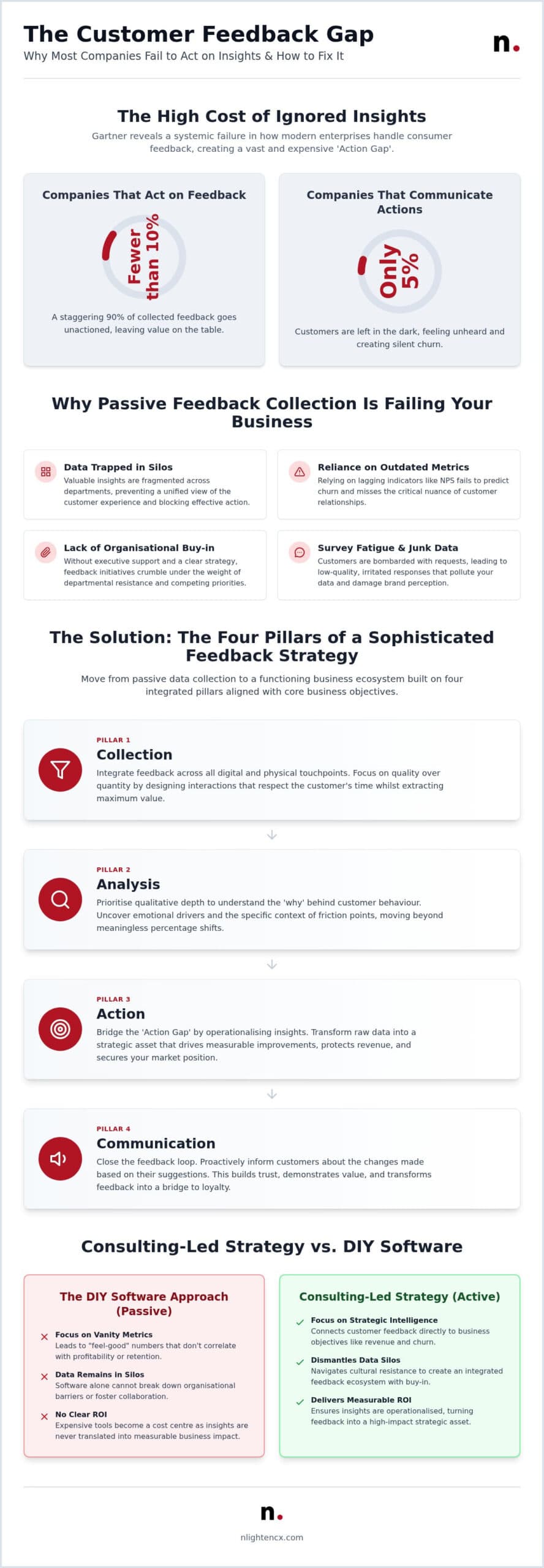
Fewer than 10% of companies act on the feedback they collect, and only 5% communicate those actions back to their customers. This staggering statistic from Gartner reveals a systemic failure in how modern enterprises handle consumer insights. You’ve likely felt this friction firsthand. Despite investing in expensive survey tools, your churn rates remain stagnant whilst valuable data sits trapped in departmental silos. This is where professional customer feedback strategy consulting becomes essential. It’s not about merely gathering more data. It’s about refining that raw information into a high-impact strategic asset that protects your revenue and secures your market position.
You understand that a business cannot survive on guesswork, yet the path to truly operationalising customer sentiment often feels obscured by organisational resistance. We promise to provide the clarity you need. This guide offers a comprehensive roadmap to master the art of feedback implementation, ensuring every insight drives measurable growth and increased lifetime value. We’ll examine how to dismantle silos, secure board-level buy-in for CX ROI, and use the True Voice Of Customer methodology to transform your organisational behaviour into a competitive advantage.
Key Takeaways
- Shift your perspective from passive data collection to strategic intelligence to predict churn more accurately than traditional NPS metrics.
- Understand why professional customer feedback strategy consulting is necessary to navigate cultural resistance and integrate fragmented data silos.
- Master the four essential pillars-Collection, Analysis, Action, and Communication-to ensure every customer insight is aligned with your broader business objectives.
- Follow a structured roadmap to audit your existing touchpoints and establish a feedback ecosystem that delivers a measurable return on investment.
- Discover how the True Voice Of Customer Program provides a turnkey solution for transforming raw sentiment into a sophisticated strategic asset.
Why Passive Customer Feedback is Failing Your Business in 2026
Business leaders often mistake a high volume of survey responses for a robust strategy. It isn’t. In the current South African market, simply “collecting data” is a passive exercise that yields diminishing returns. You need strategic intelligence. This requires a transition from observing metrics to understanding the underlying drivers of customer behaviour. When you treat feedback as a mere administrative task, you lose the opportunity to build the emotional connections that drive long-term profitability.
Traditional Net Promoter Scores (NPS) are no longer sufficient for predicting churn. A score is a snapshot in time, often captured when a customer is neither particularly frustrated nor particularly delighted. It fails to capture the nuance of the relationship. Relying on NPS alone leaves you blind to the subtle shifts in loyalty that precede a cancellation. To survive, your organisation must evolve beyond these lagging indicators.
We’re also witnessing a global survey fatigue epidemic. Customers are bombarded with requests for feedback after every minor interaction. This leads to junk data. When people respond out of habit or irritation, the quality of your insights plummets. High-level research into what is customer satisfaction proves that feedback should be a bridge to loyalty, not a digital nuisance. Professional customer feedback strategy consulting helps you design touchpoints that respect the customer’s time whilst extracting maximum value.
The High Cost of Ignored Insights
Ignoring feedback isn’t just a missed opportunity; it’s an expensive mistake. Silent churners represent your biggest threat to business stability. These are the customers who experience friction, say nothing, and simply move their business to a competitor. The financial impact of this unaddressed grievance is profound, often costing companies millions in lost lifetime value. The Feedback Gap is the distance between hearing a customer’s concern and taking decisive action to rectify it.
Moving Beyond Vanity Metrics
Many organisations settle for vanity metrics because they’re easy to measure and look good in board meetings. However, “feel-good” numbers don’t drive strategic growth. You must prioritise hard data that correlates directly with profitability and retention. This requires a shift toward systematic customer insight gathering. Without this rigour, your feedback loop remains a hollow exercise in box-ticking rather than a tool for business transformation. Engaging in customer feedback strategy consulting ensures your data is actually used to steer the ship.
The Four Pillars of a Sophisticated Customer Feedback Strategy
A robust framework is the difference between a collection of spreadsheets and a functioning business ecosystem. To move beyond passive data, you must build your approach on four distinct pillars: Collection, Analysis, Action, and Communication. Each component must align with your broader business objectives. If your collection methods don’t feed into your growth goals, you’re simply wasting resources. Multi-channel integration is non-negotiable in the South African market, where customers interact across various digital and physical touchpoints. Without executive buy-in, these pillars will crumble under the weight of departmental silos. Engaging in customer feedback strategy consulting ensures that these elements are not just present, but integrated into the very fabric of your operations.
Qualitative Depth vs Quantitative Breadth
In 2026, the “why” is far more valuable than the “how many”. Whilst quantitative data provides scale, it often misses the nuance of the human experience. Sophisticated customer experience research methodologies focus on uncovering the emotional drivers that dictate loyalty. Use open-ended questions to allow customers to speak in their own words. This qualitative depth provides the context needed to make informed strategic decisions rather than chasing meaningless percentage shifts. It’s the difference between knowing a customer is unhappy and knowing exactly which part of the journey caused the friction.
Closing the Loop: The Action Gap
Data without action is merely overhead. You must bridge the gap between hearing and doing through a structured internal communication framework. We categorise this into two distinct loops. The “Inner Loop” focuses on individual recovery. This is where you address a specific grievance to save a single relationship. The “Outer Loop” is more significant for long-term stability. It involves systemic change where you use feedback to overhaul broken processes across the entire organisation.
Prioritise these actions based on their potential ROI and impact on the customer journey. Not every piece of feedback requires a complete departmental pivot. Instead, focus on the friction points that represent the highest risk to your retention rates. If you find your team is struggling to move from insight to implementation, it may be time to consult with an expert at nlightencx to refine your operational approach. Closing the loop effectively ensures that your customers feel heard, which is a primary driver of brand advocacy.
Consulting-Led Strategy vs DIY Software Implementation
Many South African executives fall into the trap of believing that a monthly subscription to a survey platform constitutes a strategy. It doesn’t. A tool is merely a conduit; without a coherent framework, it’s just another expense on the balance sheet. This is the primary reason why customer feedback strategy consulting is a necessity for organisations seeking genuine transformation. A consultant provides the external objectivity required to identify uncomfortable truths that internal teams might overlook. Internal stakeholders are often too close to the processes they’ve built to see their flaws. Before you even consider tool selection, you must perform a thorough evaluation. We recommend using a customer experience audit checklist to establish your baseline and identify existing data gaps.
Why Tools Alone Cannot Solve Cultural Resistance
Software cannot dismantle the “Silo Effect”. In many large enterprises, departments operate as independent islands, hoarding data and resisting cross-functional accountability. When you implement a DIY tool, you often find that the marketing team ignores the insights gathered by the service centre. Cultural resistance is the silent killer of CX initiatives. To overcome this, staff must understand the “why” behind the feedback. It’s not about monitoring performance; it’s about securing the future of the business. Training is essential to align the collective mindset. At nlightencx, we facilitate this cross-functional collaboration. We ensure that every department understands its role in the feedback ecosystem and feels empowered to act on what they learn.
The Role of Expert Journey Mapping
Where should you ask for feedback? If you ask at every turn, you trigger the fatigue discussed earlier. If you ask too late, you’ve already lost the customer. Expert journey mapping identifies the high-stakes moments where feedback is most critical. A generic journey map is often a surface-level exercise that looks good in a presentation but lacks operational utility. A consulting-led deep dive, however, looks at the emotional peaks and troughs of the customer experience. By mapping these accurately, we can predict where friction will occur before it manifests as churn. This proactive approach allows you to intervene at the exact moment a relationship is at risk. It transforms feedback from a post-mortem exercise into a real-time recovery tool. To understand how strategy and mapping work together in practice, explore this comprehensive CX strategy and journey mapping reference guide for 2026.
How to Design a Robust Feedback Ecosystem: A Step-by-Step Guide
Building a feedback ecosystem requires more than technical integration. It demands a logical, step-by-step architecture that aligns customer sentiment with your commercial objectives. Many organisations fail because they skip the foundational work, jumping straight to software deployment without a clear purpose. To avoid this, you must follow a disciplined path toward operational excellence. Professional customer feedback strategy consulting serves as the blueprint for this construction, ensuring that your ecosystem is both resilient and actionable.
Your first priority is a comprehensive audit. Identify every current touchpoint where you interact with customers and locate the data silos that prevent a unified view. Once the landscape is clear, define your “True Voice” objectives. These are not vague aspirations; they are specific goals aligned with your growth targets. Step three involves selecting the right mix of listening posts. A sophisticated strategy doesn’t rely on a single survey. It incorporates qualitative interviews, social listening, and direct observation. Step four is where most fail: establishing a clear protocol for rapid response. You need a documented workflow for both individual recovery and systemic process change. Finally, measure the correlation between your actions and financial growth. If you cannot prove that fixing a specific friction point increased retention, your strategy lacks boardroom credibility.
Identifying Critical Emotional Touchpoints
Not all moments in a customer journey carry the same weight. You must identify the “Moments of Truth”-those specific interactions where a customer forms a lasting emotional impression. Behavioural science indicates that customers remember the “peak” and the “end” of an experience most vividly. If you fail at these junctures, no amount of mid-journey efficiency will save the relationship. Designing your feedback questions with empathy allows you to tap into these emotional states. It provides a clearer picture of the brand-customer bond than any generic rating scale ever could.
Synthesising Data into Boardroom-Ready Insights
Data is a liability if your leadership team cannot interpret its value. Your reporting must move beyond simple percentages and move toward strategic intelligence. Link customer sentiment directly to financial KPIs like churn rate and lifetime value. When you can demonstrate that a 5% increase in customer satisfaction correlates to a specific R-value in retained revenue, you secure the budget for future initiatives. Use storytelling to frame this data. A single, well-documented customer narrative often carries more weight in a boardroom than a hundred anonymous data points. If your team struggles to translate raw data into a compelling business case, consider engaging with nlightencx to refine your reporting methodology and strategic output.
Operationalising Insights with nlightencx Strategic Advisory
Transformation does not occur through the mere purchase of a software licence. It requires a fundamental shift in how your organisation perceives and responds to its customer base. At nlightencx, we bridge the gap between raw data and commercial results. Our customer feedback strategy consulting is designed to move your business from a state of passive awareness to one of active transformation. We don’t just provide reports; we provide a structured methodology for long term stability and growth. By positioning ourselves as your strategic partner, we ensure that your service quality remains consistent whilst your competitors struggle with fragmented data and uncoordinated responses.
Success in the South African market depends on your ability to out-execute the competition through superior customer understanding. This is why we offer a comprehensive suite of solutions, including CX Research and CX Design, to ensure your strategy is grounded in reality. Whether you are navigating complex regulatory environments or shifting consumer behaviours, having a mentor to guide your feedback ecosystem is a critical business safeguard. We provide the expertise needed to turn friction points into loyalty drivers.
The True Voice of Customer Methodology
The True Voice of Customer Program is our signature turnkey solution for businesses that demand more than superficial metrics. Unlike standard “voice of the customer” software that merely aggregates scores, our methodology focuses on deep emotional connections. We move through distinct phases of research, strategic alignment, and operational design to ensure your feedback loop is robust. This program identifies the specific drivers of profitability within your unique customer base. It allows you to ignore the noise and focus on the insights that actually move the needle on retention and lifetime value. We help you hear what your customers are truly saying, not just what they are clicking.
Building a Culture of Continuous Improvement
Initial implementation is only the beginning of the journey. To maintain momentum, you must embed CX competency into your internal teams. Our CX Masterclasses provide intensive upskilling for your staff, ensuring they have the tools to manage the feedback ecosystem independently. We also provide the nlightencx CX Handbook, a practical resource for maintaining service standards across the organisation. This focus on continuous improvement prevents the “strategy decay” that often follows a major corporate initiative. By fostering a culture that values customer insight at every level, you create a self-sustaining engine for growth. If you are ready to move beyond basic surveys and build a sophisticated strategic asset, Enquire about our True Voice of Customer Program today.
Securing Your Market Position Through Strategic Intelligence
Building a resilient organisation requires more than just listening; it requires the structural discipline to act. We’ve explored how shifting from vanity metrics to qualitative depth can reveal the emotional drivers of your customer base. You now understand that a tool is only as effective as the strategy behind it. Expert customer feedback strategy consulting provides the necessary objectivity to dismantle silos and bridge the action gap. It transforms feedback from a passive report into a high-impact strategic asset.
With our deep expertise in South African market dynamics and our signature True Voice of Customer Program, nlightencx is uniquely positioned to help you operationalise these insights. Don’t let your data remain a dormant asset whilst churn rates climb. Take the first step toward clarity by using our proprietary Free CX Quiz for an immediate assessment of your organisational maturity. This tool offers the baseline data you need to start your journey toward sophisticated customer centricity.
Transform your customer insights with nlightencx strategic consulting. Your path to sustainable growth starts with a single, informed decision to put the customer at the centre of your business strategy.
Frequently Asked Questions
What is the difference between a feedback tool and a feedback strategy?
A feedback tool is a technical instrument, such as survey software, whilst a strategy is the overarching logic that dictates how data is collected, analysed, and operationalised. Buying a tool without a strategy often leads to data silos and wasted investment. Professional customer feedback strategy consulting ensures your technical assets align with your commercial growth goals and organisational structure. It’s the difference between having a map and actually knowing how to drive the vehicle.
How often should we ask for customer feedback to avoid survey fatigue?
You should ask for feedback only at critical “Moments of Truth” to prevent survey fatigue. For transactional interactions, once per quarter per customer is a safe baseline, provided the request is relevant. Relationship-level feedback should occur bi-annually or annually. The key is to ensure every request for feedback is met with visible action. This justifies the customer’s time investment and maintains the integrity of your data whilst protecting the brand relationship.
Can a small business benefit from customer feedback strategy consulting?
Small businesses benefit immensely from customer feedback strategy consulting because it prevents them from wasting limited resources on broad, ineffective data collection. Establishing a robust feedback ecosystem early allows a smaller enterprise to build deep emotional connections and compete against larger, more impersonal corporations. It creates a foundation for sustainable growth by securing customer loyalty from the outset and preventing the high costs associated with early-stage customer churn.
What are the best metrics to track in a customer feedback programme?
Move beyond vanity metrics like raw NPS scores and focus on churn correlation and customer lifetime value (LTV). You should also track the “Action Rate”-the percentage of feedback items that result in a documented process change. Tracking qualitative sentiment themes provides the necessary context to understand the emotional drivers behind the quantitative shifts. It’s about measuring the impact of your actions on the bottom line, not just the volume of your responses.
How do we get staff to buy into a new customer feedback strategy?
Securing staff buy-in requires demonstrating that feedback is a tool for empowerment, not a mechanism for surveillance. Use CX Training and Masterclasses to show employees how customer insights can simplify their daily tasks and improve their own performance metrics. When staff see that acting on feedback reduces friction in their own workflows, they become active participants. It’s essential to link these insights to their specific departmental KPIs to show tangible value.
What happens if we receive negative feedback that we cannot immediately fix?
Transparency is your most effective tool when immediate resolution is impossible. Communicate honestly with the customer, acknowledging the grievance and explaining the systemic reasons for the delay. Most customers appreciate being kept in the loop and are often willing to wait if they perceive a genuine commitment to a long-term fix. Use this as an opportunity to build trust through vulnerability and clear expectations rather than providing hollow apologies.
How do we measure the ROI of our customer feedback efforts?
Measure ROI by tracking the reduction in customer churn and the subsequent increase in lifetime revenue. Compare the cost of your feedback initiatives against the R-value of the customers you’ve successfully retained through recovery efforts. Additionally, look for operational efficiencies gained by fixing systemic friction points. This reduces the overall cost-to-serve and provides clear, board-ready proof of your customer experience investment within the South African market context.