

Why is it that despite an extensive digital presence, your customers are still slipping through the cracks without a clear explanation? It’s a frustrating reality for many South African business leaders who find themselves overwhelmed by a mounting volume of touchpoints that seem to lead nowhere. You recognise that siloed departments are providing inconsistent service quality, yet the path to alignment remains obscured. Mapping customer interactions is not merely a documentation exercise. It’s a strategic necessity to uncover the emotional friction that is quietly bleeding your profit margins.
We understand the urgency of stabilising your growth in 2026. You deserve a clear, actionable framework that turns chaotic data into decisive leadership. This guide promises to transform your fragmented touchpoints into a cohesive strategy designed to reduce churn and bolster your bottom line. We examine the methodology for creating high-impact interaction maps, the logic of emotional connection, and the specific metrics required to prove CX return on investment to your board.
Key Takeaways
- Learn to distinguish between static touchpoints and dynamic exchanges to accurately diagnose the health of your business.
- Discover why mapping customer interactions must be rooted in rigorous CX research rather than internal assumptions to drive true profitability.
- Categorise friction into functional and emotional gaps to identify precisely where and why your customers are leaving.
- Use interaction maps as a strategic tool to bridge departmental silos and create a unified service delivery model across your organisation.
- Understand how to elevate your CX maturity through structured training and the True Voice of Customer program.
The Strategic Imperative of Mapping Customer Interactions in 2026
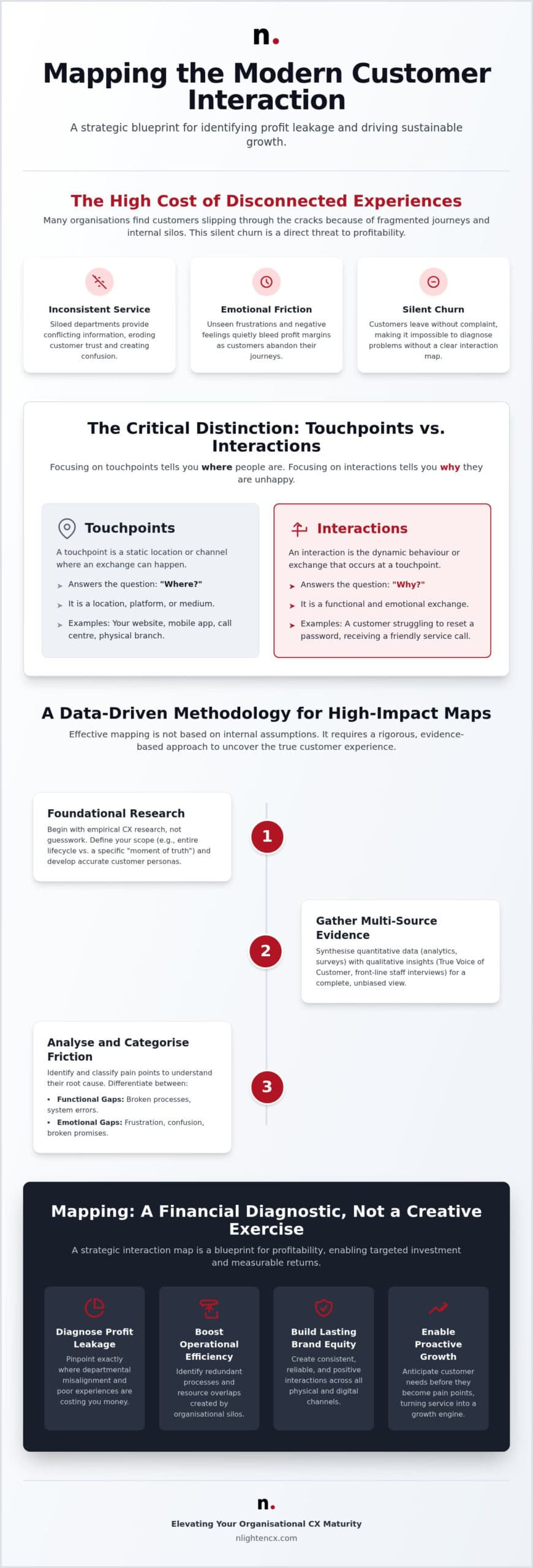
Why do so many South African organisations view mapping as a creative exercise rather than a financial diagnostic? In 2026, mapping customer interactions is the primary tool for identifying structural weaknesses that lead to profit leakage. It’s not about making pretty pictures. It’s about survival. When you map the User journey through a strategic lens, you move beyond mere observation. You begin to see the friction points that cause “silent churn,” where customers leave without ever lodging a formal complaint. This silent attrition is often the result of fragmented experiences across national branches. It’s a systemic failure that only a comprehensive map can solve.
At nlightencx, we view this mapping process as the essential precursor to calculating customer experience roi for businesses. Without a map, your CX investment is guesswork. With it, you have a blueprint for profitability. You can pinpoint exactly where a lack of departmental alignment is costing you money and where a single improved interaction could secure a lifetime of loyalty.
Touchpoints vs Interactions: Why the Distinction Matters
A touchpoint is merely a location; an interaction is a behaviour. Your mobile app is a touchpoint, but the struggle a customer faces whilst trying to reset a password is the interaction. Why does this distinction matter? Focusing on touchpoints tells you where people are, but focusing on interactions tells you why they are unhappy. This is why mapping customer interactions must go deeper than surface-level visuals. A robust customer touchpoint analysis provides the skeleton, but the interaction map provides the pulse. It uncovers the emotional and functional exchanges that either build trust or erode it. When you understand the “why” behind customer frustration, you can design solutions that actually work.
The Business Case for Interaction Clarity
Operational efficiency is the quiet hero of CX. How many redundant processes are currently bloating your overheads because departments don’t talk to each other? Mapping identifies these overlaps. It reveals where two separate teams are performing the same task, or where a vital task is being missed entirely. In 2026, the market is too competitive for linear maps that assume a predictable path. Customers move fluidly between digital and physical realms. Consistent interactions across these boundaries are what build long-term brand equity. If the experience is fragmented, the brand is perceived as unreliable. Logic dictates that clarity leads to stability. Are you prepared to let inefficient silos dictate your profit margins? A nuanced map allows you to anticipate customer needs before they become pain points, turning a reactive service model into a proactive growth engine.
A Step-by-Step Methodology for Organising Interaction Maps
Effective mapping customer interactions requires a total departure from internal guesswork. Why do so many organisations rely on “best guesses” when the stakes involve business stability and long-term growth? You must start with hard evidence. This is where CX research South Africa becomes the foundation of your strategy. Without empirical data, your map is a work of fiction. You need to define your scope early. Are you examining the entire lifecycle or a specific “moment of truth” that dictates brand loyalty? Personas also dictate the map’s complexity. A B2B journey involves multiple decision-makers and longer lead times, requiring a far more nuanced lens than a direct-to-consumer transaction. It’s about capturing the multi-layered reality of the professional relationship.
Phase 1: Gathering Multi-Source Evidence
Reliable maps are built on the intersection of quantitative data and qualitative “True Voice” insights. You can’t rely on surveys alone. They often miss the emotional nuance that drives behaviour. Avoid the assumption trap by ensuring your data reflects reality rather than your internal aspirations. To gather evidence effectively, you must synthesise direct feedback from your customers with the lived experiences of your front-line staff in a single, unified data stream. This dual perspective reveals the gap between what you think you’re delivering and what the customer is actually experiencing. If you find your internal data is fragmented, engaging with professional CX research provides the objective clarity required to move forward.
Phase 2: Visualising the Emotional Arc
Sentiment isn’t static. It fluctuates with every exchange. Your map must visualise this emotional arc, plotting the highs of success and the lows of frustration. Where does your organisational structure clash with customer needs? These are your friction points. By layering the map with thoughts, feelings, and “backstage” organisational processes, you see exactly which internal silos are responsible for a poor experience. You must look behind the curtain. If a customer feels neglected during onboarding, is it because your CRM doesn’t alert the account manager, or is the account manager overwhelmed by manual reporting? Linking these emotional states to business outcomes is the final, crucial step. Does a specific point of friction correlate with a spike in churn? Once you identify these patterns, you can move from observation to intervention. You aren’t just drawing a diagram; you’re building a business case for change that secures your organisation’s future.
Analysing Emotional Friction and Behavioural Gaps
Why do customers leave despite a functional product? It is often because the emotional cost of doing business with you has become too high. In 2026, mapping customer interactions requires you to categorise friction into two distinct buckets: functional and emotional. Functional friction is a mechanical failure; a link is broken, a payment gateway fails, or a delivery is late. Emotional friction is more insidious. It occurs when a customer feels ignored, misunderstood, or undervalued. Whilst functional gaps are easier to spot, emotional gaps are what truly drive churn in a competitive landscape.
The “Peak-End Rule” suggests that people judge an experience based on how they felt at its peak and its end. If your final interaction is a bureaucratic nightmare, that is the memory that sticks, regardless of how well the rest of the journey went. This is particularly vital in complex environments where multiple stakeholders are involved. By using the nlightencx framework for customer journey mapping for B2B, you can audit these intricate relationships and identify the “moments of truth” where your brand perception is either forged or forgotten. These high-stakes points dictate whether a client becomes a long-term partner or a one-time transaction.
Identifying “The Gap” Between Promise and Delivery
Are your marketing promises creating a debt that operations cannot pay? This “gap” is a primary source of friction. When a national organisation promises seamless service but delivers a fragmented experience across different regions, trust evaporates. Mapping customer interactions must include the “internal interaction”, which consists of the handovers between sales, finance, and support. If the internal sequence is broken, the external experience will inevitably fail. Consistency amongst a national client base is not a luxury; it is the bedrock of professional reliability. You must ensure that the “backstage” processes are robust enough to support the “front-stage” promises made to the market.
The Cost of Misaligned Interactions
A single poor interaction can devastate a customer’s Lifetime Value (LTV). Industry logic suggests it takes twelve positive experiences to rectify the damage caused by one unresolved negative event. Can your business afford that ratio? Ignoring these behavioural gaps is a choice to let profit leak from your organisation. To understand where you stand, you can use the nlightencx Free CX Quiz to benchmark your current interaction health. By quantifying these misalignments, you transform CX from a “soft” metric into a hard business case for strategic investment. This data-driven approach allows you to justify the resources needed to close the gap and secure your future growth.
Bridging the Gap: From Visual Maps to Strategic CX Implementation
A journey map is a diagnostic tool, not a finished strategy. Why do many leaders stop at the visualisation phase? Mapping customer interactions only yields value when it translates into tangible operational change. You must bridge the gap between seeing the problem and implementing the cure. This transition requires a structured prioritisation framework. Use the “Ease of Implementation vs. Impact on Customer” matrix to identify low-hanging fruit that offers immediate relief to your client base. By integrating these findings into your broader customer experience research methodologies, you ensure that mapping is a dynamic process rather than a static document. Continuous improvement is the only way to maintain a competitive advantage in the 2026 South African market. Are you prepared to move from observation to action?
Operationalising the Journey Map
Who owns the interaction? If responsibility is shared by everyone, it is owned by no one. You must assign specific interaction points to department heads to ensure accountability and break down the silos that lead to inconsistent service. Move beyond generic NPS scores. Instead, set KPIs based on the health of specific interactions identified in your map. For example, if a “moment of truth” involves technical support, the KPI should reflect the customer’s emotional state post-resolution rather than just ticket closure time. These maps serve as powerful training tools during our CX Masterclasses, helping teams visualise their role in the wider customer narrative. When employees see the direct impact of their actions on the emotional arc, they are more likely to take ownership of the outcome.
The Role of Technology in Scaling Interactions
Technology should scale your strategy, not replace it. When do you automate, and when do you maintain the “human touch”? Automation is ideal for functional friction, such as tracking a delivery or updating account details. However, emotional friction requires human empathy. Ensure your CRM reflects the reality of the customer journey map. If your data doesn’t highlight the emotional peaks and troughs you’ve identified, your technology is working against your strategy. Future-proofing your interactions for 2026 means building a tech stack that is flexible enough to adapt to changing customer behaviours whilst maintaining a core of human-centric service. To ensure your team is equipped for this transition, explore how our CX Strategy solutions can align your technology with your human expertise.
Elevating Your Organisational CX Maturity with nlightencx
Maturity is not an overnight achievement. It’s a deliberate progression from chaotic reaction to strategic mastery. Mapping customer interactions effectively requires a level of internal alignment that many organisations struggle to maintain. This is where the nlightencx Masterclass serves as a vital vehicle for change. It equips your team with the analytical tools to see beyond the surface of a transaction. Professional consulting provides the external perspective necessary to identify the “blind spots” that internal teams often overlook because of proximity. You simply can’t fix what you haven’t learned to see. Logic dictates that an outside expert can spot friction that has become invisible to those who live with it daily.
Our True Voice of Customer Program represents a significant shift in how you listen to the market. It moves beyond the limitations of static surveys to provide real, actionable awareness of the customer’s emotional state. This program is designed to reveal the “why” behind the data, giving you the clarity needed to make high-stakes decisions. To deepen your internal expertise, we recommend reviewing the CX Handbook for practitioners. It is an essential resource for those committed to long-term business stability and professional growth. By embedding these principles into your culture, you move from documenting journeys to mastering them.
Strategic Advisory for National Organisations
Large firms face unique challenges in navigating complex interaction landscapes. A multidisciplinary approach, combining research, design, and strategy, is required to maintain consistency across national branches. We position ourselves as your authoritative ally, ensuring that your growth journey is supported by logic and data rather than intuition. By addressing the friction points identified in your maps, we help you build a resilient organisation that prioritises professional relationships. This strategic advisory ensures that your CX investment is always aligned with your broader business objectives, reducing waste and increasing impact. We don’t just provide a map; we provide the strategic guidance to navigate it.
Next Steps: From Mapping to Mastery
The path to CX excellence is structured and methodical. We invite you to take the following steps to secure your brand’s future in 2026:
- Take the Free CX Quiz: Assess your current standing amongst your competitors and identify immediate areas for improvement.
- Enrol in the next CX Masterclass: Build internal mapping capabilities within your leadership team to ensure long-term sustainability.
- Contact nlightencx for a Bespoke Strategic Journey Mapping Session: Align your departments and eliminate profit-bleeding friction through expert intervention.
Securing Your Competitive Edge through Strategic Mastery
The transition from documenting touchpoints to strategically mapping customer interactions is the defining factor for organisational stability in 2026. You’ve seen how identifying emotional friction and operationalising visual maps can transform a fragmented service model into a cohesive engine for growth. By leveraging our authoritative CX Handbook and expert-led CX Masterclasses, your team can move beyond surface-level observations to achieve deep, data-driven awareness. Our bespoke True Voice of Customer Program ensures that your strategy remains rooted in reality rather than internal assumptions.
Don’t allow departmental silos and silent churn to dictate your profit margins. It’s time to take control of your customer narrative and build a business case for CX that delivers measurable ROI. Begin your strategic growth journey by taking our Free CX Quiz today. We are ready to serve as your seasoned mentor in this competitive landscape. Your path to mastery starts with a single, decisive step toward clarity.
Frequently Asked Questions
What is the difference between a touchpoint and a customer interaction?
A touchpoint is a static point of contact, such as a website or a physical branch, whilst a customer interaction is the dynamic exchange of value or emotion that occurs at that point. Mapping customer interactions allows you to see the behaviour behind the contact. If a customer visits your branch but leaves frustrated by a long queue, the branch is the touchpoint, but the frustration is the interaction. You must focus on the latter to drive loyalty.
How often should a national organisation update its customer journey map?
National organisations should review their maps at least once a year or whenever a significant shift in market conditions or internal structure occurs. In the fast-moving South African landscape of 2026, waiting longer risks your data becoming obsolete. Regular updates ensure your strategy remains aligned with evolving customer expectations. If you launch a new digital channel or restructure your support team, an immediate audit is required to maintain consistency across all regions.
Can mapping customer interactions really help reduce churn?
Yes, mapping customer interactions is a primary tool for reducing churn because it uncovers the “silent” friction points where customers quietly exit. By identifying where the emotional cost of doing business becomes too high, you can intervene before the relationship is severed. Closing these gaps turns a reactive service model into a proactive retention strategy. It allows you to address systemic failures that lead to dissatisfaction long before they appear in your financial reports.
What are the most common mistakes when mapping customer interactions?
The most frequent error is relying on internal assumptions rather than hard evidence from CX research. Many organisations create “idealised” maps that ignore the messy reality of customer behaviour. Another mistake is failing to document the “backstage” processes that support each interaction. If your internal handovers are broken, the external experience will inevitably fail. Finally, treating the map as a static design piece rather than a living strategic document renders it useless for driving change.
How do I map interactions for a B2B service business?
B2B mapping requires a focus on the multi-stakeholder relationship rather than a single individual. You must account for different personas, such as the procurement officer, the end-user, and the executive decision-maker. Each has distinct needs and emotional drivers. Because B2B cycles are longer and more complex, your map should highlight the “handover” points between sales and account management. This ensures that the professional relationship remains stable throughout the entire contract lifecycle.
What tools do I need to begin mapping customer interactions effectively?
You don’t need complex software to start; you need high-quality data. Effective mapping begins with insights from a True Voice of Customer Program and rigorous qualitative research. Once you have this evidence, visualisation tools can help organise the data into a readable format. However, the most vital “tool” is a cross-functional team that includes representatives from every department. Their collective insight is what allows you to see the full scope of the customer experience.
How do I ensure my team actually uses the maps we create?
You must assign ownership of specific interactions to department heads to ensure they are accountable for the outcomes. If a map remains a theoretical document, it won’t change behaviour. Integrate interaction health into your performance metrics and KPIs. When team members see that their success is tied to the emotional arc of the customer, they are more likely to engage. Using these maps as foundational material during a CX Masterclass also helps build internal alignment and capability.
Is it better to map the “current state” or the “future state” first?
You must map the “current state” first to establish an honest baseline of your performance. It’s impossible to design a “future state” if you don’t understand the existing friction points that are currently bleeding profit. A current-state map serves as a diagnostic tool that reveals exactly where your organisation is failing. Once you’ve identified these gaps, you can logically transition to designing a future state that resolves these issues and secures your long-term growth. Embedding customer journey optimization services into this transition ensures that every improvement is aligned with both customer emotion and measurable business outcomes.