

Why does your South African organisation continue to lose high-value clients when your internal metrics suggest your service is excellent?
It’s a sobering question that many local executives face as they watch retention rates dip despite positive survey scores. You’ve likely gathered mountains of data, yet it remains fragmented across departments, offering little more than a rear-view mirror perspective on past failures. You aren’t alone in feeling that your current feedback loop is broken. Understanding the disconnect between what you think you provide and what your market actually experiences is the first step toward long-term stability.
Establishing a robust voice of customer program South Africa is not merely about sending out more surveys; it’s about building a strategic framework that converts raw sentiment into actionable intelligence. This guide provides the blueprint you need to unify your data and silence the noise. We’ll explore how to move beyond basic metrics to uncover the emotional drivers of loyalty, ultimately reducing churn and securing a measurable ROI on your CX initiatives by 2026.
Key Takeaways
- Identify the strategic necessity of a voice of customer programme South Africa to remain competitive as local market expectations for personalised service continue to evolve.
- Discern the critical difference between raw feedback and “True Voice” by analysing direct, indirect, and inferred data to uncover genuine customer intent.
- Recognise why traditional metrics like NPS can be misleading when used in isolation and how to build active insight engines instead of passive listening posts.
- Follow a structured roadmap to design a cross-channel feedback architecture that links customer experience initiatives directly to business profitability and retention.
- Leverage the nlightencx True Voice Of Customer Program to transform fragmented data into a unified, strategic engine for sustainable corporate growth.
Why Your Organisation Needs a Voice of the Customer Program in South Africa
A structured voice of customer program South Africa is far more than a collection of survey results. It is a strategic system designed to capture, analyse, and act on customer feedback with surgical precision. In a market where consumer loyalty is increasingly fragile, this programme serves as your organisation’s central nervous system, identifying friction points before they escalate into terminal failures. It moves your business beyond the “what” of customer behaviour and into the “why,” providing the context necessary to make informed leadership decisions.
The South African market reality has shifted. Customers no longer settle for generic service; they expect personalised, adaptive quality that reflects their specific needs. Businesses that rely on outdated, static service models are quickly being left behind by more agile competitors. Unlike broad market research, which offers a bird’s-eye view of industry trends, a Voice of the Customer (VoC) programme provides business-specific insights that are directly applicable to your unique operational challenges.
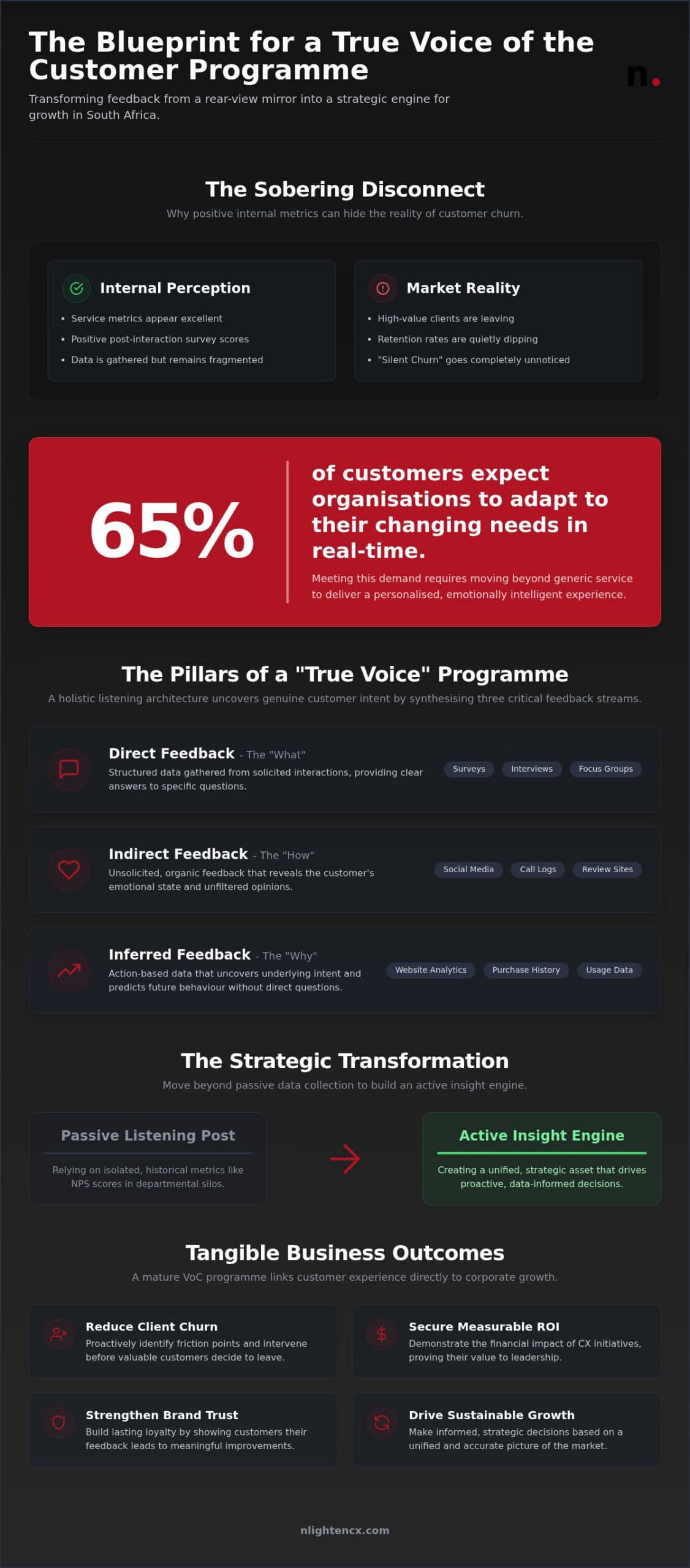
Perhaps the most dangerous threat to your stability is “silent churn.” These are the customers who encounter a problem, decide it isn’t worth the effort to complain, and simply move their business elsewhere. Without a formalised listening architecture, you remain blind to these exits until the revenue impact is already felt. A sophisticated VoC strategy identifies these quiet frustrations, allowing you to intervene and secure the relationship before the customer reaches a breaking point.
The Growth Blind Spot in National Organisations
Ignoring the customer voice creates a profound growth blind spot that no amount of aggressive marketing can fix. When leadership is disconnected from the frontline experience, acquisition costs skyrocket because the bucket you are trying to fill is leaking. Retention is the most cost-effective path to sustainability. This is why measuring customer experience roi for businesses has become the non-negotiable metric for 2026. By linking feedback to financial outcomes, you can prove the tangible value of consistent service quality and its direct impact on long-term brand equity.
Meeting the Expectations of the Modern South African Consumer
Modern consumers are better informed and more demanding than ever before. Industry data indicates that 65% of customers now expect companies to adapt to their changing needs in real-time. Meeting this expectation requires more than just efficiency; it requires an emotional connection. When a customer feels heard and sees their feedback reflected in your service delivery, trust is established. In a competitive landscape, this trust is your strongest defence against brand switching. A formalised programme ensures that every interaction is an opportunity to strengthen that bond rather than a risk of breaking it.
The Pillars of a True Voice of the Customer Program
A world-class voice of customer program South Africa rests on a foundation of holistic listening. Most organisations make the mistake of equating feedback with survey scores alone. This is a narrow view that often misses the strategic mark. To capture the “True Voice,” you must look beyond the literal words. You need to understand the underlying intent and the unspoken expectations that drive consumer behaviour. This requires a three-tiered approach to data collection: direct, indirect, and inferred feedback.
Implementing this effectively across national touchpoints requires sophisticated customer experience research methodologies. It isn’t enough to collect data in silos; you must synthesise these streams to create a single, clear picture of the customer journey. Whether it’s a digital interaction or a face-to-face consultation, every touchpoint must be an active listening post. This ensures that no segment of your audience is left unheard.
Direct vs. Indirect Feedback Channels
Direct channels like interviews and focus groups are invaluable for deep dives into specific issues. They provide the structured “what” of the customer experience. However, indirect channels, such as call logs and social media sentiment, often provide the “how” of the customer’s emotional state. By employing systematic customer insight gathering, you can unify these disparate channels into a cohesive strategy. This prevents data fragmentation and ensures that a complaint on social media is treated with the same strategic weight as a formal survey response.
The Role of Emotional Connection in Data
Data without context is merely noise. Why did a long-term client suddenly switch to a competitor despite a history of “satisfied” ratings? The raw data might show the exit, but it won’t reveal the emotional disconnect that preceded it. Identifying the emotional drivers behind loyalty and churn is the key to driving strategic change. You must move from merely documenting “what happened” to diagnosing “why it happened.” This level of insight allows you to build a more resilient business model that anticipates needs rather than just reacting to failures. Organisations that invest in CX design for service businesses understand that building emotional architecture into every touchpoint is what separates transactional interactions from lasting client relationships. If you’re looking to deepen these insights, the True Voice Of Customer Program offers a structured path to mastering this emotional intelligence.
Active vs. Passive VoC: Moving Beyond Simple Surveys
Passive data collection is the silent killer of strategic growth. Many organisations believe they are listening simply because they have a “contact us” form or a post-purchase survey in place. These are merely listening posts; they are reactive systems that wait for the customer to initiate the dialogue. To build a resilient voice of customer program South Africa, you must transition from these passive structures to active insight engines. An active approach seeks out the truth of the customer experience before a problem becomes a permanent exit.
Passive systems are increasingly vulnerable to survey fatigue. This is a significant hurdle amongst South African consumers who are tired of repetitive, non-actionable questionnaires that offer no clear value in return. When response rates plummet, your data pool shrinks and becomes biased. To counter this, a sophisticated strategy must employ a comprehensive customer touchpoint analysis. This methodology allows you to capture feedback at the exact moment of interaction, providing a much higher degree of accuracy and relevance than a generic email sent days after the fact.
Why NPS is Not a Strategy
A high Net Promoter Score is frequently used as a corporate shield against necessary change. It’s a useful metric, but it is not a strategy. If your organisation focuses solely on the number, you ignore the complex human behaviour that drives it. A single score cannot tell you why a customer is frustrated or what would make them more loyal. This is where CX research South Africa becomes essential. By balancing quantitative scores with deep qualitative feedback, you uncover the narrative behind the data. You move from knowing that customers are happy to understanding the specific actions required to keep them that way. To objectively benchmark where your organisation stands, using a customer experience score quiz can transform a simple diagnostic into a sophisticated roadmap for loyalty and long-term profitability.
Sentiment Analysis and Text Mining
Unstructured data, such as call recordings, emails, and social media mentions, often holds the most valuable strategic insights. Traditional surveys often miss the nuance found in these organic interactions. By employing sentiment analysis and text mining, you can identify patterns that a manual review would overlook. Are clients frequently using words like “delayed” or “confusing” in their correspondence? Identifying these emerging brand crises before they escalate into public PR disasters is a hallmark of a mature VoC programme. It turns every complaint into a clear opportunity for product or service improvement, ensuring your business remains adaptive and competitive.
Implementing Your VoC Strategy: A Roadmap for National Success
Executing a successful voice of customer program South Africa requires more than just intent; it demands a rigorous operational roadmap. You cannot manage what you do not measure, and you certainly cannot fix what you haven’t mapped. The first step involves defining clear objectives that align with your broader business growth goals. Are you looking to reduce churn in a specific province or increase the lifetime value of your corporate clients? Once defined, you must design a cross-channel feedback architecture that captures data where your customers actually live, whether that is via WhatsApp, email, or physical branch visits.
Establishing a ‘closed-loop’ process is the pivot point where data becomes action. This involves integrating these real-time insights into your broader CX strategy and journey mapping. By visualising the feedback against the actual customer path, you can identify systemic failures rather than just treating symptoms. Finally, you must measure the ROI of every change implemented. Did the R100,000 invested in a new digital onboarding process actually result in a 5% increase in retention? If you can’t answer that, your programme is a cost centre, not a strategic engine. Conducting a thorough customer experience maturity assessment at this stage helps you benchmark your current capabilities and prioritise the initiatives that will deliver the greatest measurable impact.
Closing the Loop with Customers
Recovering a dissatisfied customer is often more profitable than acquiring a new one. An effective “inner loop” process ensures that frontline staff follow up with unhappy clients immediately to resolve individual grievances. Conversely, the “outer loop” focuses on systemic issues identified through aggregated data. Building a culture of accountability means that every team member understands their role in this cycle. If a customer takes the time to provide feedback, the organisation has a professional obligation to demonstrate that the message was received and acted upon.
Breaking Down Departmental Silos
A truly effective voice of customer program South Africa must be an organisation-wide initiative. It is a common mistake to leave VoC solely in the hands of the marketing department. Insights must be shared fluidly with sales, product development, and operations teams to be effective. When everyone from the boardroom to the warehouse sees the same customer reality, friction disappears. Utilising professional customer experience management training is the most efficient way to align your workforce with these strategic goals. To ensure your roadmap leads to genuine growth, consider partnering with an expert to implement the True Voice Of Customer Program.
Partnering with nlightencx for Strategic VoC Excellence
Data is a commodity in the modern business environment, yet genuine insight remains a rare competitive advantage. Many South African firms possess mountains of feedback but lack the strategic mechanism to convert that data into sustainable profitability. This is where a professional partnership becomes essential. A robust voice of customer program South Africa requires more than technical implementation; it demands a deep understanding of local market dynamics and organisational psychology. nlightencx serves as a high-level strategic ally, providing the expertise needed to turn fragmented feedback into a unified engine for growth.
We don’t believe in one-size-fits-all solutions. Our methodology is rooted in the reality that every organisation faces unique friction points. By bridging the gap between high-level research and practical, profitable execution, we ensure that your CX initiatives deliver a measurable return on investment. Whether you’re struggling with high churn or looking to refine your market position, our approach provides the clarity and structure necessary to move forward with confidence. We help you navigate the complexities of the national market by focusing on outcomes that matter to your bottom line.
The True Voice Of Customer Program Advantage
The signature nlightencx True Voice Of Customer Program offers a bespoke framework tailored to your organisation’s specific challenges. We’ve spent years identifying the subtle shifts in consumer behaviour that generic software often misses. Our focus is on the “True Voice,” the emotional drivers that dictate long-term loyalty. We move your organisation beyond survey scores, helping you build lasting connections that protect your market share against aggressive competitors.
Building Internal Capability with Masterclasses
Strategic excellence shouldn’t depend on external consultants indefinitely. We empower your team through professional CX Masterclasses and training sessions. This ensures your customer-centric culture is built on professional competence rather than just good intentions. A key resource in this journey is the Customer Experience Handbook for Practitioners, which serves as a vital guide for ongoing development. It’s time to stop guessing and start growing.
Contact nlightencx today to schedule a strategic audit of your current feedback systems and discover how the True Voice Of Customer Program can transform your organisation’s future.
Securing Your Market Position in 2026 and Beyond
Establishing a sophisticated voice of customer program South Africa is no longer an optional exercise for national organisations; it’s a fundamental requirement for long-term survival. You’ve seen that passive listening and isolated metrics like NPS are insufficient to stop the silent churn that erodes profitability. True growth requires a structured framework that unifies fragmented data and uncovers the emotional drivers behind customer behaviour. By bridging the gap between raw feedback and strategic execution, you transform your organisation into an agile, insight-driven leader.
Stability in a volatile landscape demands a partner who understands the specific friction points of the local market. nlightencx offers authoritative CX consulting and specialised training to ensure your team has the skills to act on every insight. It’s time to move beyond the “what” and master the “why” of your customer experience. Your market is evolving rapidly. Don’t let your organisation get left behind. Your customers are already speaking; it’s time you started listening with strategic intent.
Transform your customer insights with the nlightencx True Voice Of Customer Program
Frequently Asked Questions
What is the primary goal of a Voice of the Customer programme?
The primary goal is to transform raw feedback into a strategic engine for retention and profitability. It moves beyond simple data collection to create a structured system where every insight leads to a specific business action. By aligning customer needs with operational changes, organisations can secure their market position and drive sustainable growth. This process ensures that the customer’s perspective is integrated into corporate decision-making rather than being relegated to a secondary marketing task.
How does a VoC program differ from a standard customer satisfaction survey?
A standard survey is a point-in-time measurement, whereas a voice of customer program South Africa is a continuous, closed-loop strategic framework. Standard surveys often focus on historical satisfaction scores that provide little forward-looking value. In contrast, a robust VoC programme captures direct, indirect, and inferred feedback across the entire journey. It prioritises the “why” behind the data, allowing leadership to identify emotional drivers and systemic friction points that a simple questionnaire would inevitably miss.
Which metrics should we use to measure the success of our VoC programme in South Africa?
Success should be measured through a combination of financial outcomes and operational efficiency. Key metrics include Customer Lifetime Value (CLV), the cost of customer acquisition, and tangible retention rates. Whilst NPS is a common indicator, it must be balanced against the ROI of specific CX initiatives. In the South African context, tracking the reduction in “silent churn” and the speed of resolving “inner loop” grievances provides a far more accurate picture of programme health.
Can a VoC programme help reduce customer churn in B2B markets?
Yes, a VoC programme is highly effective at reducing churn in B2B markets by identifying early warning signs of dissatisfaction. B2B relationships are complex and often involve multiple stakeholders with different needs. A structured listening framework allows you to map these relationships and identify where your service is failing to meet professional expectations. By proactively addressing these issues through journey mapping, you build deeper trust and prevent clients from exploring competitor offerings when contracts come up for renewal.
How long does it take to see results from a Voice of the Customer program?
Initial tactical wins, such as resolving individual customer complaints, can be seen within the first thirty days of implementation. However, strategic results like a measurable reduction in national churn rates typically take six to twelve months to manifest fully. This timeline allows for the collection of baseline data, the implementation of systemic changes, and the subsequent measurement of their impact. A long-term commitment is necessary to transform these insights into a permanent competitive advantage for the organisation.
What tools are necessary for managing a national VoC initiative?
A national initiative requires a combination of centralised data management systems and decentralised action tools. You need a platform capable of aggregating unstructured data from call logs, emails, and social media sentiment. Additionally, a robust “closed-loop” alert system is essential to notify frontline staff when immediate intervention is required. These technical tools must be supported by professional CX training to ensure that employees across all provinces understand how to interpret and act on the data provided.
How do we encourage customers to provide honest and detailed feedback?
Encouraging detailed feedback requires demonstrating that the customer’s input has a direct impact on your service delivery. South African consumers are more likely to engage when they believe their voice will be heard and respected. Avoid generic, lengthy surveys that lead to fatigue. Instead, use transactional “micro-surveys” at key touchpoints and share “you said, we did” updates. When customers see that their previous feedback resulted in tangible improvements, they are far more willing to provide honest, qualitative insights.
Is it better to build a VoC programme internally or hire a consultancy?
Building an internal team provides long-term continuity, but hiring a consultancy offers immediate access to specialised expertise and proven frameworks. Most successful organisations adopt a hybrid approach. They partner with experts to implement the voice of customer program South Africa whilst simultaneously investing in Masterclasses to build internal capability. This ensures the programme is established correctly from the start whilst empowering your own staff to manage the day-to-day operations with professional confidence and strategic clarity.