

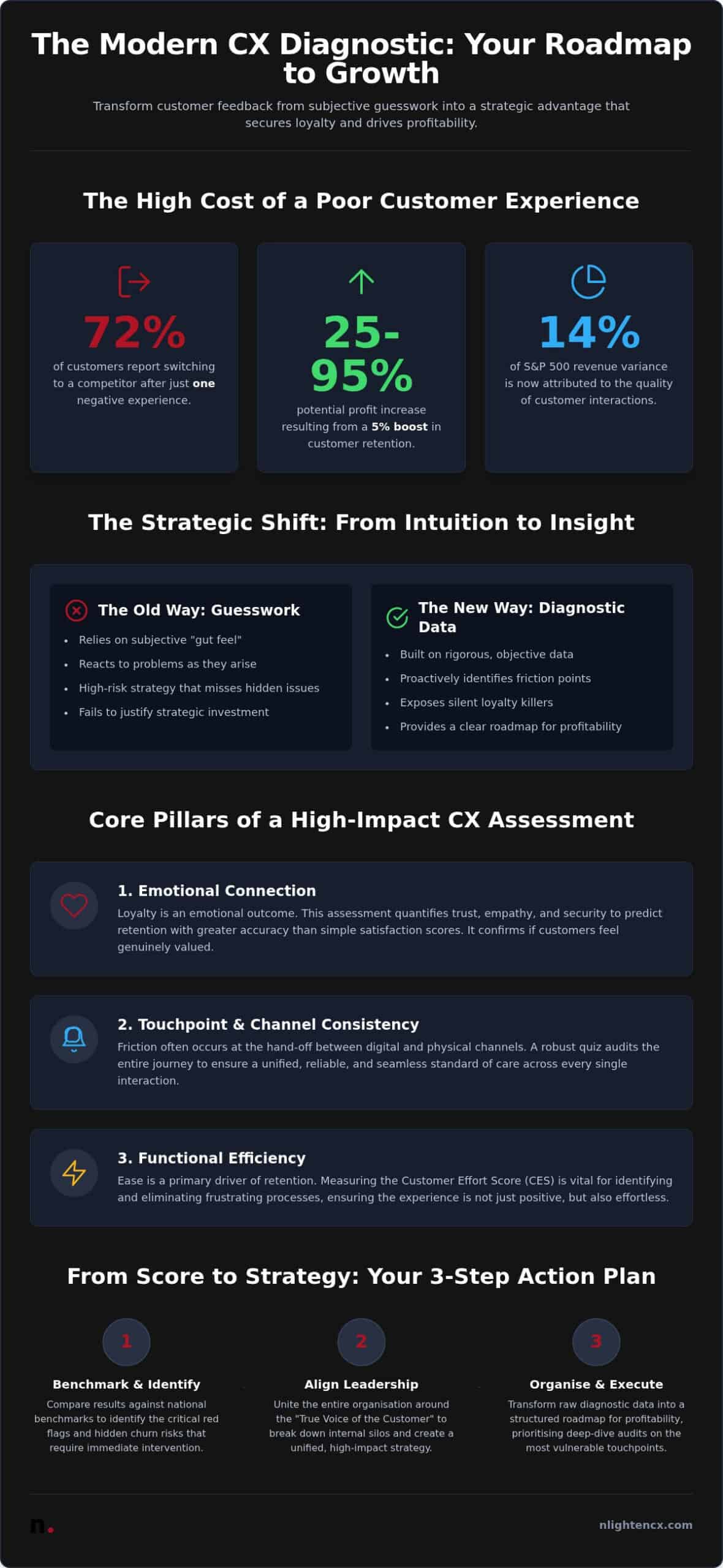
72% of customers now report switching to a competitor after just one negative experience. This isn’t just a statistic; it’s a direct threat to your business stability in a landscape where the margin for error has evaporated. You likely recognise the frustration of rising churn rates despite your team’s best efforts to provide decent service. Without objective data from a customer experience score quiz, justifying strategic investment to your board remains an uphill battle. Is your current strategy truly driving growth, or are you merely reacting to friction points as they arise?
This guide will show you how to transform a simple diagnostic score into a sophisticated roadmap for customer loyalty and long-term profitability. We’ll explore where your business sits compared to national benchmarks, how to link CX metrics to tangible ROI, and the exact steps needed to organise your service delivery into a unified, high-performing system. Discover how to turn raw data into a strategic advantage that secures your position in a competitive market and ensures your organisation is built for sustainable growth.
Key Takeaways
- Utilise a customer experience score quiz to replace subjective guesswork with rigorous diagnostic data, identifying the hidden loyalty killers that threaten your business stability.
- Evaluate the emotional resonance and multi-channel consistency of your brand to ensure a seamless and reliable journey for every client across all digital and physical touchpoints.
- Master the 2026 national benchmarks to recognise the critical red flags that signal imminent churn and require immediate strategic intervention to protect your revenue.
- Align your leadership team around the “True Voice of Customer” to transform raw diagnostic results into a structured, high-impact roadmap for long-term profitability.
- Transition from basic metrics to a comprehensive maturity assessment by conducting deep-dive audits on your most vulnerable touchpoints and service delivery gaps.
Why Every Business Needs a Customer Experience Score Quiz in 2026
Relying on intuition is a high-risk gamble that most modern enterprises can no longer afford. In a market where the average S&P 500 company now attributes 14% of its revenue variance to the quality of its customer interactions, “gut feel” has become a liability. You need a rigorous, data-driven approach to identify the friction points that erode your bottom line. A customer experience score quiz functions as more than a simple checklist; it’s a strategic diagnostic that exposes the silent loyalty killers lurking within your operations. By benchmarking your performance against national standards, you transform vague sentiment into a leading indicator of future business profitability.
The Evolution of CX Measurement
Traditional feedback loops are failing to keep pace with modern consumer behaviour. Whilst standardised metrics are widely used to provide a snapshot of satisfaction, they frequently miss the structural disconnects in a multi-channel journey. Static surveys often capture “polite” feedback rather than the raw truth of a customer’s frustration. You must move beyond basic scores to a more holistic assessment that accounts for emotional resonance and digital efficiency. A CX score quiz is a diagnostic tool for organisational health that identifies exactly where your internal processes are failing to meet external expectations. It moves the conversation from “how are we doing?” to “where are we failing?” with brutal, necessary clarity.
The Business Case for Regular Assessment
Consistency is the foundation of trust, yet it’s often the first thing to slip as an organisation scales. There’s frequently a dangerous gap between how a leadership team perceives their service quality and the actual experience of the end-user. Closing this gap is a financial necessity. Since 72% of customers report switching to a competitor after just one negative experience, the cost of ignorance is staggering. Regular assessment creates a sense of professional urgency, forcing teams to confront reality before churn rates spike. These assessments reveal the friction points that drive customers away, such as inconsistent service quality across digital and physical channels. Research shows a 5% increase in customer retention can lead to a 25-95% increase in profits. You aren’t just measuring scores; you’re securing your future revenue streams by ensuring every touchpoint delivers on your brand promise.
The Core Components of a High-Impact CX Assessment
A robust customer experience score quiz must look beneath the surface of transactional data to examine the structural integrity of your client relationships. Utilising a customer experience score quiz allows you to identify whether your brand promise is a reality or merely marketing fluff. It’s not enough to know if a customer was satisfied with a single purchase; you need to understand the architecture of their loyalty. This requires a diagnostic framework that evaluates the emotional resonance of your brand alongside the functional efficiency of your delivery. High-impact assessments prioritise the elements that actually drive retention: trust, ease, and consistency.
Measuring Emotional Connection
Loyalty is an emotional outcome, not a logical one. You can provide a functional service that still leaves a customer feeling indifferent, which is why your diagnostic must capture the nuance of human perception. Quantifying trust and security within your framework allows you to predict retention with far greater accuracy than simple satisfaction scores. Empathy isn’t a “soft skill” in the current landscape; it’s a measurable driver of long-term stability. When clients feel understood and valued, they’re less likely to switch to a competitor, even when faced with a minor service failure.
Touchpoint and Channel Consistency
Friction often occurs at the hand-off between digital and physical channels, creating a disjointed journey that frustrates the user. If your online portal is seamless but your telephone support is sluggish, the entire brand perception is compromised. Transforming the Customer Experience requires a unified strategy that breaks down internal silos and ensures a reliable standard of care across every interaction. You must ensure the “True Voice of Customer” is the guiding force behind every touchpoint to prevent the inconsistencies that drive churn. Efficiency is equally critical, which is why measuring your Customer Effort Score (CES) is vital. A good CES is typically above 5.5 on a 7-point scale, indicating that you’ve removed the hurdles that make doing business with you a chore. If you’re unsure where your organisation stands, exploring a structured Voice of Customer Program can provide the deep-dive insights needed to identify these critical friction points.
Interpreting Your CX Score: Benchmarks and Red Flags
Raw data is a liability if you lack the framework to interpret it. You must understand how your results compare to national standards to determine if your organisation is leading the market or falling behind. When benchmarking CX quality, context is everything. For instance, whilst the cross-industry average for CSAT is approximately 78%, a score in the low 70s for a software company might signal a crisis, given that their industry average is closer to 80%. A customer experience score quiz serves as your primary diagnostic, but its true value lies in identifying the specific red flags that precede customer churn.
The 2026 CX Maturity Scale
We categorise performance into three distinct tiers based on diagnostic results. Organisations scoring between 0 and 40 are in the “Danger Zone”. These models are typically reactive and fragmented, where service quality is inconsistent and customer frustration is high. A score of 41 to 70 represents the “Stagnation Plateau”. Here, experiences are functional and consistent, but they lack the emotional resonance required to drive long-term loyalty. Finally, scores between 71 and 100 indicate strategic market leadership. These businesses don’t just solve problems; they leverage empathy and predictive service to create a competitive moat that rivals find impossible to breach.
Spotting Critical Friction Points
Data from a customer experience score quiz is most powerful when it highlights specific departmental failures that are otherwise hidden by aggregate metrics. Are your digital channels outperforming your physical touchpoints? Is there a disconnect between your sales promise and service delivery? Recognising these warning signs is essential for protecting your customer experience roi for businesses. When scores begin to dip or plateau, it’s a clear signal to move from a preliminary diagnostic to a comprehensive customer experience maturity assessment. This deeper dive allows you to prioritise strategic CX research, ensuring your investment is directed where it will have the most significant impact on your bottom line. Don’t wait for churn rates to spike before you interrogate the health of your customer relationships.
How to Organise Your CX Strategy Post-Quiz
The customer experience score quiz provides the diagnostic data, but the data alone cannot fix a systemic service failure. You must move from diagnostic results to a structured execution plan that addresses every friction point identified during the assessment. This begins with a deep-dive audit of your lowest-scoring touchpoints to understand the root cause of consumer frustration. Once these gaps are identified, you must align your leadership team around the “True Voice of Customer” to ensure that strategic decisions are driven by actual sentiment rather than internal assumptions. Without this alignment, your CX initiatives will likely remain siloed and underfunded.
To achieve sustainable improvement and protect your market position, follow this structured path:
- Conduct a granular audit of specific service failures highlighted by the quiz.
- Unify leadership objectives to ensure CX investment is prioritised at the board level.
- Invest in professional customer experience management training to close critical skill gaps within your teams.
- Refine your journey mapping based on empirical insights rather than guesswork.
- Establish a continuous feedback loop to monitor score improvements and adjust tactics in real time.
From Insights to Actionable Design
Bridging the gap between raw data collection and service redesign is the most critical phase of your strategy. You must prioritise “quick wins” that provide immediate relief to customers whilst simultaneously planning for long-term structural shifts in your service model. Journey mapping transforms score data into a visual roadmap that highlights exactly where the customer experience deviates from your brand promise. This visual tool allows your design team to see the friction points from the customer’s perspective, making it easier to build a journey that is both efficient and emotionally resonant. For organisations ready to move beyond diagnostics, following a rigorous customer experience implementation roadmap ensures that these insights are translated into a cohesive, high-ROI strategy rather than a collection of disconnected initiatives.
Upskilling the Organisation
Your organisational score will not improve without a fundamental shift in internal culture. Masterclasses play a vital role in building a customer-centric mindset across all departments, ensuring that even back-office functions understand their impact on the final experience. Empowering employees to take ownership of the customer score creates a sense of collective responsibility for the brand’s success. When every staff member is equipped with the right tools and mindset, service quality becomes a consistent reality rather than an occasional occurrence. If you are ready to move beyond basic metrics, take our Free CX Quiz to establish your baseline and begin your journey toward strategic market leadership.
Elevating Your Organisation with nlightencx
Identifying your current performance level is a vital first step, but a diagnostic result is only as valuable as the actions it inspires. Most organisations treat the final number as a finish line; we view it as the starting line for strategic transformation. Our customer experience score quiz provides the foundational data you need to stop guessing and start growing. By moving beyond surface-level metrics, you can begin to uncover the unique market advantages that your competitors are likely overlooking. We position your business to transition from reactive problem-solving to proactive market leadership through specialised CX research South Africa designed to turn raw data into a sustainable growth engine.
Complex environments require more than generic advice. For organisations operating in the professional services or industrial sectors, we provide expert advisory for customer journey mapping for B2B. This process ensures that every high-stakes interaction is engineered for maximum trust and reliability. We help you organise your internal processes so that the service quality remains consistent, regardless of which department handles the client. This results-oriented approach ensures that your CX investment is always linked to tangible business stability and revenue protection.
The True Voice of Customer Advantage
Authentic growth occurs when you bridge the gap between transactional data and emotional connection. Our signature Voice of Customer Program South Africa allows you to hear the unvarnished truth of your client base, providing the clarity needed to redesign failing service models. We employ a multidisciplinary approach to research and design, ensuring that your strategy is both analytical and empathetic. This methodology helps national firms scale their customer loyalty by identifying the specific emotional drivers that keep clients from switching to a competitor after a single negative experience.
Your Path to CX Mastery
Securing your organisation’s future requires a commitment to ongoing professional development and strategic refinement. You can accelerate this process by enrolling your leadership and frontline teams in the nlightencx Masterclass series, where we build the customer-centric mindset necessary for long-term success. For practitioners seeking a structured reference for daily operations, our CX Handbook serves as a definitive guide for maintaining service standards and navigating complex client interactions. We provide the tools, the training, and the strategic oversight needed to turn your initial customer experience score quiz results into a permanent competitive advantage. Ready to see where you stand? Take our Free CX Quiz today and begin the journey toward organisational excellence.
Securing Your Strategic Advantage in 2026
The margin for error in customer retention has effectively disappeared. You’ve seen how a customer experience score quiz acts as a critical diagnostic tool, exposing the hidden friction points that threaten your revenue. By interpreting your results against national benchmarks, you can move from reactive firefighting to proactive market leadership. Success in this landscape isn’t about intuition; it’s about the precise application of data to strengthen your professional relationships and ensure long-term stability.
Sustainable growth requires more than just a score. It demands a fundamental shift in how you organise your internal culture and service delivery. Whether you’re leveraging our signature True Voice of Customer Program or upskilling your teams through expert-led CX Masterclasses, the goal remains the same: transforming raw data into long-term loyalty. Our national strategic advisory is here to ensure that your path to CX maturity is both logical and profitable. Don’t leave your organisation’s stability to chance. Take the first step toward a more resilient and customer-centric future today.
Benchmark your business today with our Free CX Quiz
Frequently Asked Questions
What is a customer experience score quiz and how does it work?
It is a diagnostic tool that evaluates organisational health across multiple touchpoints. It works by asking targeted questions about service consistency, emotional resonance, and channel alignment. The results provide a baseline score that reveals friction points in the customer journey. This allows your leadership team to move from intuitive guesswork to data-driven strategy. It serves as the primary entry point for a more comprehensive maturity assessment.
How often should our organisation conduct a CX assessment?
You should ideally conduct a full assessment annually, with smaller diagnostic pulses every quarter. Regular evaluation is necessary because market conditions and consumer behaviours shift rapidly. Frequent checks ensure that service standards don’t slip as you scale. This rhythm allows you to identify emerging loyalty killers before they impact your bottom line. Consistent benchmarking is the only way to ensure your CX strategy remains relevant and effective.
Can a simple quiz really predict customer churn?
Yes, because it identifies the specific red flags that precede a customer’s decision to leave. By measuring the “ease of doing business” and emotional trust, a customer experience score quiz highlights where expectations are not being met. Research shows that 72% of customers switch after just one bad experience. Identifying these friction points early is a predictive necessity for maintaining business stability and protecting your future revenue streams.
What is the difference between a CX score and NPS?
NPS measures a customer’s likelihood to recommend you, whilst a CX score provides a holistic view of the entire journey’s health. A CX score includes metrics like Customer Effort Score (CES) and emotional resonance. Whilst NPS is a useful snapshot of sentiment, a CX assessment offers deeper diagnostic data. It reveals the structural reasons why a customer might or might not recommend your brand, providing a much clearer roadmap for improvement.
How do we use our quiz results to improve our ROI?
Use the data to prioritise investments in high-impact service improvements. By fixing the low-scoring touchpoints identified in the quiz, you reduce churn and increase lifetime value. A 5% increase in retention can boost profits by 25-95%. Linking these score improvements to reduced acquisition costs provides a clear, logic-driven case for the financial return. This allows you to justify CX investment to the board with objective, tangible data.
What are the most important metrics to include in a CX score?
You must include Customer Satisfaction (CSAT), Net Promoter Score (NPS), and Customer Effort Score (CES). Additionally, measuring emotional drivers like trust and security is vital for a comprehensive view. These metrics combined allow you to see the functional and emotional health of your client base. A balanced score ensures you aren’t ignoring the silent friction points that erode long-term loyalty and threaten your overall business sustainability.
Is a CX score quiz relevant for B2B organisations?
Absolutely, as B2B relationships are built on trust and consistent delivery over long cycles. In complex B2B environments, the cost of losing a single client is significantly higher than in B2C. A customer experience score quiz helps B2B firms identify disconnects in long-term journey mapping. It ensures that your brand promise remains consistent across multiple stakeholders and high-stakes service interactions, which is essential for securing long-term contracts.
How do we ensure our staff are aligned with our CX goals after the quiz?
Alignment requires a mix of transparent data sharing and professional upskilling. Conduct a CX Masterclass to build a customer-centric mindset across all departments. Use the quiz results to create clear, departmental KPIs that empower staff to take ownership of the experience. When teams understand how their specific actions influence the final score, they are more likely to maintain high service standards and deliver a consistent, reliable brand experience.