

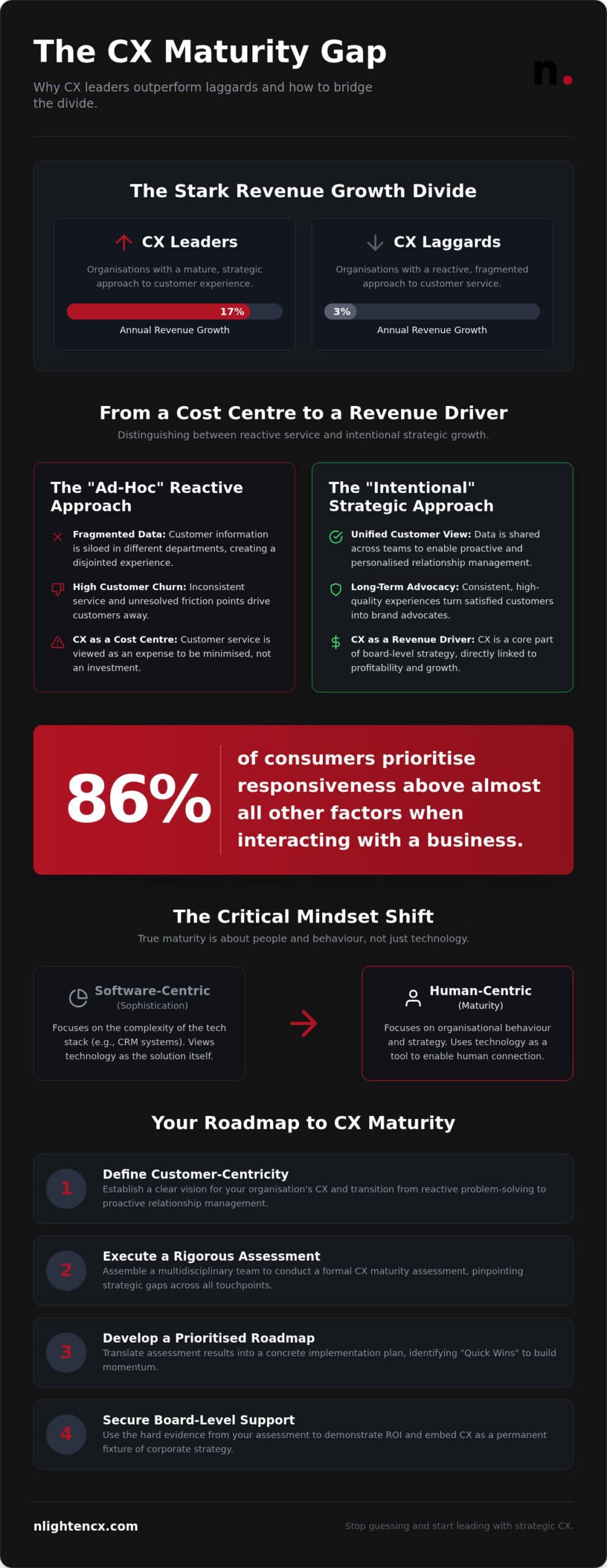
Why do CX leaders achieve 17% revenue growth whilst laggards stagnate at a mere 3%? This stark performance gap, highlighted by research in 2026, isn’t a matter of chance or simply purchasing a more expensive CRM. It’s the direct result of a rigorous customer experience maturity assessment that looks past surface-level metrics to the heart of organisational culture. You’ve likely experienced the sting of high customer churn even when your technical systems seem functional. Disjointed data across your departments creates a fragmented reality that your customers notice immediately.
You understand that a reactive, ad-hoc approach to service is no longer a viable strategy when 86% of consumers prioritise responsiveness above almost all else. We’ll help you bridge the gap between fragmented service and strategic excellence. This article delivers a definitive benchmark for your current operations and a prioritised roadmap of actions for the coming year. We’ll explore how to integrate employee experience and AI infrastructure to drive measurable profitability and long-term security. It’s time to stop guessing and start leading.
Key Takeaways
- Define your organisation’s level of customer-centricity to transition from reactive problem-solving to proactive relationship management.
- Execute a rigorous customer experience maturity assessment to pinpoint strategic gaps and ensure a consistent experience across every national touchpoint.
- Distinguish between “Ad-Hoc” reactive service and “Intentional” strategic growth to transform your CX from a cost centre into a powerful revenue driver.
- Assemble a multidisciplinary team to avoid biased self-assessment and uncover the reality of how customer data is shared across your departments.
- Translate assessment results into a prioritised implementation roadmap that identifies “Quick Wins” to demonstrate ROI and secure long-term board-level support.
Defining Customer Experience Maturity in the Modern Business Environment
What does it truly mean to be a customer-centric organisation? It is the difference between merely surviving and dominating your market. Customer experience maturity is the measurable degree to which an organisation integrates the customer experience into its operational DNA and high-level strategy. It represents a fundamental shift in how a business perceives its purpose. Instead of viewing customers as transactional data points, mature organisations treat them as the primary drivers of sustainable growth. Conducting a regular customer experience maturity assessment allows leaders to see past the noise of daily operations and evaluate if their culture actually supports their claims of being “customer-first.”
The transition from reactive problem-solving to proactive relationship management is the hallmark of a mature business. This shift directly impacts the customer experience ROI for businesses, turning satisfied users into long-term advocates who drive profitability. Strategic CX is the ultimate goal for national organisations. It moves the customer from the periphery of a meeting agenda to the very centre of every board-level decision. By aligning your internal culture with external expectations, you create a resilient business model that thrives in volatile markets.
Why a Formal Assessment is Non-Negotiable in 2026
Identify hidden friction points that cause customer churn whilst your competitors are standing still. Without a structured customer experience maturity assessment, you’re operating with blind spots that can lead to catastrophic losses. These assessments create a common language for CX across every department, from marketing to finance, ensuring that everyone understands their role in the customer journey. They provide the hard evidence needed to justify budgetary requirements by showing clear gaps in organisational capability that software alone cannot fix. By quantifying these gaps, you turn abstract complaints into a concrete business case for investment.
The Shift from Software-Centric to Human-Centric Maturity
A CRM alone doesn’t equate to a mature customer experience. It’s a tool, not a strategy. Sophistication describes the complexity of your tech stack, whilst maturity describes the depth of your organisational behaviour and strategic alignment. Many businesses mistake “going digital” for “being mature.” True maturity focuses on the role of emotional connection in driving long-term loyalty. It’s about how your team thinks and reacts, not just what tools they use. When you prioritise human-centric maturity, you ensure that every digital interaction feels personal, relevant, and valuable to the end user.
The Definitive CX Maturity Checklist: Identifying Strategic Gaps
How do you move beyond ad-hoc service to achieve sustainable growth? You need a structured framework that exposes the cracks in your foundation before they become chasms. Most organisations fail because they view CX as a departmental task rather than a business-wide strategy. A professional customer experience maturity assessment reveals these hidden weaknesses by evaluating your operations against global excellence standards. To be truly effective, your maturity must be consistent across all national touchpoints, ensuring that a customer in one region receives the same high-standard behaviour as a customer in another.
Pillar 1: Strategy and Leadership Commitment
Does the board review CX metrics with the same vigour as financial reports? Without executive buy-in, any CX initiative is doomed to remain a vanity project. You need a documented CX strategy that aligns perfectly with your overall business goals. Leaders must actively model customer-centric behaviour amongst their teams to foster a culture of genuine care. This accountability ensures that CX remains a permanent fixture of the corporate identity. For public sector benchmarks, the Digital.gov Customer Experience resources provide an excellent baseline for establishing robust governance frameworks.
Pillar 2: Customer Insight and Research Capabilities
Data is useless without context. How frequently is systematic customer insight gathering performed within your organisation? If you are looking for CX research South Africa, you must move beyond basic surveys. A mature organisation implements a “True Voice of Customer” program that reaches deep into customer sentiment and emotional drivers. Stop letting insights get trapped in departmental silos. Instead, share them across the business to drive unified action and informed decision-making at every level.
Pillar 3: Design and Journey Mapping
Are your customer journeys designed based on research or internal assumptions? Many businesses build paths that suit their internal processes rather than the customer’s actual needs. Performing regular customer journey mapping for B2B or B2C segments is vital for identifying friction points that cause churn. Establish a formal process for CX Design to ensure that every new product or service launch is inherently customer-focused. If you’re unsure where your organisation currently stands, taking a customer experience score quiz can provide immediate clarity on your path to maturity.
Choosing Your Methodology: How to Conduct an Effective Assessment
How do you ensure your findings reflect reality rather than corporate optimism? A rigorous customer experience maturity assessment requires a methodical approach that prioritises objectivity over convenience. First, you must define the scope. Are you assessing a single product line or the entire national organisation? Attempting to fix everything at once often leads to fixing nothing at all. Clarity of scope ensures that your resources are directed where they can generate the most immediate impact.
Assemble a multidisciplinary team to lead the process. Including voices from finance, operations, and marketing prevents the biased self-assessment that occurs when CX is graded only by those who manage it. Once internal views are gathered, you must validate them against the customer’s actual perspective. Utilising a voice of customer programme South Africa allows you to cross-reference internal scores with real-world sentiment. This step is critical. If your internal team thinks you’re a leader but your customers feel neglected, your strategy is built on sand.
Conduct a comprehensive “Gap Analysis” as your final step. This process identifies the distance between your current state and your desired maturity level. It provides the logical foundation for your customer experience maturity assessment, allowing you to move from vague intentions to a prioritised list of strategic actions.
Internal vs External Assessments: Which is Right for You?
DIY assessments are cost-effective but carry the significant risk of “Internal Blindness.” It’s difficult to grade your own homework objectively when departmental politics or personal biases are involved. You may find that teams are hesitant to highlight failures for fear of repercussion. Hiring a CX consultant provides neutral benchmarking against national standards. These experts identify the friction points that internal teams have grown accustomed to, offering a fresh perspective that is essential for genuine organisational transformation.
The Role of the CX Score Quiz
A full-scale audit can feel overwhelming for teams just beginning their journey. A quick diagnostic tool can build necessary momentum by providing an immediate, high-level baseline. We recommend using the nlightencx customer experience score quiz to capture an initial snapshot of your performance. This quiz acts as a tactical entry point for your strategic planning, offering enough data to secure initial buy-in from stakeholders before you commit to a deeper, more intensive organisational audit.
Interpreting Your Results: Moving Beyond Ad-Hoc Customer Interactions
Once you complete your customer experience maturity assessment, the real work begins. It is not merely about assigning a grade; it is about holding a mirror to your organisational culture. The results typically categorise a business into one of four distinct stages. Understanding these levels is vital for identifying the specific friction points that prevent you from scaling your success. Where does your organisation truly sit when the corporate veneer is stripped away?
Level 1: Ad-Hoc/Reactive. At this stage, CX is viewed as a cost centre rather than a growth driver. The business is in perpetual fire-fighting mode, treating “fixing complaints” as a primary success metric rather than a systemic failure of process. Level 2: Intentional. You have a vision and perhaps a dedicated CX lead, yet execution remains fragmented. The desire to be customer-centric exists, but it lacks the consistent operational discipline required to move the needle on retention.
Level 3: Strategic. CX is integrated into daily operations with regular measurement and purposeful design. You are no longer guessing what customers want because you have the data to prove it. Level 4: Embedded. This is the gold standard. The customer is at the centre of every decision, and your superior experience has become your primary competitive advantage. To reach this peak, you must move beyond tactical fixes and embrace a holistic transformation. If you are ready to accelerate this journey, the True Voice of Customer Program provides the strategic framework needed to elevate your operations.
Common Pitfalls: Why Organisations Get Stuck at Level 2
The “Silo Trap” is perhaps the most common reason for stagnation. CX is often wrongly relegated to marketing or customer service, whilst finance and operations continue to prioritise internal efficiencies over customer health. Another hurdle is “Data Overload.” Many businesses collect feedback with enthusiasm but fail to act on the insights, leading to analysis paralysis. Finally, “Short-Termism” often kills maturity. Prioritising immediate sales targets over the long-term emotional connection with your base creates a fragile business model that cannot withstand market shifts.
Benchmarking Against National Competitors
Understand what “Good” looks like in the South African service landscape. In a market where consumer expectations are rising at an unprecedented rate, being “average” is a dangerous strategy. National leaders are already utilising sophisticated research to differentiate their brands. Use your maturity score to identify exactly where you can outpace your rivals, whether through more responsive service or more intuitive digital journeys. Differentiation is no longer about the product you sell; it is about the experience you curate around it.
Developing Your CX Roadmap: Strategic Growth through nlightencx Expertise
A customer experience maturity assessment is a diagnostic tool; it is not the cure itself. Without a prioritised implementation roadmap, your findings will simply collect dust whilst your competitors continue to erode your market share. You must translate the granular data of your customer experience maturity assessment into a logical sequence of strategic actions that balance long-term transformation with immediate operational gains. Identifying “Quick Wins” is your first priority. These are low-effort, high-impact changes that resolve obvious customer pain points and demonstrate immediate ROI to the board. Securing this early executive trust is essential for unlocking the budget and resources required for the more complex cultural shifts ahead. A customer experience implementation roadmap provides the clarity your teams need to move from a state of reactive confusion to one of purposeful, strategic growth.
Upskilling Your Team for the Journey Ahead
Professional training is the bedrock of sustained maturity. You cannot expect a Level 2 team to deliver Level 4 results without a fundamental upgrade in their analytical and empathetic capabilities. This transition requires comprehensive customer experience management training to align every staff member with your new strategic vision. Our CX Masterclasses are designed to equip leadership and operational teams with the specific methodologies needed to manage complex journeys. To ensure these gains are permanent, the CX Handbook serves as a daily reference for standardising excellence. It provides a common language and set of behaviours that prevent your organisation from slipping back into ad-hoc habits.
The nlightencx Approach to Maturity Evolution
We guide firms away from the exhausting cycle of “fixing” broken experiences and toward the superior state of “designing” them from the outset. This evolution requires multidisciplinary consulting to achieve national scale whilst maintaining the deep emotional connections that drive loyalty. The True Voice of Customer Program stands as the definitive vehicle for reaching Level 4 maturity, offering the continuous, high-fidelity insight needed to outpace rising consumer expectations. Your evolution from a service-led business to an experience-led leader begins with a single, objective measurement of your current state. Take our Free CX Quiz to start your maturity journey today and secure the strategic advantage your organisation deserves.
Securing Your Strategic Advantage in 2026
True CX maturity is the ultimate safeguard against market volatility. You’ve seen how a rigorous customer experience maturity assessment exposes the gaps between intent and execution. It’s the difference between merely managing complaints and designing an ecosystem where loyalty is inevitable. By moving beyond ad-hoc interactions, you position your organisation as a resilient leader in an increasingly crowded landscape. Success in 2026 isn’t about having the most expensive CRM; it’s about having the most integrated strategy.
The path to excellence requires a fundamental shift in organisational behaviour. We’re trusted by leading national brands to facilitate this transformation through our signature True Voice of Customer Program and expert-led CX Masterclasses. Don’t let another quarter pass with disjointed data and rising churn. Every day you wait is a day your competitors gain ground. It’s time to stop guessing and start leading with data-driven confidence.
Take the Free CX Quiz and assess your organisation’s maturity to gain the clarity you need for sustainable growth. Your journey toward Level 4 excellence is a logical progression that begins with one honest measurement. We’re ready to help you bridge the gap.
Frequently Asked Questions
What exactly is a customer experience maturity assessment?
A customer experience maturity assessment is a structured evaluation of how well an organisation integrates customer-centricity into its operations and strategy. It measures the shift from reactive problem-solving to proactive relationship management. By using a framework to score different pillars like leadership and research, businesses can identify exactly where they sit on the spectrum of excellence. It provides the logical evidence needed to move from ad-hoc service to a strategic, revenue-driving function.
How long does a full CX maturity audit typically take?
A comprehensive audit usually spans four to eight weeks, depending on the size and complexity of the organisation. This timeframe allows for deep-dive interviews, data analysis, and the validation of internal scores against external customer sentiment. Rushing the process often leads to surface-level findings that fail to uncover root causes. A methodical approach ensures that the resulting roadmap is both accurate and actionable for long-term stability and strategic growth.
Who should be involved in the assessment process?
Success requires a multidisciplinary team that includes executive leadership, department heads, and frontline staff. You shouldn’t leave the evaluation solely to the marketing or customer service departments. Finance and operations must be involved to ensure that CX goals align with broader business objectives and budgetary constraints. This cross-functional approach prevents departmental silos from skewing the results and ensures that the final strategy has board-level buy-in across the entire national organisation.
Can a small business benefit from a maturity model?
Yes, smaller organisations can use maturity models to build a solid foundation for scalable growth. Whilst the complexity of the audit might differ, the core principles of understanding customer behaviour and designing consistent journeys remain the same. Starting early allows a business to avoid the ad-hoc trap that often plagues larger firms. It ensures that customer-centricity is baked into the culture before the organisation reaches national scale and faces more complex operational challenges.
What is the difference between CX maturity and NPS?
NPS is a single metric that measures customer sentiment at a specific point in time, whilst a customer experience maturity assessment evaluates the organisational capabilities that produce those scores. NPS tells you what your customers think; maturity tells you why they think it and whether your business has the systems to improve it. Maturity is a holistic view of your strategy, leadership, and research, rather than just a transactional feedback score.
How often should we re-assess our CX maturity level?
You should conduct a formal re-assessment every twelve to eighteen months to track progress and adjust your roadmap. Markets shift and consumer expectations rise, so a score that was competitive last year might be average today. Regular audits ensure that your organisation remains focused on strategic growth rather than slipping back into reactive habits. It provides the continuous benchmarking needed to maintain a high-level competitive advantage amongst your national rivals.
What are the first steps to take if our score is lower than expected?
Don’t panic; a low score is a clear diagnostic starting point for improvement. Begin by identifying quick wins that can be implemented immediately to show ROI and build momentum. You should then consider professional CX Training or a CX Masterclass to upskill your leadership team. Using a Free CX Quiz can help you pinpoint specific friction points before committing to a larger, more intensive transformation program like the True Voice of Customer.