

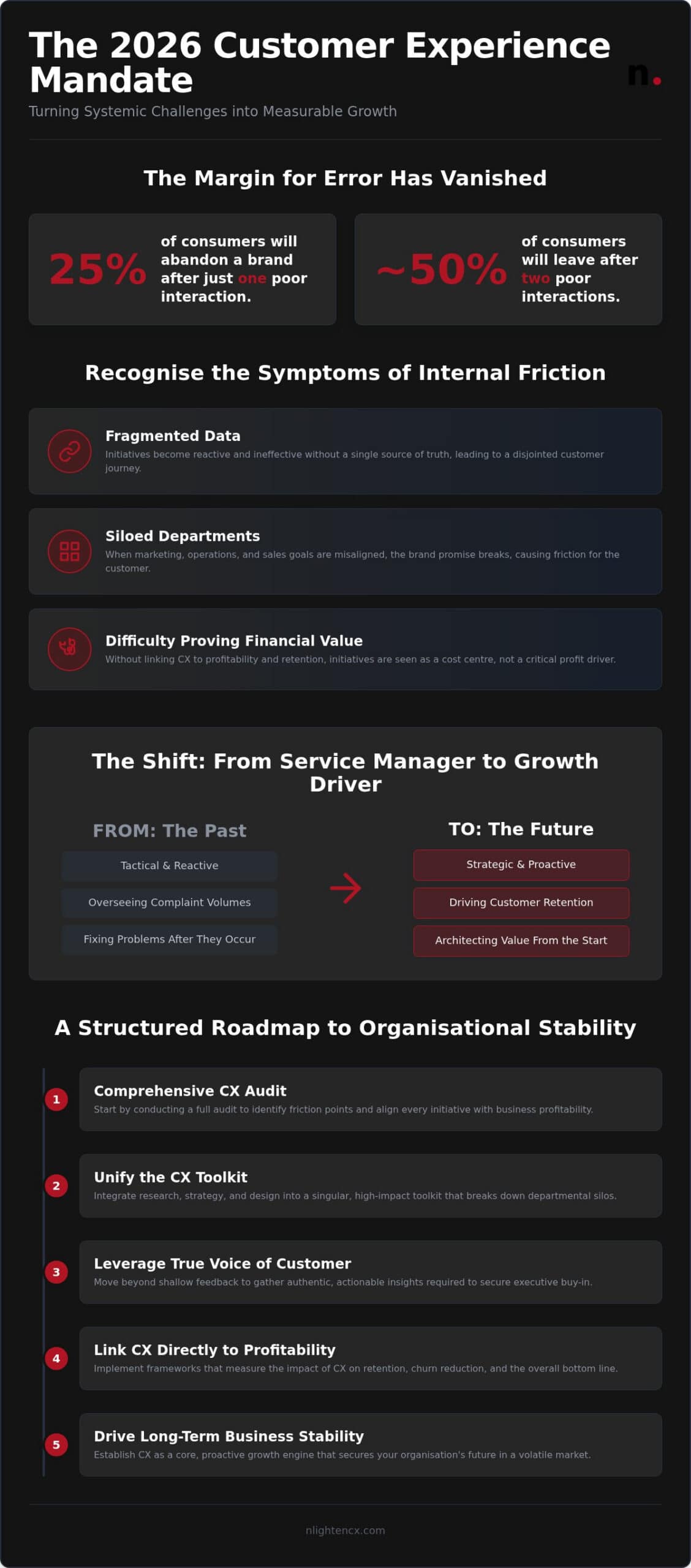
What if a single operational misstep cost you twenty-five per cent of your customer base instantly? The margin for error in 2026 has effectively vanished. Recent data shows that one in four consumers will abandon a brand after just one poor interaction, whilst nearly half will leave after two. This customer experience handbook for practitioners addresses the internal friction that precedes these losses. You likely recognise the symptoms: fragmented data, siloed departments, and the constant struggle to prove the financial value of design to a sceptical board. It’s a high-stakes environment where enthusiasm for customer-centricity often fails to translate into actual business stability.
At nlightencx, we’ve designed this guide to serve as your strategic engine for turning these systemic challenges into measurable growth. You’ll master the essential frameworks, tools, and methodologies required to lead high-impact CX initiatives with confidence. We’ll provide a clear roadmap for implementation, from reliable journey mapping to the logic needed to link CX directly to profitability and retention. It’s time to move beyond theory and establish a structured path toward professional excellence and organisational security.
Key Takeaways
- Redefine your professional role from a service manager to a strategic growth driver by prioritising high-impact retention strategies in a volatile market.
- Master the essential frameworks within this customer experience handbook for practitioners to unify research, strategy, and design into a singular, high-impact toolkit.
- Bridge the gap between theoretical design and operational reality by identifying why most programmes fail and how to eliminate jargon that alienates colleagues.
- Implement a structured five-step roadmap that starts with a comprehensive CX audit to align every initiative with overarching business profitability.
- Leverage the True Voice of Customer methodology to provide the authentic insights required to secure executive buy-in and drive long-term business stability.
The Practitioner’s Mandate: Why a Strategic Handbook is Essential in 2026
In 2026, the role of the CX practitioner has undergone a fundamental transformation. You are no longer a service manager tasked with overseeing complaint volumes or monitoring call centre queues. You are a strategic growth driver. Businesses facing economic volatility have realised that aggressive customer acquisition is an expensive, often unsustainable gamble. The real battle for business stability is won through retention. This shift requires a rigorous, documented approach. A customer experience handbook for practitioners is not merely a collection of best practices; it is a strategic engine that ensures every department moves in the same direction.
Why is a formalised handbook so critical now? Without a single source of truth, CX initiatives become fragmented and reactive. You end up chasing symptoms rather than curing systemic issues. A professional handbook provides the logical framework needed to align cross-functional teams, from marketing to operations. It moves the organisation from a state of “putting out fires” to one of proactive experience design, where every touchpoint is intentional and every interaction is measured against its impact on the bottom line.
The Shift from Service to Experience Strategy
Customer service is tactical. It is a reactive function that solves problems after they occur. In contrast, customer experience is strategic and holistic. Whilst service is a component of the journey, CX encompasses the entire emotional and physical interaction a person has with your brand. Practitioners who fail to make this distinction risk losing professional credibility. To secure executive buy-in, you must move beyond measuring simple satisfaction. You must prove how you are building deep emotional connections that prevent churn. At nlightencx, we believe that sustainability depends on your ability to transition from a fixer of problems to an architect of value.
Managing Complexity in a Multi-Channel Environment
The complexity of 2026 lies in the seamless integration of digital and physical realms. Customers don’t see channels; they see one brand. If your mobile app promises speed but your physical delivery is sluggish, the experience is broken. This friction is usually the result of departmental silos where data isn’t shared and goals are misaligned. Your mandate is to break these silos down. By utilising a customer experience handbook for practitioners, you can implement a unified CX roadmap. This roadmap serves as a diagnostic tool to identify friction points before they result in customer loss. It provides the clarity needed to ensure that whether a customer interacts via an AI copilot or an in-person representative, the brand promise remains identical.
Core Components of a Modern Customer Experience Toolkit
A professional toolkit must be built on three non-negotiable pillars: Research, Strategy, and Design. Without research, you’re guessing. Without strategy, you’re wandering. Without design, you’re failing to execute. This customer experience handbook for practitioners serves as the blueprint for integrating these elements into a cohesive business function. You must ensure your measurement frameworks speak the language of the boardroom, focusing on hard numbers rather than soft sentiment. By grounding your initiatives in operational data, you transform CX from a “nice-to-have” department into a critical profit centre.
Advanced Customer Journey Mapping for B2B and B2C
Static maps are relics. In 2026, you need dynamic journey management that links persona behaviour to real-time operational data. You must identify critical moments of truth across the entire lifecycle, a concept explored deeply in The Truth About Customer Experience. For those operating in complex industrial or service sectors, specialised customer journey mapping for B2B is essential. This approach allows you to manage longer sales cycles and the intricate needs of multiple stakeholders whilst maintaining a consistent brand promise across every touchpoint.
The True Voice of Customer Methodology
Standard feedback is often shallow and misleading. Our signature True Voice of Customer Program moves beyond generic surveys to uncover the authentic drivers of loyalty and frustration. It’s about gathering systematic insights that lead to actionable change, not just collecting data for data’s sake. Are you closing the feedback loop? If you don’t tell the customer how you’ve used their input to improve their experience, you’re wasting a prime opportunity for engagement. Authentic insight requires a rigorous methodology that filters out noise and highlights the emotional drivers of your specific customer base.
Calculating ROI and Business Impact
Can you link your CX initiatives to the balance sheet? If not, your programme is at constant risk during budget reviews. You need a framework that connects experience design to financial outcomes like reduced churn and increased Customer Lifetime Value (CLV). Referencing our guide on customer experience roi for businesses will help you quantify the cost-to-serve and prove the profitability of your strategy. Mastering the financial logic within a customer experience handbook for practitioners is what separates a designer from a strategist. If you’re ready to operationalise these concepts, our CX Masterclass provides the practical immersion needed to lead these high-stakes initiatives with confidence.
Navigating the Gap Between CX Theory and Operational Reality
Why do so many CX programmes fail despite having “good” intentions? The blunt reality is that most initiatives collapse in the “messy middle” of implementation. It’s easy to design a beautiful journey map in a boardroom; it’s significantly harder to ensure a retail clerk or a software engineer executes that vision under pressure. This disconnect often stems from a lack of operational grounding. A customer experience handbook for practitioners acts as the bridge between high-level theory and the daily grind of business operations. It transforms abstract concepts into repeatable, documented processes that every employee can follow.
You must view yourself as a change agent, not just a researcher. Your role is to dismantle the silos that prevent a seamless experience. When departments speak different languages, the customer feels the friction. Marketing talks about brand sentiment, whilst Finance focuses on cost-to-serve. By using a formalised handbook, you create a common vocabulary for the entire organisation. This ensures that every team, regardless of their function, understands exactly how their specific actions impact the customer’s journey and, ultimately, the company’s profitability.
Avoiding the Trap of Professional Jargon
Professional jargon is a barrier to progress. If you present “empathy maps” and “emotional resonance” to a business owner without context, you’ll likely lose their support. You must advocate for clear, logic-driven communication. Translate your CX metrics into business-critical KPIs that the boardroom understands. Instead of discussing “customer delight,” talk about “churn reduction” and “increased referral rates.” Simplifying complex experience concepts for executive presentations doesn’t diminish your expertise; it demonstrates your understanding of business stability. Speak the language of the CFO to secure the resources you need for long-term growth.
Building an Authentic Customer-Centric Culture
Strategy alone is insufficient without deep-rooted cultural alignment. You can have the most sophisticated roadmap in the world, but if your staff don’t feel empowered to act, the strategy will fail. Authentic customer-centricity starts with leadership modelling the right behaviour. It requires a systematic approach to internal development, such as customer service culture training, to ensure that every team member is aligned with the brand promise. When culture and strategy are in sync, the customer experience handbook for practitioners becomes a living document that guides every decision, from the executive suite to the front line.
Operationalising Your CX Handbook: A Five-Step Implementation Roadmap
Transitioning from strategic theory to operational reality requires a disciplined, step-by-step approach. You cannot expect organisational change to occur through osmosis. It requires a structured framework that dictates how every department interacts with the customer. A customer experience handbook for practitioners provides this necessary structure, serving as the definitive guide for your implementation efforts. Follow this five-step roadmap to ensure your CX initiatives move beyond the planning phase and start delivering measurable business stability.
- Step 1: Conduct a comprehensive CX audit. You must identify current friction points across all channels. Be blunt in your assessment; ignoring internal failures only delays the inevitable customer churn.
- Step 2: Define a clear strategy. Your objectives must align with overarching business goals. If your CX strategy doesn’t contribute to profitability or retention, the board will view it as a cost, not an investment.
- Step 3: Map the journeys. Document both the “as-is” and “to-be” customer journeys. This process requires direct stakeholder input from every department to ensure the proposed changes are operationally feasible.
- Step 4: Implement the True Voice of Customer programme. Establish a systematic way to monitor progress. Use authentic feedback to validate that your changes are actually improving the customer’s experience.
- Step 5: Continuously refine. CX is not a project with a finish line. Use data-driven insights to iterate on your design and stay ahead of evolving consumer expectations.
Securing Executive Buy-In and Alignment
Your handbook will remain a shelf-document without active support from senior leadership. You must present the handbook as a strategic asset that secures future revenue, rather than a design project. Finding “CX champions” amongst senior management is vital for breaking through departmental resistance. For those tasked with leading these high-level conversations, customer experience leadership training provides the persuasive logic needed to align the board with your vision. When the executive team views CX as a pillar of business security, resource allocation becomes a logical necessity rather than a struggle.
Designing Feedback Loops That Drive Change
A functional feedback loop is the heartbeat of a successful CX programme. It follows a strict four-stage mechanics: Listen, Analyse, Act, and Review. Most organisations fail at the “Act” stage, gathering data but never changing the underlying operational workflows. You must integrate feedback into daily routines to ensure that friction is addressed with speed. If a customer reports a failure, the recovery must be swift and visible. Speed in response is often more valued by consumers than perfect initial execution. To build this capability within your team, consider implementing our True Voice Of Customer Program to establish a permanent link between customer sentiment and operational action.
Elevating Professional Standards with the nlightencx CX Handbook
The nlightencx CX Handbook represents the definitive reference for the modern practitioner. It avoids the fluff typical of generic guides, opting instead for a rigorous, multidisciplinary approach that fuses research, strategy, and design. This customer experience handbook for practitioners provides the foundational logic required to navigate the high-stakes corporate environment. It ensures that your initiatives are not just creative, but commercially viable and anchored in reality. By integrating these three pillars, you establish a professional standard that prioritises business stability and long-term client retention. Research identifies the friction; strategy defines the remedy; design executes the solution. This methodical flow is what transforms a standard service manager into a high-impact strategic asset.
Strategic Insights from the nlightencx Masterclass
Masterclasses serve as the logical next step for those ready to move from theory to execution. Whilst the handbook provides the map, our customer experience management training provides the tactical skills needed to navigate the terrain. You will learn amongst seasoned mentors who understand the unique friction points within the national corporate landscape. These sessions bring the principles of the customer experience handbook for practitioners to life through practical, high-stakes application. You’ll be challenged to apply the logic of the handbook to real-world scenarios, identifying exactly where current designs fail to meet the standard of excellence. It is an investment in your professional credibility and your company’s future security.
Professional Certification and Continuous Development
Professional standards are not static. In a landscape defined by rapid technological shifts and evolving consumer behaviours, staying current is a prerequisite for survival. You should view the handbook as a living document that evolves alongside your professional growth. It provides a structured path for continuous development, ensuring your skills remain relevant in an increasingly competitive market. How does your current strategy measure up against these elevated standards? We invite you to take our Free CX Quiz to assess your organisational maturity and uncover the hidden friction points in your customer journey. This diagnostic tool provides the clarity needed to prioritise your next strategic move and secure your position as a leader in the field.
Equip your team with the tools to retain and grow your client base.
Securing Your Strategic Advantage in 2026
The transition from reactive customer service to proactive experience strategy is no longer optional. It’s the difference between business stability and rapid customer churn. By mastering the frameworks within this customer experience handbook for practitioners, you’ve established the foundation for a more resilient organisation. You now have the tools to bridge the gap between high-level theory and operational reality, ensuring every touchpoint delivers measurable value to both the customer and the boardroom.
Success depends on your ability to implement these principles with precision. Whether you are utilising our signature True Voice of Customer methodology or engaging in expert-led Masterclasses for corporate teams, the goal remains the same: results-oriented growth. nlightencx provides the strategic advisory needed to turn these insights into a permanent competitive edge. Download the nlightencx CX Handbook and start transforming your customer strategy today.
The path toward professional excellence is clear. With a structured approach and the right tools, you’re ready to lead your organisation into a more profitable, customer-centric future.
Frequently Asked Questions
What should be included in a comprehensive CX handbook for practitioners?
A comprehensive customer experience handbook for practitioners must integrate three core pillars: research, strategy, and design. It should contain standardised journey mapping templates, clear ROI calculation frameworks, and protocols for establishing operational feedback loops. Beyond theory, it needs to provide a logical roadmap for cross-functional alignment. This ensures that every department, from marketing to finance, operates from a single source of truth to drive business stability and long-term growth.
How does a customer experience handbook differ from a standard service manual?
A standard service manual is tactical and reactive, focusing primarily on how staff should handle specific complaints or enquiries. In contrast, a CX handbook is a strategic engine that governs the entire customer journey. It shifts the focus from merely resolving issues to proactively designing interactions that build emotional connection. Whilst a manual manages the moment, a handbook manages the relationship, ensuring sustainability through a holistic understanding of customer behaviour and perception.
Can a well-implemented CX handbook help reduce customer churn?
Yes, a structured handbook is a vital tool for reducing customer churn. By documenting reliable methods for identifying friction points, you can address issues before they lead to abandonment. In the current landscape, data shows that nearly half of consumers will leave a brand after just two bad experiences. Implementing the frameworks within a customer experience handbook for practitioners allows you to establish the speed and consistency required to retain your client base in a volatile market.
Is journey mapping a standard component of the nlightencx handbook?
Journey mapping is a fundamental component of the nlightencx handbook. We view it as the primary diagnostic tool for understanding the current state of your customer interactions. Our approach moves beyond static maps, encouraging practitioners to create dynamic models that link persona behaviour to real-time operational data. This ensures that your journey management remains relevant and capable of identifying critical moments of truth across both digital and physical touchpoints.
How often should a practitioner update their organisation’s CX strategy?
You should view your CX strategy as a living framework rather than a static document. Whilst a comprehensive audit and formal strategy review should occur annually, the operational reality of 2026 requires continuous, data-driven refinement. Practitioners must stay agile to respond to evolving consumer expectations and shifting regulatory landscapes. Regular pulse checks through systematic feedback ensure your strategy remains aligned with the actual needs of your customers and the overarching goals of the business.
What is the True Voice of Customer programme mentioned in the handbook?
The True Voice of Customer programme is our signature methodology for uncovering authentic insights. It moves beyond the limitations of generic sentiment surveys to identify the true emotional and physical drivers of customer loyalty. By establishing a systematic feedback loop, the programme ensures that the insights you gather lead to actionable organisational change. It is designed to filter out statistical noise and provide the clarity needed to secure executive buy-in for your initiatives.
How do nlightencx masterclasses complement the handbook content?
nlightencx Masterclasses provide the practical immersion required to bring the handbook principles to life. Whilst the handbook serves as a definitive reference guide, the Masterclasses offer expert-led mentorship and hands-on application within a corporate environment. This allows practitioners to operationalise the theory, testing frameworks against real-world friction points. It is the logical next step for those who want to lead high-impact initiatives with the confidence of a seasoned strategic partner.
Is the nlightencx handbook suitable for both B2B and B2C practitioners?
The nlightencx handbook is specifically designed to address the unique challenges of both B2B and B2C environments. For B2B practitioners, it provides frameworks for managing complex stakeholder relationships and long sales cycles. For those in B2C, it offers strategies for maintaining consistency across high-volume digital and physical touchpoints. Regardless of your sector, the core logic remains the same: reducing friction and building emotional connections is the most reliable path to business stability.