

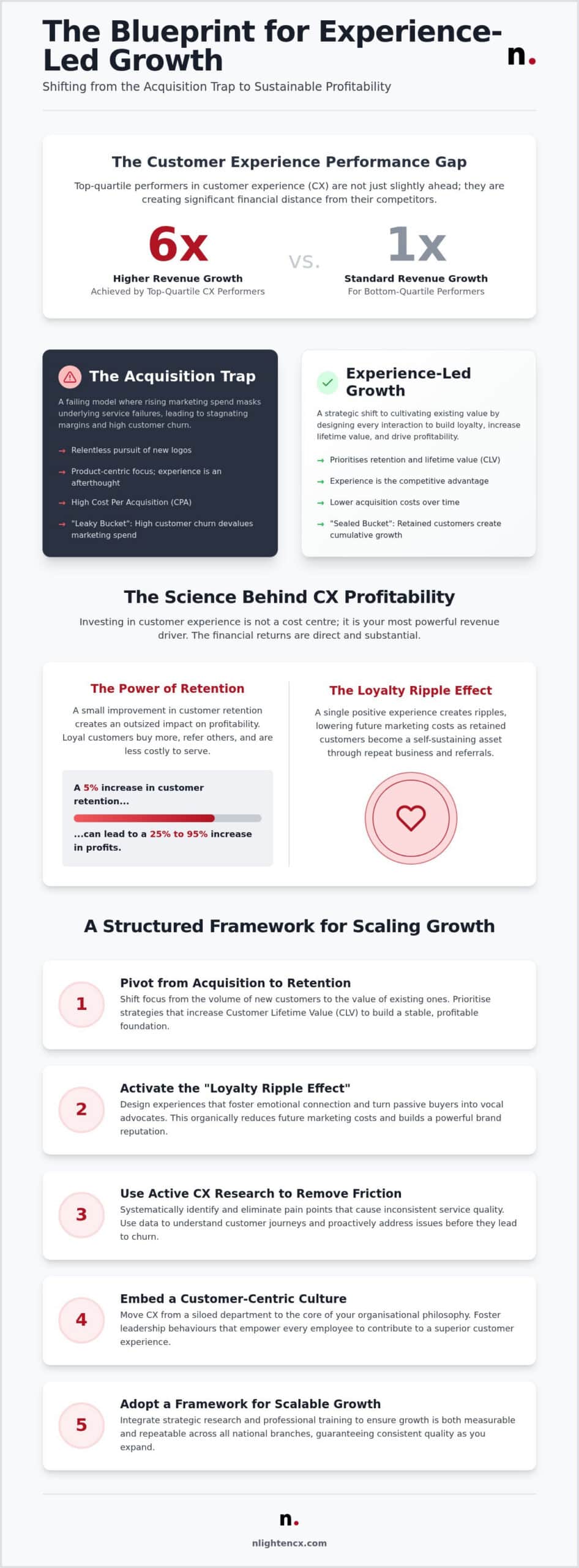
Top-quartile performers in customer experience are now achieving revenue growth that is six times higher than their bottom-quartile counterparts. This isn’t a coincidence. It’s a structural reality of the 2026 market. You’re likely feeling the pressure of rising acquisition costs and the frustration of stagnating growth despite your heavy marketing spend. You know that winning a customer is just the first step, yet maintaining consistent quality across every national branch remains an elusive goal. Achieving sustainable business growth through customer experience requires more than just reactive service. It demands a fundamental shift in how you value every interaction.
Transition from a traditional acquisition model to an experience-led strategy using the strategic blueprint provided in this guide. We’ll explore how to dismantle the silos that cause inconsistent service and replace them with a robust framework designed for long-term profitability. Prioritise retention to lower acquisition costs and increase customer lifetime value. From the unification of customer data to the implementation of agentic AI, we’ll outline the steps to secure your market dominance.
Key Takeaways
- Learn how to pivot from the “acquisition trap” to sustainable business growth through customer experience by prioritising retention and long-term lifetime value.
- Understand the “loyalty ripple effect”. This shows how strategic CX design directly influences your bottom line whilst reducing future marketing costs.
- Discover why active CX research is essential for identifying and removing the friction points that hinder consistent service quality across national branches.
- Identify the leadership behaviours needed to embed a customer-centric philosophy into your organisational culture. Don’t treat it as a siloed department.
- Explore a structured framework for scaling. This integrates professional masterclasses and strategic research to ensure your growth is both measurable and repeatable.
The Growth Ceiling: Why Traditional Sales Models Fail in 2026
Growth is not a sales figure. For many national organisations, the relentless pursuit of new logos has become a fiscal treadmill that leads nowhere. You’re likely seeing your marketing spend climb whilst your net margins remain stubbornly flat. This is the acquisition trap. It occurs when the cost of winning a new client exceeds the value they bring before they churn. True business growth through customer experience represents a strategic pivot. It’s the transition from a frantic search for new volume to the methodical cultivation of existing value. By 2026, the average S&P 500 company attributes 14% of its revenue variance to the quality of its customer experience. This isn’t a soft metric. It’s the emotional architecture that supports your entire commercial structure.
Why do national firms hit a ceiling? They often rely on aggressive sales tactics to mask underlying service failures. This approach is unsustainable. When your acquisition costs are high, you cannot afford a revolving door of clients. You must recognise that What is Customer Experience? is actually a question of business resilience. If your interactions aren’t designed to secure loyalty, you’re simply renting customers rather than owning your market share.
The Shift from Product-Centric to Experience-Led Growth
Functional advantages are short-lived. In the current market, any product feature you launch can be mimicked by a competitor within weeks. Your product is no longer your moat; your experience is. National market expectations have shifted from mere utility to emotional connection. CX-led growth is the deliberate design of every touchpoint to foster loyalty. It creates a proprietary way of doing business that competitors cannot easily replicate. This strategic shift ensures that your brand remains the preferred choice even when price points are similar.
The Hidden Cost of Customer Churn amongst National Firms
Churn is a silent killer of brand equity and investor confidence. When a national firm loses a client, the damage extends far beyond a lost invoice. It erodes the reputation of your branches and signals a lack of operational control. Think of your business as a bucket. Aggressive sales pour water in, but inconsistent service quality creates holes at the bottom. This “leaky bucket” syndrome devalues every marketing pound you spend. CX design acts as the sealant for these holes. It ensures that the growth you achieve is cumulative rather than temporary, providing the stability necessary for long-term expansion.
The Science of Experience: How CX Designs Profitability
Profitability is the ultimate validator of strategy. Whilst many leaders view CX as a cost centre, the data suggests it’s actually your most potent revenue driver. There’s a direct correlation between customer experience ROI for businesses and long-term financial health. When you shift your focus to the science of interaction, you unlock the ‘loyalty ripple effect’. This phenomenon describes how a single retained customer lowers future marketing expenses by providing steady revenue without the recurring tax of acquisition fees. Achieving business growth through customer experience means turning your customer base into a self-sustaining asset.
Quantifying the ROI of Customer Loyalty
Financial sustainability relies on the balance between Customer Lifetime Value (CLV) and Cost Per Acquisition (CPA). If your CPA is rising whilst your CLV remains stagnant, your business model is under threat. Research indicates that a 5% increase in customer retention can lead to a 25% to 95% increase in profits. This dramatic jump occurs because loyal customers buy more, refer others, and require less hand-holding. High-quality service reduces the volume of expensive support tickets and complaints, allowing your team to focus on value-added activities rather than fire-fighting.
The Power of Emotional Connection in Service Design
Logic gets you in the door, but emotion keeps you in the room. Developing an emotional connection in customer service transforms passive buyers into vocal brand advocates. In a national landscape where consumers often feel like just another number, the psychology of ‘belonging’ becomes a competitive advantage. Rational benefits like price and speed are easily matched; however, the feeling of being understood is unique. This is why Customer Experience and Business Growth are so tightly linked. Customers who feel an emotional bond are less price-sensitive and more forgiving during a crisis. They don’t just use your service; they identify with it.
Data-driven CX research is the tool that makes this connection possible. It identifies the friction points that cause operational waste and frustrate your clients. By removing these hurdles, you streamline your path to profitability. If you’re ready to accelerate business growth through customer experience, a robust CX Strategy can help you map out a more profitable future.
Strategic CX Research: Turning Data into Growth Engines
Data is the foundation of any sustainable expansion strategy. For national organisations, the challenge isn’t a lack of information; it’s the absence of insight. You cannot achieve business growth through customer experience by relying on anecdotal evidence or gut feelings. You need CX research South Africa to uncover the friction points that remain hidden in high-level reports. Passive feedback mechanisms, such as automated surveys, often provide a distorted view. They capture the opinions of the extremely satisfied or the deeply disgruntled, leaving a massive gap where the ‘unbiased truth’ of the average customer resides. Active, strategic research methodologies bridge this gap. They allow you to organise your service standards around actual behaviour rather than assumptions. This unification is vital for national brands. It ensures that a client in one region receives the same high-calibre experience as a client in another, protecting your brand equity across the entire footprint.
Implementing a True Voice of Customer Program
Traditional metrics like Net Promoter Scores (NPS) offer a snapshot, not a strategy. To drive growth, you must implement a True Voice of Customer program. This is a multidisciplinary approach to listening that looks beyond the score. It seeks to understand the ‘why’ behind the ‘what’. By moving into deep behavioural insights, you transform raw data into actionable growth initiatives. This isn’t about making customers happy; it’s about making your business indispensable. It involves triangulating feedback from multiple sources to create a 360-degree view of the relationship. This strategic depth is the engine of business growth through customer experience, turning every piece of feedback into a competitive advantage. It allows you to predict future needs whilst your competitors are still reacting to past complaints.
Customer Journey Mapping for Complex National Markets
In complex sectors, the path to purchase is rarely linear. This is particularly true for customer journey mapping for B2B and national service providers. Blind spots often occur at the hand-off points between departments or branches. If your service quality is inconsistent across different regions, your brand reputation suffers. Mapping every touchpoint allows you to identify these vulnerabilities before they lead to churn. It enables proactive problem-solving. When you understand the entire lifecycle of a client interaction, you can design interventions that secure loyalty long before a crisis occurs. This foresight is what separates market leaders from those who are perpetually stuck in a cycle of acquisition and loss.
Scaling Growth: From Strategy to Organisational Culture
CX is not a department. It is an organisational philosophy. If you treat it as a siloed function, your efforts will inevitably fail as you scale. Why do so many national firms struggle with service inconsistency? The answer lies in the disconnect between executive strategy and front-line execution. Achieving business growth through customer experience requires every employee, from the boardroom to the branch floor, to speak a unified language of value. Leadership must champion customer service quality improvement as a core business objective rather than a secondary metric. This involves a radical realignment of internal KPIs. If your staff are measured solely on speed or volume, they’ll naturally sacrifice the quality of the interaction. You must incentivise the behaviours that drive retention and long-term stability.
Maintaining a “centre of excellence” across multiple national locations is a significant operational challenge. It requires more than just a mission statement; it requires a structured framework that survives the complexities of a distributed workforce. You need to embed your CX principles into the very fabric of your culture so that excellence becomes the default behaviour rather than a managed exception. This cultural shift ensures that your growth is built on a foundation of reliability, which is the only way to secure market dominance in a competitive landscape.
The Role of CX Leadership and Training
Execution depends on competence. Comprehensive customer experience management training is essential for both front-line teams and executive leadership. Training creates a unified language for customer success within the firm, ensuring everyone understands their role in the broader growth strategy. Professional masterclasses are particularly valuable for upskilling CX practitioners, providing them with the advanced tools needed to navigate the 2026 market. When your team is equipped with the right methodology, they can move from reactive problem-solving to proactive value creation. This shared expertise is what allows a national organisation to maintain its edge whilst expanding its footprint.
Designing for Consistency across National Channels
Consistency is the hallmark of a mature brand. Distributed organisations often face “experience drift,” where service quality varies wildly between regions. Utilising CX design for service businesses ensures that your “True Voice” is heard at every interaction, regardless of geography. A definitive CX Handbook serves to standardise this excellence. It provides a clear, documented set of standards that removes the guesswork from service delivery. By designing your interactions with the same rigour you apply to your product development, you create a repeatable model for business growth through customer experience. If you are ready to professionalise your approach, consider enrolling your team in a CX Masterclass to bridge the gap between strategy and execution.
Mastering Growth with the nlightencx Framework
Sustainable expansion isn’t a matter of chance; it’s a matter of architecture. To achieve true business growth through customer experience, you need a partner who understands the underlying mechanics of loyalty. nlightencx provides the strategic framework required to transition from a reactive service model to a proactive growth engine. We integrate deep CX Research with high-level Strategy and professional Masterclasses to ensure your organisation doesn’t just improve, it transforms. Our True Voice of Customer Program acts as a catalyst for this change. It provides the unbiased data needed to make informed, high-stakes decisions. Are you ready to see where you stand? Take our Free CX Quiz to identify the friction points currently capping your potential.
Professional CX Masterclasses and Training
Knowledge is the precursor to execution. Our CX Masterclasses for corporate leaders provide a rigorous curriculum designed to solve real-world operational challenges. We don’t just teach theory. We provide the tools to build a sustainable culture of excellence. Enrolling your teams in specialised CX Training creates a unified operational language across your national branches. This ensures that every interaction is an opportunity for retention rather than a risk of churn. For practitioners seeking a foundational resource, our CX Handbook serves as a definitive guide to standardising quality and maintaining professional standards across a distributed workforce. It’s the blueprint your team needs to deliver consistent value at scale.
Consulting and Advisory for National Impact
Scaling a national organisation requires a multidisciplinary approach. We combine CX Design with detailed Customer Journey Mapping to ensure your brand’s promise is delivered at every touchpoint. Our advisory services provide the confidence and authority of a seasoned mentor who has seen the inner workings of diverse organisations. We identify the blind spots in your service delivery and help you build a “centre of excellence” that survives geographical expansion. Stop guessing why your growth has stalled and start building a resilient, experience-led organisation. Start your growth journey with a professional CX assessment from nlightencx.
Securing Your Market Dominance in 2026
Transitioning from the acquisition trap to an experience-led strategy is no longer a choice for the future; it’s a requirement for the present. By prioritising retention and plugging the “leaky bucket” of customer churn, you protect your margins and secure long-term stability. Achieving sustainable business growth through customer experience requires a fundamental shift in perspective. You must move from viewing CX as a cost centre to seeing it as your most powerful revenue engine. This transformation is supported by our signature True Voice Of Customer Program and expert CX Research and Strategy, which replace anecdotal evidence with actionable truth.
Don’t let inconsistent service quality across your national branches cap your potential. Instead, embed a culture of excellence that survives geographical expansion and complex market shifts. You have the opportunity to lead your industry by turning every interaction into a strategic asset. Start by assessing your current standing with our Free CX Maturity Quiz or take the next step in professional development. Enrol in a CX Masterclass to drive your business growth. Your path to a resilient and profitable future starts with a single, deliberate interaction.
Frequently Asked Questions
How does customer experience lead to measurable business growth?
Customer experience drives growth by increasing customer lifetime value and reducing reliance on expensive acquisition campaigns. Focus on business growth through customer experience to create a “loyalty ripple effect” where existing clients refer others. This organic expansion is far more sustainable than buying market share through aggressive sales. By 2026, top CX performers are achieving revenue growth six times higher than laggards. They prioritise the long-term value of the relationship over the immediate volume of the transaction.
What is the difference between customer service and customer experience?
Customer service is a reactive function focused on resolving specific issues, whilst customer experience is the sum of every interaction a person has with your brand. Service is a single touchpoint; CX is the entire journey from initial discovery to long-term advocacy. It involves emotional architecture, physical interactions, and digital touchpoints. Whilst good service can fix a problem, a robust CX strategy prevents the problem from occurring in the first place, ensuring a smoother path to profitability.
Can CX strategy really reduce customer churn in a national market?
A well-executed CX strategy reduces churn by identifying and removing the friction points that cause clients to leave. In a national market, churn often stems from inconsistent service quality between different branches or regions. By mapping the journey and implementing standardised service designs, you ensure a reliable experience regardless of location. This stability builds trust, which is the most effective defence against competitors. Plugging the “leaky bucket” of churn is the fastest way to improve your bottom line.
How do we calculate the ROI of our customer experience investment?
Calculate ROI by measuring the shift in Customer Lifetime Value (CLV) against your Cost Per Acquisition (CPA). Monitor retention rates and the volume of support tickets before and after your CX initiatives. A 5% increase in retention can boost profits by 25% to 95%. You should also track the “referral rate” as a measure of organic growth. These metrics provide a logical business case for investment, proving that superior experience is a profit driver rather than a cost.
Why is customer journey mapping important for B2B service businesses?
B2B journeys are often complex and involve multiple stakeholders over long periods, making journey mapping essential for identifying hidden “blind spots”. Unlike retail, B2B relationships rely on consistent value delivery across various departments. Mapping these touchpoints allows you to anticipate needs and resolve issues before they escalate. It ensures that your service remains indispensable during every phase of the contract. This proactive approach is vital for maintaining high-value accounts and securing renewals in a competitive national landscape.
What is a True Voice of Customer program and how does it work?
The True Voice of Customer program is a research-led methodology that moves beyond generic feedback tools to uncover the “unbiased truth” of customer behaviour. It triangulates data from multiple sources to provide a 360-degree view of the client relationship. By understanding the emotional drivers behind the scores, you can implement business growth through customer experience more effectively. It transforms raw data into actionable strategy, allowing you to design interactions that resonate deeply with your audience and foster genuine, long-term loyalty.
How can we ensure consistent service quality across all our national branches?
Consistency across national branches is achieved through the implementation of a CX Handbook and standardised service designs. These tools provide a unified language and clear operational standards for every team member. Without a “centre of excellence” to guide behaviour, service quality will inevitably drift between locations. Regular training and monitoring ensure that the brand promise is upheld everywhere. This structural approach removes the guesswork from service delivery, making excellence a repeatable part of your organisational culture. Applying proven customer experience best practices within this framework ensures your standards are grounded in a strategic approach designed for the demands of 2026.
Is CX training necessary for senior leadership or just front-line staff?
Training is essential for both groups, but it serves different strategic purposes. Senior leadership requires CX training to understand how to align internal KPIs with external customer outcomes and allocate resources effectively. Front-line staff need practical skills to manage interactions and build emotional connections. When leaders champion CX as an organisational philosophy, it empowers the entire team to prioritise the customer. Professional masterclasses bridge this gap, ensuring that every level of the firm is equipped to drive growth.