

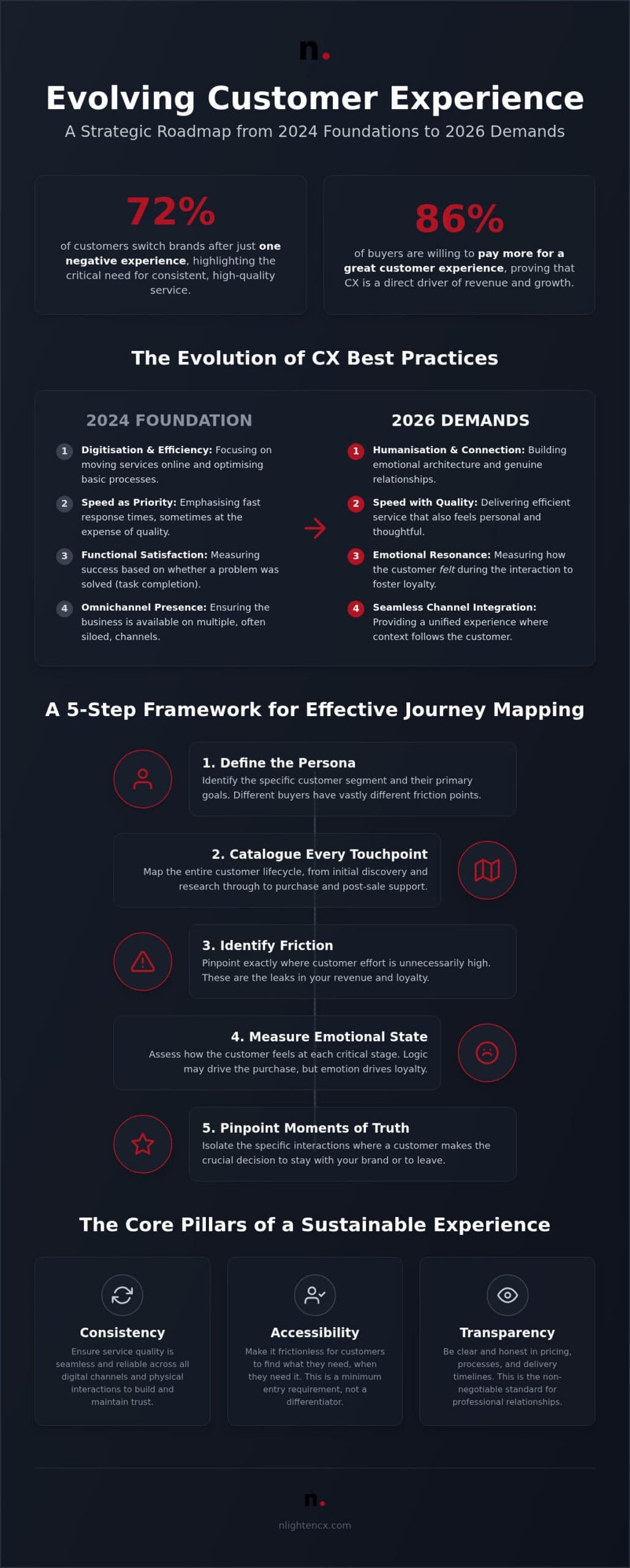
Why is it that despite record investments in digital transformation, 72% of customers still report switching brands after just one negative experience? You have likely felt the frustration of rising churn rates and the persistent difficulty of proving ROI to your stakeholders. It is a common struggle; many organisations remain trapped in a cycle of reactive service rather than proactive strategy. Whilst the customer experience best practices 2024 established provided a solid foundation for functional efficiency, they are no longer enough to secure your competitive advantage. You recognise that your business needs more than just a list of tactics; it requires a sustainable emotional architecture.
This article provides the strategic roadmap you need to bridge the gap between current operations and the demands of 2026. We’ll show you how to master the foundational lessons of the past two years and evolve them into a high-growth framework that drives lifetime value. By examining the True Voice of Customer and refining your journey mapping, you’ll learn to build a truly customer-centric culture. We start by deconstructing the shifts in consumer behaviour that make this evolution an absolute business necessity.
Key Takeaways
- Understand why the customer experience best practices 2024 established remain the essential bedrock for modern retention and organisational stability.
- Discover how to move beyond basic surveys by implementing a True Voice of Customer program that captures genuine, actionable sentiment.
- Learn to design an emotional architecture that transforms functional service into deep, long-term brand loyalty for the 2026 market.
- Recognise that CX is a company-wide philosophy and identify the professional training required to align your leadership and frontline staff.
- Master the strategic process of journey mapping to eliminate friction points and significantly reduce customer churn rates.
Evaluating the 2024 CX Foundation for Modern Success
What exactly constitutes a best practice? At its core, customer experience represents the critical intersection where your customer’s expectations meet your organisation’s ability to deliver. In the national market, we have observed a decisive shift away from reactive troubleshooting toward a model of proactive experience design. This evolution is not merely a trend; it’s a survival mechanism. Customer experience is a strategic business discipline that demands board-level attention rather than a siloed department tasked with managing complaints.
The Core Pillars of Customer Experience
Sustainability in business begins with consistency. If your service quality fluctuates between digital channels and physical interactions, you aren’t just failing a transaction; you’re eroding trust. Accessibility is no longer a differentiator; it is the minimum entry requirement for any serious player. Customers expect to find what they need, when they need it, without friction. Additionally, transparency in pricing and delivery timelines has become the non-negotiable standard for maintaining professional relationships. Without these pillars, even the most sophisticated marketing will fail to retain a modern audience.
Why 2024 Strategies Need an Update for 2026
The customer experience best practices 2024 introduced were focused on digitisation and basic efficiency. They served as the bedrock for modern retention by ensuring businesses could function in an increasingly online world. However, the requirements for 2026 have matured significantly. Speed was the priority in 2024, but today, speed without quality is perceived as dismissive. We are moving from a simple omnichannel presence to a state of seamless channel integration, where the customer’s context follows them across every touchpoint.
Functional satisfaction is no longer the metric of market leaders. Whilst the customer experience best practices 2024 helped us measure whether a problem was solved, the current landscape demands we ask how the interaction felt. High-growth organisations are now measuring emotional resonance because they know that 86% of buyers are willing to pay more for a great experience. If your strategy remains tethered to the functional basics of two years ago, your churn rate will inevitably climb.
Mastering Journey Mapping and the Voice of the Customer
How well do you actually know your customer’s path from initial curiosity to long-term advocacy? Many organisations operate under the illusion that their internal processes mirror the customer’s reality. They don’t. To bridge this gap, you must adopt a strategic framework for CX that prioritises the buyer’s perspective over operational convenience. Whilst the customer experience best practices 2024 focused heavily on digitising the journey, the requirement for 2026 is to humanise it through precision mapping and active listening.
A 5-Step Framework for Journey Mapping
Effective customer journey mapping for B2B and service sectors requires a clinical approach to data. It is not a creative exercise; it is an analytical one. Follow these steps to build a map that actually drives results:
- Define the persona: Identify the specific customer segment and their primary objective. Different buyers have vastly different friction points.
- Catalogue every touchpoint: Map the entire lifecycle from initial discovery through to post-purchase support.
- Identify friction: Pinpoint exactly where customer effort is unnecessarily high. These are the leaks in your revenue bucket.
- Measure emotional state: Assess how the customer feels at each critical interaction. Logic drives the purchase, but emotion drives the loyalty.
- Pinpoint moments of truth: Isolate the specific interactions where a customer decides to stay or leave.
By documenting these stages, you can identify the “moments of truth” where loyalty is won or lost. This level of detail allows you to deploy a targeted reduce customer churn strategy that addresses root causes rather than symptoms.
Capturing the True Voice of the Customer
Standard NPS surveys often fail because they capture a snapshot of satisfaction rather than the depth of sentiment. If you only ask for a score, you miss the context. To achieve meaningful customer service quality improvement, you need to hear the True Voice of Customer. This is a superior feedback mechanism because it utilises systematic research to uncover deep-seated needs that a simple 1-to-10 scale cannot reach.
Why does this matter? It matters because 67% of customer churn can be prevented if you resolve the issue during the first contact. You cannot resolve what you do not understand. Moving beyond basic surveys allows you to anticipate needs before they become complaints. If you are ready to stop guessing and start growing, implementing a formalised True Voice of Customer program is the most reliable way to secure your organisation’s future.
Designing for Emotional Connection: Beyond Functional Service
Is functional efficiency enough to sustain your growth? In previous cycles, a successful interaction was defined simply by whether the problem was solved. Did the product arrive on time? Was the service technical requirement met? Whilst the customer experience best practices 2024 prioritised these functional baselines, the landscape for 2026 demands a shift toward what we call emotional architecture. This sophisticated approach to CX design for service businesses moves beyond the mechanics of delivery to address the psychological state of the buyer.
Functional service is forgettable; emotional resonance is what builds a fortress around your market share. When a customer feels understood, valued, or secure, they are far less likely to defect to a competitor based on price alone. You must realise that 86% of buyers are now willing to pay more for a superior experience. This makes emotional connection in customer service a primary driver of profitability rather than a soft metric for the marketing department.
Building the Emotional Architecture
How do you engineer an emotion? It begins by identifying the specific feelings your brand should evoke, whether that is the security of a professional partnership or the excitement of a new solution. You must integrate specific customer experience tactics that allow your staff to recognise and respond to customer emotional cues in real time. Consider these elements:
- Emotional Cue Recognition: Training frontline teams to sense frustration or hesitation before it escalates.
- Delight Engineering: Designing small, low-effort moments that yield high emotional impact, such as proactive updates or personalised acknowledgements.
- Value Alignment: Ensuring every touchpoint reinforces the core emotional promise of your brand.
Measuring the ROI of Emotional Connection
Business owners often hesitate to invest in “emotions” because they struggle to see the financial link. This is a strategic error. By linking emotional satisfaction scores to actual renewal and referral rates, you can see the direct impact on your bottom line. Data shows that a 5% increase in customer retention can lead to a profit increase of between 25% and 95%. Using a clear framework for customer experience roi for businesses allows you to justify these design investments to stakeholders with absolute confidence. Emotional loyalty acts as a buffer; it protects your margins when the market becomes volatile.
Professional Development and Cultural Alignment
CX is not a department. It is a philosophy. Whilst many organisations attempt to delegate the responsibility of customer satisfaction to a specific support team, this approach is fundamentally flawed and destined to fail. To achieve sustainable growth, you must dismantle the silos that separate your marketing, sales, and operations teams. A customer-centric culture requires every employee, from the boardroom to the loading bay, to understand their role in the emotional architecture of the business. The customer experience best practices 2024 established emphasized the need for cross-functional collaboration, but 2026 demands total cultural immersion.
How do you transition from a fragmented organisation to a unified force? It begins with formalised customer experience management training. Without a shared language and a common set of objectives, your CX initiatives will remain superficial. Utilising a professional customer experience handbook for practitioners provides your team with a concrete reference point, ensuring that best practices are not just discussed but consistently applied across all touchpoints.
The Role of Leadership in CX Transformation
Transformation is a top-down process. If your executive team does not visibly champion the customer, your frontline staff will not either. Research indicates that 70% of companies now compete on customer experience alone, yet many leadership teams still struggle to move beyond traditional financial metrics. You must set CX-based KPIs that carry the same weight as revenue targets. Organising regular masterclasses is an effective way to keep your leadership team aligned with shifting consumer behaviours and emerging strategic frameworks. When leaders prioritise the customer, the rest of the organisation follows suit because the path to success has been clearly defined.
Empowering the Frontline
Your frontline staff are the primary architects of your customer’s emotional state. Do they have the authority to solve a problem instantly, or are they bound by rigid scripts and approval hierarchies? Empowerment is the difference between a frustrated customer and a loyal advocate. You must move beyond basic service training and invest in empathy-based development programs. These programs should teach staff to recognise emotional cues and act decisively to resolve issues. Creating internal feedback loops is equally vital; your staff are your best source of information regarding customer pain points. If you listen to them, they will help you refine your journey mapping in real time.
Ready to align your team with a results-oriented strategy? Explore our comprehensive customer experience management training to begin your organisational transformation today.
Implementing a Sustainable CX Strategy with nlightencx
How do you translate high-level theory into a measurable, profit-driving reality? Whilst the customer experience best practices 2024 provided a necessary baseline for operational efficiency, the complexity of the 2026 market requires a more sophisticated partner. nlightencx acts as that strategic ally, providing the expertise required to move your organisation beyond basic service and into the realm of emotional architecture. We don’t just offer advice; we provide a structured path toward business stability and growth. Our Voice of Customer Program South Africa is specifically engineered to move your organisation beyond guesswork and into data-backed certainty.
If you’re unsure where your organisation stands, clarity is just a few minutes away. We invite you to take our Free CX Quiz to benchmark your current maturity level against national standards. This diagnostic tool provides the immediate insight you need to identify friction points and prioritise your internal resources effectively. In an environment where 73% of customers say one extraordinary experience raises their expectations for every other brand, you cannot afford to remain stagnant.
Our Multidisciplinary Approach
We believe that sustainable transformation requires a blend of rigorous CX Research, creative CX Design, and practical CX Training. Our bespoke consulting services are tailored to the unique challenges of the national market, ensuring that your strategy is both globally relevant and locally effective. By combining hard data with an understanding of human behaviour, we help you build professional relationships that withstand economic volatility. Additionally, our CX Masterclasses offer your leadership team the opportunity for professional networking and growth, ensuring your organisation remains at the forefront of the industry.
Next Steps for Your Organisation
Transformation begins with a single, decisive action. We recommend starting with an initial CX audit to identify immediate opportunities for improvement and “quick wins” that prove the ROI of your initiatives to stakeholders. From there, we work with you to develop a long-term roadmap that prioritises high-impact touchpoints and aligns your team with a unified customer-centric philosophy. You can contact our team today for a tailored strategy session to discuss how we can help you implement the customer experience best practices 2024 and beyond.
By 2026, the gap between those who provide service and those who design experiences will be insurmountable. Customer experience is no longer an optional extra; it’s the only sustainable competitive advantage left in a crowded marketplace. Secure your organisation’s future by building a strategy that values the customer as much as the bottom line.
Securing Your Market Position Through Strategic CX Design
The transition from functional efficiency to an emotional architecture isn’t a choice for organisations seeking sustainability. The customer experience best practices 2024 established serve as a necessary bedrock, yet they’re merely the starting point for the high-growth strategies required in 2026. By refining your journey mapping and prioritising the True Voice of Customer, you move beyond reactive troubleshooting and into proactive experience design.
Cultural alignment and professional development are the engines that drive this transformation. Trusted by leading national brands, nlightencx provides the specialised True Voice of Customer Program and expert-led CX Masterclasses needed to eliminate friction and reduce churn. Is your organisation truly prepared for the demands of the next two years? Benchmark your business today with our Free CX Quiz and begin building a customer-centric culture that delivers measurable ROI. The path to market leadership is clear; it’s time to take the first step toward a more secure and profitable future.
Frequently Asked Questions
What are the top customer experience best practices for 2026?
The leading strategies for 2026 involve a shift from functional efficiency to emotional architecture. Whilst the customer experience best practices 2024 introduced prioritised digital speed and basic personalisation, the current landscape demands proactive support and AI-human hybrid experiences. Organisations must focus on building deep trust through transparency and seamless channel integration. This ensures that every touchpoint reinforces a sense of security and belonging, which are the primary drivers of modern brand loyalty.
How do I measure the ROI of my customer experience strategy?
Measuring ROI requires linking customer sentiment data directly to financial outcomes like retention and lifetime value. A 5% increase in customer retention can lead to a profit increase of between 25% and 95%. You should track how improvements in journey mapping reduce the cost-to-serve and lower churn rates. By quantifying these shifts, you provide a logic-driven business case that proves CX is a driver of profitability rather than a traditional cost centre.
What is the difference between customer service and customer experience?
Customer service is a reactive, transactional event where a customer seeks help for a specific issue. Customer experience, however, is the cumulative perception of every interaction a person has with your brand over their entire lifecycle. Service is a single piece of the puzzle; CX is the entire picture. Whilst service focuses on solving a problem, CX design focuses on the emotional resonance of the journey and the strength of the professional relationship.
Why is customer journey mapping important for B2B businesses?
B2B journeys are complex, involving multiple decision-makers and longer sales cycles. Mapping these paths allows you to identify “moments of truth” where loyalty is either solidified or eroded. It helps your organisation dismantle internal silos, ensuring that sales, marketing, and support teams are aligned with the client’s actual objectives. This strategic clarity reduces customer effort and ensures that your service remains consistent across every high-stakes interaction in the professional lifecycle.
How can I reduce customer churn through better CX?
Churn reduction starts with resolving issues on the first contact, which can prevent up to 67% of customer defection. By implementing a True Voice of Customer program, you can uncover the deep-seated pain points that lead to dissatisfaction. Better CX involves moving beyond reactive service to design an emotional architecture that makes customers feel valued. When a client feels a genuine connection to your brand, they are significantly less likely to defect based on price.
What should be included in a Voice of the Customer (VoC) program?
A comprehensive True Voice of Customer program should integrate multiple data streams to capture genuine sentiment. Key elements include:
- Direct feedback through systematic interviews and targeted surveys.
- Indirect feedback gathered from monitoring social media and professional review platforms.
- Inferred feedback derived from analysing customer behaviour and transaction patterns.
This multidisciplinary approach ensures you aren’t just collecting scores but are uncovering actionable insights that drive continuous service quality improvement across the organisation.
How do I start building a customer-centric culture in my firm?
Building a customer-centric culture requires a top-down commitment to professional development. Start by setting CX-based KPIs for leadership and investing in specialised CX Training for all staff. Providing your team with a professional CX Handbook ensures everyone utilises a shared language and strategic framework. Regular masterclasses help keep the organisation aligned with evolving behaviours, fostering an environment where employees are empowered to make decisions that prioritise the customer’s emotional needs.
Can a small business implement enterprise-level CX best practices?
Small businesses are often better positioned to implement high-level CX because their size allows for greater agility and deeper personal connections. The fundamental principles of journey mapping and emotional resonance apply regardless of company size. By utilising tools like a Free CX Quiz, smaller firms can identify high-impact touchpoints and benchmark their maturity. Professional training ensures that even a small team can deliver a consistent, high-growth experience that competes effectively with larger organisations.