

Customer churn isn’t a software failure. It’s a strategic disconnection from the emotional journey your customers are actually experiencing. You likely feel the pressure as the rising cost of acquisition makes every lost account a blow to your long-term sustainability. It’s exhausting to watch your team spend their days in a state of reactive damage control, firefighting cancellations that could have been prevented months ago whilst your competitors gain ground. To build a truly resilient business, you need a robust reduce customer churn strategy that shifts the focus from salvage operations to proactive relationship management.
We’ve seen too many organisations fly blind. They lack the visibility required to understand why their internal behaviour is driving users away. This guide will transform your retention efforts from a defensive burden into a research-driven growth engine. You’ll discover a repeatable system for identifying risk early and fostering a culture of proactive service that naturally improves customer lifetime value. We’ll explore how deep research and journey mapping provide the clarity needed to secure your market position for 2026 and beyond.
Key Takeaways
- Learn why it’s essential to shift from a “leaky bucket” mentality to a “Value Compounder” model for long-term stability and sustainable growth.
- Discover the concept of “Silent Churn” and how to uncover the emotional drivers of attrition that remain hidden in standard data reports.
- Master the use of strategic journey mapping to identify and eliminate the micro-frictions that compromise the customer experience.
- Implement a proactive reduce customer churn strategy by auditing your current CX maturity and re-establishing a high-impact onboarding process.
- Understand how professional CX research and training programmes can transform your retention efforts whilst turning churn risks into strategic opportunities.
The Economic Reality of Churn: Why Retention is Your Primary Growth Lever
Churn is not a manageable byproduct of growth. It is a structural weakness that undermines your entire commercial foundation. Many leaders still prioritise acquisition, pouring resources into the top of the funnel whilst ignoring the erosion at the base. This approach is failing in the 2026 economic landscape. Why? Because the cost of acquiring a new customer has reached a point where the “leaky bucket” metaphor is no longer sustainable. You cannot simply out-recruit your losses.
Instead, you must adopt a “Value Compounder” model. In this framework, every retained customer acts as a foundation for the next. Research by Bain & Company suggests that increasing customer retention rates by just 5% can increase profits by more than 25%, and in some sectors, up to 95%. This isn’t just about keeping a subscription active; it’s about the compounding impact of loyalty on sustainable profitability. A sophisticated reduce customer churn strategy treats retention as the primary engine of growth, not a secondary safety net.
Calculating the True Cost of Customer Attrition
The financial impact of a lost customer extends far beyond the immediate loss of recurring revenue. You must account for the “shadow costs” that never appear on a standard P&L statement. When a customer leaves, they take potential referrals with them. They may even damage your reputation amongst their professional network. Additionally, your internal teams waste hours in “save” conversations, a desperate drain on high-value resources. This friction directly impacts the customer experience roi for businesses, turning what should be a profit centre into a recovery operation.
The Shift from Reactive to Proactive Retention
Relying on “Save Desks” or last-minute discounts is a tactical error. These are sticking plasters applied to a systemic wound. If you’re waiting for a cancellation request to start your retention efforts, you’ve already lost. True stability requires strategic customer experience planning that identifies friction points before they become deal-breakers. Retention shouldn’t be the sole responsibility of a customer success team. It must be a multidisciplinary function involving product, marketing, and sales. By implementing a robust reduce customer churn strategy that aligns these departments, you create a seamless journey that makes leaving feel like an illogical choice for the customer.
Beyond the Data: Uncovering the Emotional Drivers of Attrition
Data is a seductive trap. It provides a veneer of certainty whilst often obscuring the underlying human truth. Your dashboards might show high platform engagement or steady transaction volumes—a metric often prioritised by digital asset services like n.exchange—yet you’re still losing key accounts. This is the phenomenon of “Silent Churn”. These customers don’t log complaints or engage in heated support calls; they simply vanish. They leave because the emotional connection to your brand has withered, leaving them vulnerable to the next competitor who offers a minor discount or a sleeker interface. Without a deep, research-driven reduce customer churn strategy, you’re merely measuring the speed at which your business is shrinking.
A truly effective reduce customer churn strategy must look beyond quantitative metrics to understand the “why” behind the “what”. Whilst data shows that usage has dropped, qualitative research reveals the frustration or apathy that caused the decline. Inconsistent service quality is a primary culprit. When a customer experiences brilliance one day and mediocrity the next, trust erodes. This instability creates a psychological distance that no amount of automated “we miss you” emails can bridge. You must identify where your internal processes are failing to deliver a reliable, high-standard experience.
Standard NPS surveys are frequently insufficient for modern strategic planning. They often capture a superficial snapshot of sentiment that fails to reflect the complexity of a long-term professional relationship. To gain genuine insight, you need a systematic programme designed to extract the unvarnished truth. This involves leveraging specialised CX research South Africa to identify regional market nuances whilst maintaining a robust national strategy. If you aren’t hearing the difficult truths from your customers, you aren’t looking hard enough. Engaging in deep CX research allows you to repair the strategic disconnections that lead to attrition.
Analysing Customer Behaviour and Perception
Many businesses mistakenly believe that “satisfied” customers are safe. In reality, these customers often reside in the “Zone of Indifference”. They are content enough to stay, but they lack the emotional investment required to resist a competitor’s advances. Moving customers out of this zone requires more than just functional excellence; it requires engaged employees. Your staff are the primary conduits of your brand’s values. If they are disengaged, that apathy will inevitably bleed into the customer experience. Emotional resonance acts as a buffer against price-based competition by transforming a transactional utility into a valued professional partnership. Understanding how to improve customer loyalty through precision CX design is what separates organisations that merely retain accounts from those that build genuine brand advocates. By focusing on perception as much as performance, you create a defensive moat that data alone cannot build.
Strategic Journey Mapping: Visualising and Eliminating Friction
Why do customers who seem satisfied on paper suddenly walk away? The answer often lies in the invisible accumulation of micro-frictions. Whilst a single minor delay or a slightly confusing invoice might not trigger a cancellation, the cumulative weight of these experiences eventually breaks the relationship. This is where a process map fails you. A process map describes how you think your business works; a true customer journey map describes how the customer feels whilst interacting with you. To build a successful reduce customer churn strategy, you must bridge the gap between your internal operations and the external reality of the customer experience.
Journey mapping allows you to identify “Moments of Truth”. These are the high-stakes touchpoints where the relationship is either solidified or irrevocably damaged. Is it the first time they encounter a technical issue? Is it the moment they receive their first renewal notice? By visualising the entire lifecycle, you can align internal silos that otherwise operate in isolation. When marketing, sales, and support all view the same journey, they can finally coordinate their efforts to protect the account rather than passing the buck between departments.
Identifying Defection Points Across Channels
Inconsistencies between digital and physical touchpoints are a primary driver of attrition. If your website promises a seamless, modern experience but your physical delivery or support calls feel archaic, the resulting cognitive dissonance destroys trust. Poor onboarding is particularly dangerous. It sets a negative tone that often leads to churn six months later, long after the initial friction has occurred. You must utilise rigorous customer experience research methodologies to validate your journey assumptions. Don’t rely on internal guesswork; use objective research to see where the path actually breaks.
Designing Out the Friction
Mapping is only the diagnostic phase. To actually retain your base, you must move from “mapping” to “design”. This means actively re-engineering touchpoints to remove the irritants you’ve identified. You cannot fix everything at once. You must prioritise interventions based on their documented impact on retention and lifetime value. Proactive communication plays a vital role here. By managing expectations and informing customers of changes before they happen, you neutralise potential frustration. A robust reduce customer churn strategy doesn’t just react to problems; it designs them out of existence before the customer ever encounters them.
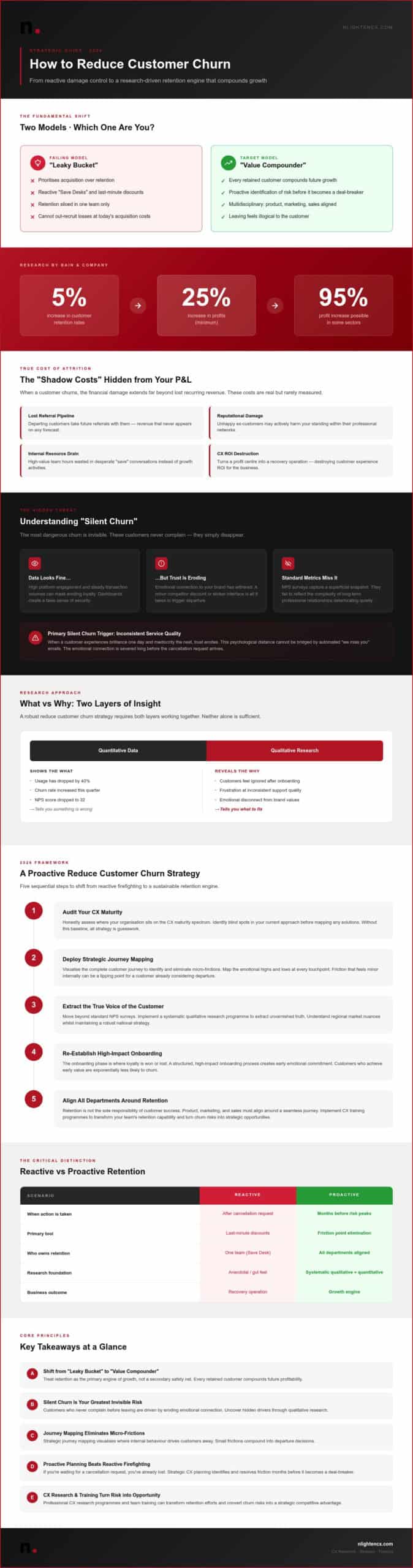
A 2026 Framework to Reduce Customer Churn
Reducing attrition isn’t a project with a start and end date. It is a structural realignment of your business objectives. To move beyond reactive damage control, you need a methodical framework that embeds retention into your daily operations. This five-step reduce customer churn strategy provides a clear path toward building a more resilient, customer-centric organisation.
- Step 1: Audit your current CX maturity. You cannot fix what you haven’t accurately measured. Start by identifying the gaps between your intended service level and the actual customer experience. To establish your baseline, take our Free CX Quiz to see where your organisation currently stands.
- Step 2: Re-establish the onboarding experience. Value must be delivered early and often. If a customer doesn’t experience a “win” within their first 30 days, their psychological commitment to your brand begins to fade.
- Step 3: Implement predictive analytics alongside human-centric research. Use data to spot the “when” of churn, but rely on qualitative research to understand the “why”. A balanced reduce customer churn strategy uses AI to flag at-risk accounts whilst using human insight to repair the underlying relationship.
- Step 4: Empower employees to resolve issues. High-churn environments are often characterised by rigid bureaucracies. Give your front-line staff the autonomy to fix problems in real-time without seeking multiple layers of approval.
- Step 5: Close the feedback loop. Silence is a lead indicator of defection. When you receive feedback, act on it and, crucially, tell the customer what you’ve changed. This proves their voice has actual weight.
Building a Culture of Customer Awareness
Retention is everyone’s job. From the CEO to the front line, every team member must understand how their specific role impacts the final customer experience. It’s essential to train your teams to recognise the early warning signs of dissatisfaction, such as a sudden drop in communication or a shift in the tone of support requests. Utilising a professional CX Handbook ensures internal consistency, providing a single source of truth for service standards across the entire business. When everyone speaks the same language, the customer feels a seamless sense of care.
Leveraging Incentives Without Eroding Value
Avoid the “Discount Trap”. Offering price cuts to customers who threaten to leave is a dangerous tactic that attracts low-value, high-churn individuals who lack brand loyalty. Instead, organise your loyalty programmes to celebrate the relationship rather than just the transaction. Focus on rewards that add genuine utility or exclusive access. When you choose to use incentives, ensure they are linked to service improvements that solve a recurring problem. This approach protects your margins whilst demonstrating that you value the customer’s long-term success over a quick, temporary “save”.
Future-Proofing Your Business with nlightencx Solutions
Churn is not an inevitability; it is a signal that your strategic alignment has slipped. Whilst many organisations attempt to fix this internally, they often lack the objective distance required to see the friction points clearly. This is where professional consulting provides a decisive advantage. At nlightencx, we transform churn from a looming threat into a catalyst for organisational refinement. By partnering with us, you gain access to a research-backed reduce customer churn strategy that is customised for the unique complexities of large-scale, national organisations.
The first step toward stability is an honest assessment of your current state. Without a clear baseline, any intervention is merely guesswork. We recommend starting with our Free CX Quiz to identify where your retention efforts are failing and where your greatest opportunities for growth lie. Once you have this clarity, you can begin the process of building a culture that prioritises customer value above all else. Strategic clarity is the only antidote to attrition.
Expert CX Training and Masterclasses
Upskilling your leadership team is the most effective way to drive long-term change. Our professional CX Masterclass provides the high-level tools required to move from theory to strategic execution. Participants learn to master journey mapping and CX design, ensuring that every touchpoint is engineered for maximum retention. By empowering your team with the methodologies found in our CX Handbook, you ensure internal consistency and professional excellence. The outcome is a leadership tier capable of identifying risk and implementing solutions before they impact the bottom line.
The True Voice of Customer Program
Understanding your clients requires more than just reading survey data. It demands a multidisciplinary approach that captures the emotional and practical drivers of their behaviour. Our signature True Voice of Customer Program is designed to extract unvarnished feedback and transform it into a strategic roadmap for growth. We help you listen to what your customers are actually saying, rather than what you hope they are saying. This clarity allows you to build a robust reduce customer churn strategy that addresses the root causes of defection. Ready to plug the leak? Enquire about our True Voice of Customer Program today to secure your business’s future.
Securing Your Market Position Through Strategic Retention
The path to sustainable growth in 2026 requires a fundamental shift in how you perceive your customer base. You’ve seen that churn is rarely a random event; it’s the logical conclusion of unaddressed friction and eroded emotional connections. By moving beyond superficial data and adopting a research-driven reduce customer churn strategy, you transform your retention efforts into a powerful engine for profitability. You now have the framework to identify “Silent Churn” and the tools to design a journey that prioritises long-term value over short-term saves.
Business stability isn’t a matter of luck. It’s the result of deliberate, expert-led planning. Whether you leverage our signature True Voice Of Customer Program, upskill your leadership through our expert-led CX Masterclasses, or equip your team with our comprehensive CX Handbook for Practitioners, the first step is always the same. You must assess where you stand today to build a better tomorrow. Take our Free CX Quiz to assess your retention health and begin your transition from reactive firefighting to proactive growth. Your customers are waiting for a reason to stay; give it to them.
Frequently Asked Questions
What is the most effective way to reduce customer churn quickly?
The most immediate way to curb attrition is to re-engineer your onboarding process to deliver value within the first 30 days. Many businesses lose customers because the initial experience is confusing or fails to demonstrate a return on investment. By identifying and removing early friction points, you secure the psychological commitment of the user. This tactical shift is a vital component of any reduce customer churn strategy that seeks to produce measurable results in a short timeframe.
How do you calculate a healthy churn rate for a service business?
A healthy churn rate varies by industry, but for B2B service businesses, an annual rate below 5% is typically considered the benchmark for stability. You must calculate this by dividing the total number of lost customers by the number of customers you had at the start of the period. Rather than obsessing over a single figure, compare your churn against the cost of acquisition. If your attrition outpaces your ability to profitably replace accounts, your business model is fundamentally unsustainable.
Can customer journey mapping really prevent cancellations?
Journey mapping prevents cancellations by revealing the micro-frictions that quantitative data often misses. It allows you to see the experience through the customer’s eyes, identifying the specific “Moments of Truth” where trust is either built or broken. When you visualise the entire lifecycle, you can proactively fix broken touchpoints before they lead to a formal cancellation request. This transition from reactive firefighting to intentional design is what separates market leaders from their struggling competitors.
What are the main drivers of customer churn in 2026?
In the 2026 landscape, the primary drivers of attrition are inconsistent service quality and a lack of emotional resonance. Customers no longer leave solely because of price; they leave because they feel like a transaction rather than a partner. This “Silent Churn” often occurs without a single logged complaint. When your service fails to meet the high expectations of a sophisticated market, customers quietly migrate to competitors who offer a more reliable and empathetic experience.
Is it better to focus on customer satisfaction or customer loyalty?
You must prioritise customer loyalty over mere satisfaction. A satisfied customer is often indifferent and will defect for a minor discount or a sleeker alternative. Loyalty, however, is an emotional commitment that acts as a buffer against competitor advances and price fluctuations. Whilst satisfaction measures if you met the basic requirements, loyalty measures the strength of the relationship and the likelihood of the customer advocating for your brand in their professional network.
How does a Voice of the Customer program help with retention?
A True Voice Of Customer Program provides the qualitative insights needed to repair strategic disconnections. It moves beyond superficial NPS scores to uncover the unvarnished truth about your service delivery. By listening to the specific pain points and desires of your base, you can align your internal behaviour with their actual needs. This direct feedback loop allows you to build a reduce customer churn strategy based on human perception rather than internal assumptions.
What role does employee engagement play in reducing churn?
Employee engagement is the foundation of a high-retention culture. Your staff are the primary conduits of your brand’s values, and if they are disengaged, that apathy will inevitably bleed into the customer experience. When employees feel empowered and valued, they are more likely to go above and beyond to resolve customer issues. A motivated team can spot the early warning signs of dissatisfaction and intervene before a customer decides to walk away from the relationship.
Should we offer discounts to customers who are about to leave?
Offering discounts to prevent cancellations is generally a tactical error that leads to the “Discount Trap”. Whilst a price cut might secure a temporary “save”, it often attracts high-churn, low-value customers who lack genuine brand loyalty. This practice erodes your margins and trains your base to threaten cancellation to receive better pricing. Instead of devaluing your offering, focus on improving the service quality and demonstrating the long-term value that your partnership provides to their business.