

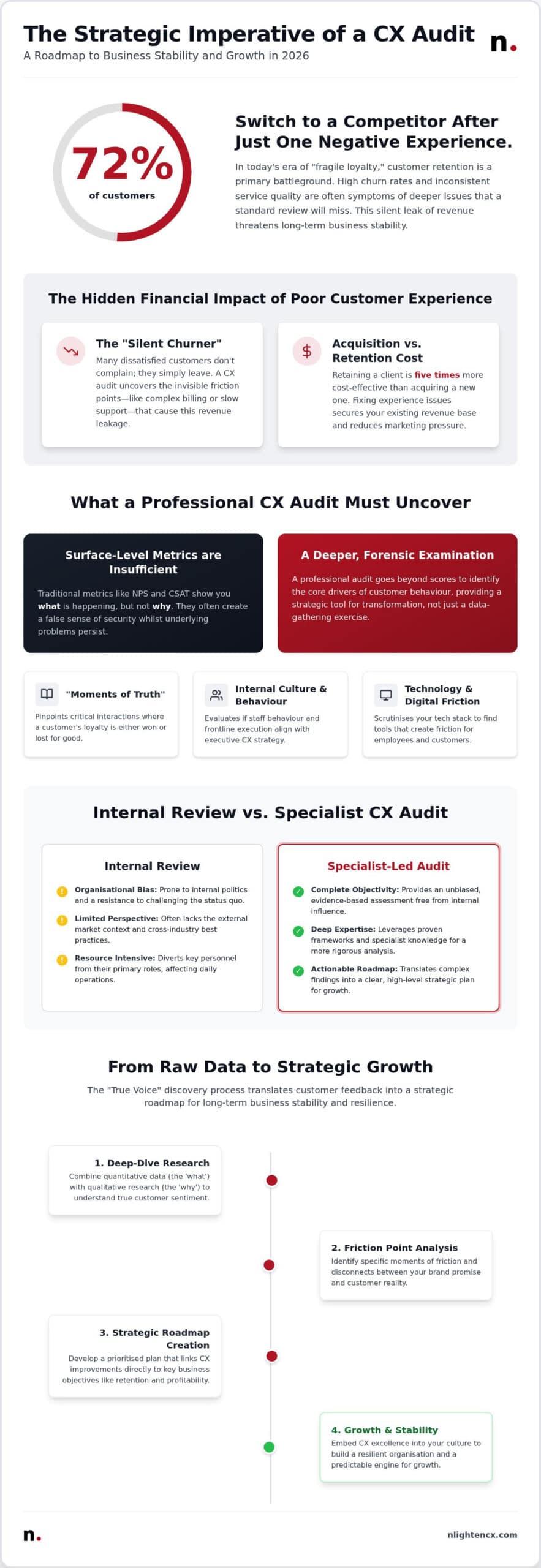
72% of customers report switching to a different brand after just one negative experience. It’s a staggering figure that highlights the fragility of modern loyalty in the South African market. You’ve likely invested significantly in brand awareness, yet you’re still facing high customer churn and inconsistent service quality across your teams. Executing a CX audit business strategy is no longer a luxury for those with excess budget; it’s a strategic necessity for any leader who wants to stop the silent leak of revenue.
We agree that it’s difficult to link traditional metrics to actual business profitability when the data feels disconnected from the human experience. This guide promises to reveal how a rigorous audit identifies hidden friction points and builds the emotional connections required for long-term stability. We’ll preview a clear roadmap for improvement that reduces acquisition costs and ensures your organisation remains resilient against market fluctuations. By the end of this article, you’ll understand how to turn your customer journey into a predictable engine for growth.
Key Takeaways
- Recognise why traditional metrics like NPS are insufficient in 2026 and how to identify the specific “moments of truth” that define customer loyalty.
- Discover the systematic framework for a CX audit business strategy that uncovers hidden friction points across every touchpoint in the lifecycle.
- Evaluate the strategic trade-offs between internal reviews and specialist-led audits to eliminate organisational bias and ensure objective results.
- Master the “True Voice” discovery process to translate raw customer data into a high-level strategic roadmap for long-term business stability.
- Learn how to sustain growth by embedding CX excellence into your team’s culture through professional training and Masterclasses.
The Business Case for a CX Audit: Why Stability Starts with Your Customers
Stability is not a passive state. It’s a hard-won outcome of strategic vigilance. For South African enterprises facing an increasingly volatile market, a CX audit business strategy serves as a strategic autopsy of your operational health. It isn’t merely a survey or a collection of feedback; it’s a systematic evaluation of every touchpoint in your customer lifecycle. By scrutinising the journey from initial discovery to long-term retention, you identify the structural weaknesses that threaten your growth.
Why is this critical in 2026? We’ve entered the era of “fragile loyalty.” Research indicates that 72% of customers will switch to a competitor after just one negative experience. In a landscape where 86% of buyers are willing to pay more for superior service, your ability to provide a consistent experience is directly linked to your bottom-line profitability. This Customer Experience Overview confirms that managing these perceptions is a deliberate science. Moving from reactive problem-solving to proactive auditing allows you to anticipate needs rather than just apologising for failures.
The High Cost of Customer Churn
Retaining a client is five times more cost-effective than acquiring a new one. This financial reality is often ignored until churn rates spike. The most dangerous threat to your stability is the “silent churner.” These individuals don’t lodge formal complaints or engage with your support teams; they simply disappear. A professional audit uncovers the friction points—such as complex billing processes or slow response times—that cause this invisible revenue leakage. For companies managing unattended or digital sales, it is worth your time to explore Per-Transaction Processing Fees to ensure your financial touchpoints are as seamless as possible. By fixing these issues, you secure your existing revenue base and reduce the constant pressure on your marketing budget to find replacements.
Aligning Brand Promise with Customer Reality
Does your marketing department promise a level of innovation that your operations team cannot support? This disconnect creates a “trust gap” that erodes brand equity. In South Africa’s competitive corporate sector, inconsistencies across digital and physical channels are common. An audit identifies where these promises break down. Whether it’s a failure in the onboarding process or a breakdown in post-sale support, these gaps have a psychological impact on your clients. When reality fails to meet the expectations set by your brand, long-term trust vanishes. Aligning these two worlds is the only way to build a resilient, growth-oriented organisation.
Essential Components: What a Professional CX Audit Must Uncover
Surface-level metrics often provide a false sense of security. Whilst Net Promoter Scores (NPS) and Customer Satisfaction (CSAT) data offer a high-level snapshot, they rarely explain the underlying motivations of your clientele. A professional CX audit business framework must dig deeper. It requires a forensic examination of the “moments of truth”—those critical interactions where a customer either solidifies their loyalty or begins looking for an alternative. If your audit doesn’t identify these pivot points, it’s merely a data-gathering exercise rather than a strategic tool.
Examine your internal culture with the same rigour as your external touchpoints. Does your staff’s daily behaviour reflect your stated CX goals? Often, there’s a significant disconnect between executive strategy and frontline execution. Similarly, your technology stack must be scrutinised. Are your digital tools enabling a seamless journey, or are they creating technical friction that frustrates both your employees and your customers? A resilient business ensures that its internal systems and human capital are perfectly aligned with the desired customer outcome.
Deep-Dive CX Research and Data Analysis
Quantitative data tells you what is happening, but qualitative research explains why. To build a complete picture of your operational health, you must analyse patterns in customer behaviour that indicate future churn before it occurs. This involves looking beyond the numbers to understand the sentiment behind the interactions. CX research South Africa practitioners understand that effective intelligence requires more than just collecting feedback; it demands a rigorous analytical framework that translates human behaviour into strategic capital. By integrating direct feedback with behavioural analytics, you can move from reactive firefighting to predictive strategy. If you are unsure where your data gaps lie, taking a free CX quiz can provide immediate clarity on your current standing.
The Human Element: Emotional Connection and Service Design
Logic-driven businesses frequently overlook the emotional journey. You might have the most efficient delivery system in South Africa, but if the interaction feels cold or transactional, you won’t build long-term bonds. Assessing the empathy and responsiveness of your frontline teams is essential. Service design consulting allows you to re-organise these interactions, ensuring that every touchpoint feels personal and supportive. When you design for emotion rather than just efficiency, you create a brand that customers feel a genuine connection to, making them far less likely to switch to a competitor based on price alone.
Internal Review vs. Specialist CX Audit: Choosing the Right Path
Can you objectively critique the systems you built? It’s a difficult question for any leadership team. Whilst internal reviews are often the first step, they frequently fall victim to proximity blindness. You are simply too close to the daily operations to see the friction points that are blindingly obvious to your clients. A CX audit business strategy requires an impartial lens to be effective. Without it, you risk merely confirming your existing biases rather than uncovering the systemic issues that cause churn.
Beyond objectivity, consider the resource cost. Diverting senior staff to conduct an in-house review might seem cost-effective, but the opportunity cost is immense. These are hours taken away from core strategic tasks. A boutique consultancy offers a more tailored approach, providing high-level expertise without the overhead of a large firm. They bring an “outside-in” perspective, looking at your organisation through the eyes of a South African consumer who has no interest in your internal hierarchies or legacy systems. They only care about the experience.
The Limitations of Self-Assessment
Internal politics often skew the findings of a home-grown audit. Employees may hesitate to highlight failures in departments led by influential colleagues, leading to a diluted report that avoids the most painful truths. There’s also the danger of “survey fatigue.” Customers are far more likely to provide honest, detailed feedback to an independent third party than to the company itself. Most importantly, internal teams often focus on symptoms, such as a slow response time, rather than the root cause, such as a fragmented data architecture or misaligned KPIs.
What to Expect from a Strategic CX Consultancy
Working with specialists grants you access to proprietary methodologies like the True Voice Of Customer Program. This isn’t a standard feedback loop; it’s a forensic deep-dive into the emotional and practical needs of your market. You receive a clear, objective roadmap that prioritises actions based on their potential ROI, ensuring your budget is spent where it will have the greatest impact on stability. External experts also act as neutral mediators. They facilitate cross-departmental alignment by presenting hard data that forces different teams to stop working in silos and start collaborating on a unified customer journey.
The Comprehensive CX Audit Business Checklist: 2026 Edition
Efficiency requires a structured framework. A successful CX audit business process is not a singular event; it’s a phased methodology designed to move your organisation from ambiguity to total clarity. You must approach this with the same rigour you apply to a financial audit. The process begins with the Pre-Audit phase, where you define objectives and identify the stakeholders who hold the keys to your operational data. This leads into Discovery, where you gather raw evidence, followed by Analysis to identify the gaps between your current state and your strategic goals. The final stages involve Reporting, creating a logic-driven business case for change, and Action, where you implement improvements with clear, measurable KPIs.
Discovery: Mapping the Customer Journey
Success in the discovery phase depends on your ability to step outside your own perspective. You must identify every touchpoint from initial discovery through to post-purchase support. Documenting the emotional state of the customer at each stage is vital. Are they frustrated by a complex sign-up form? Do they feel abandoned after the sale? Highlighting these specific pain points allows you to see exactly where customers are most likely to drop off. This forensic mapping ensures that your resources are directed at the friction points that actually matter to your bottom line.
Internal Alignment: The Staff and Culture Check
Your people are the primary drivers of your brand’s reputation. Evaluate whether your teams possess the specific training and tools required to deliver consistent quality. You must check for organisational silos that prevent a seamless transition between departments. If a customer has to repeat their problem to three different agents, your internal alignment has failed. Determine if CX goals are integrated into employee performance reviews. When excellence is not rewarded, it is rarely achieved. Ensuring your culture is customer-centric is a prerequisite for long-term stability.
The Technology and Interface Review
Technology should be an invisible enabler, not a hurdle. Does your website or app facilitate a frictionless path to purchase, or are there technical barriers slowing the journey? Your CRM and support tools must provide a single, unified view of the customer across all platforms. In the South African market, where digital adoption is high but patience is low, your digital experience must match the quality of your physical service. If you’re ready to move beyond theory and start building a resilient strategy, you can learn more about our CX Strategy services to begin your transformation.
Translating Audit Findings into Strategic Growth with nlightencx
Data without direction is a liability. At nlightencx, we specialise in turning the complexities discovered during a CX audit business engagement into a high-level strategic roadmap. We don’t believe in static reports that gather dust on a server. Instead, we focus on creating a living strategy that aligns your operational capabilities with the emotional needs of your clients. This transition from data to action is where resilience is built. By synthesising raw feedback with strategic objectives, we ensure your organisation moves forward with confidence and clarity.
The True Voice Of Customer Program serves as the ultimate tool for ongoing maturity. It moves beyond the limitations of standard surveys by capturing the genuine sentiment and deep-seated needs of your market. When you understand the “why” behind customer behaviour, you can design experiences that don’t just satisfy but delight. This program ensures that your strategy remains rooted in reality, allowing you to adapt as market conditions evolve. It is the foundation upon which long-term business stability is constructed.
From Strategy to Implementation
Navigating organisational change requires a steady hand and a clear set of priorities. We help you identify the “quick wins”—those immediate adjustments that reduce friction and yield instant ROI—whilst developing a long-term plan for sustainable growth. Our strategic advisory services ensure you aren’t just fixing symptoms. We look at the root causes we identified in the audit and guide you through the process of re-organising your interactions. This approach ensures your growth is not just rapid but stable and resilient against the fluctuations common in the South African corporate sector.
Empowering Your Teams for Long-Term Success
How do you ensure the findings from your CX audit business strategy translate into cultural change? You embed them into your organisation’s DNA. This includes ensuring your business is professionally established and branded; resources from The CEO Creative can assist with the foundational steps of building a credible corporate identity. Our professional CX Masterclasses build internal expertise, turning your employees into active advocates for the customer. We provide the tools, such as the CX Handbook, to maintain consistent service standards nationwide. This ensures that a client in Cape Town receives the same high-quality experience as one in Johannesburg. By closing the loop through training and continuous research, you turn your audit into a cycle of permanent improvement, ensuring your business remains a leader in a competitive landscape.
Securing Your Strategic Advantage Through Customer Excellence
Business stability in the South African market depends on your willingness to confront the uncomfortable truths within your customer journey. We’ve established that a rigorous CX audit business strategy is the only way to move from reactive firefighting to proactive, strategic growth. By choosing a specialist partner over an internal review, you bypass organisational bias and gain access to a proven track record in journey mapping and strategy. This isn’t just about identifying faults; it’s about building a resilient foundation for the years ahead.
Transformation doesn’t end with a report. It requires embedding these insights through specialist CX Masterclasses for executive teams and leveraging our signature True Voice Of Customer Program to maintain ongoing maturity. You now have the roadmap and the business case required to secure your revenue. The next step is execution. Book a consultation with nlightencx to start your strategic CX audit and turn your findings into a logic-driven plan for long-term resilience. The market won’t wait for you to address your friction points. Start building a customer-centric organisation that is truly resilient against market fluctuations today. Your future growth depends on the connections you strengthen now.
Frequently Asked Questions
What is the primary goal of a CX audit for a business?
The primary goal is to perform a systematic evaluation of every touchpoint in the customer lifecycle to identify friction and revenue leakage. Unlike surface-level checks, this process uncovers the structural weaknesses that prevent long-term stability. A CX audit business strategy ensures your operational reality aligns with your brand promise, allowing you to build the emotional connections necessary to secure loyalty in a volatile market.
How often should a business conduct a customer experience audit?
You should ideally conduct a comprehensive audit annually to account for shifts in consumer behaviour and market dynamics. However, immediate reviews are necessary during periods of high churn, after a merger, or when launching major new service lines. Regular auditing ensures your strategy remains proactive rather than reactive, preventing small friction points from evolving into systemic failures that threaten your bottom line.
How does a CX audit differ from a standard customer satisfaction survey?
A standard survey captures a brief snapshot of sentiment, whilst a CX audit is a forensic examination of your entire ecosystem. Surveys tell you what a customer feels; an audit explains why they feel it by scrutinising your internal culture, technology stack, and service design. It moves beyond metrics like NPS to provide a logic-driven roadmap for organisational change and strategic growth.
Can a CX audit help reduce our customer churn rate?
Yes, an audit is specifically designed to identify the “silent churners” who leave without lodging formal complaints. By mapping the customer journey and identifying “moments of truth,” you can pinpoint exactly where clients lose trust. Addressing these friction points through a professional CX audit business process directly reduces churn and lowers the cost of acquiring new clients to replace lost revenue.
What data do we need to provide for a professional CX audit?
You need to provide access to CRM data, support logs, customer feedback history, and internal performance KPIs. A professional audit also requires qualitative input, which we gather through the True Voice Of Customer Program. This combination of quantitative operational data and direct customer interviews allows for a complete, unbiased picture of your current state and identifies the root causes of any service inconsistencies.
How long does a typical CX audit process take to complete?
A typical strategic audit takes between four and twelve weeks to complete, depending on the complexity of your organisation. This timeline includes the initial discovery phase, deep-dive research, and the development of a high-level strategic roadmap. We move at a steady pace to ensure accuracy whilst maintaining professional urgency, ensuring you receive actionable insights that can be implemented for immediate business stability.
What are the most common findings in a strategic CX audit?
Common findings include disconnected organisational silos that prevent a seamless transition between departments and a significant gap between marketing promises and operational delivery. Many businesses also discover that their technology stack creates technical friction rather than enabling a frictionless path to purchase. These insights allow you to re-organise interactions and embed CX excellence through targeted training and professional Masterclasses.
How do we measure the ROI of a customer experience audit?
You measure ROI by tracking improvements in customer retention rates, reduced acquisition costs, and increased lifetime value. Additionally, an audit improves operational efficiency by eliminating redundant processes and reducing the volume of support tickets. By linking these CX research South Africa metrics to actual profitability, you can demonstrate the tangible impact of your investment on the overall stability and growth of the business.