

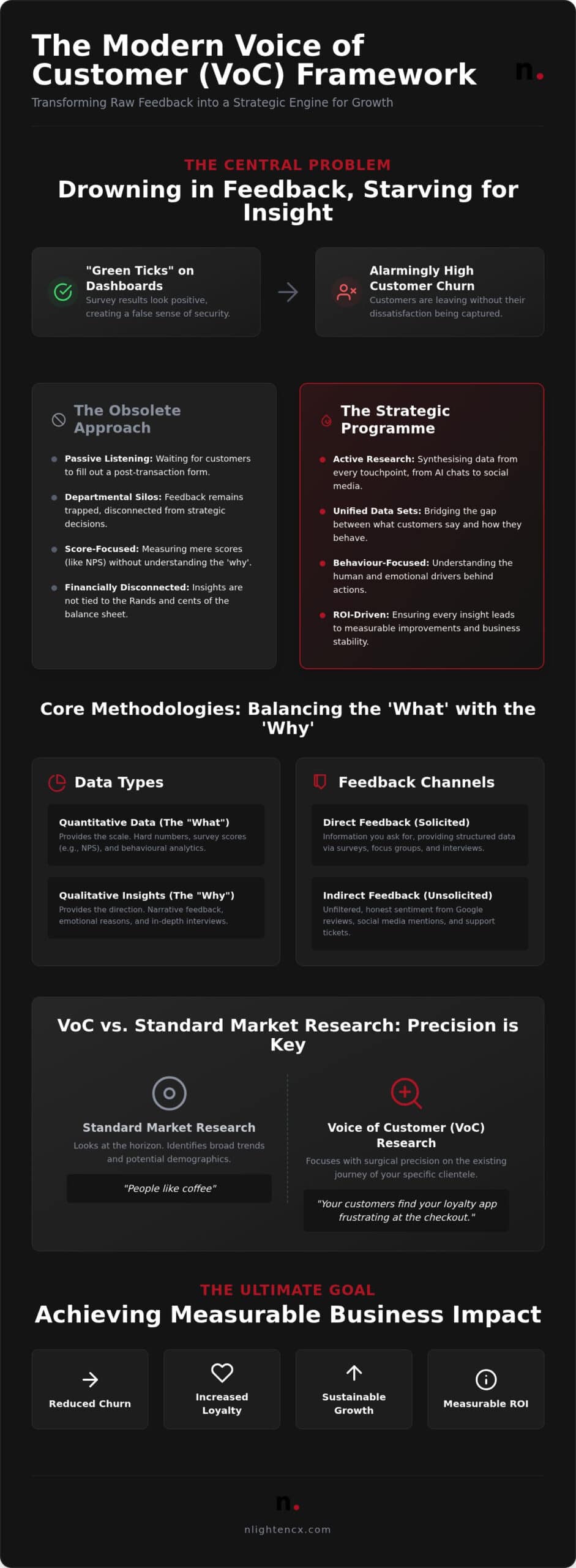
Your survey dashboard is likely full of green ticks, yet your customer churn rate remains alarmingly high. Why does this disconnect exist? Most South African businesses are currently drowning in feedback whilst starving for the actionable insights that drive real profitability. Traditional voice of customer research has often failed because it remains trapped in departmental silos, disconnected from the Rands and cents of the balance sheet. You know that listening to your customers is vital, but without a structured methodology, you’re simply guessing at the drivers of loyalty.
This guide will transform your approach by turning raw sentiment into a strategic engine for business stability and growth. We’ll examine how the shift towards conversational AI and unified data sets can finally bridge the gap between customer emotion and executive decision-making. You’ll discover a clear, structured path to move from reactive troubleshooting to a proactive strategy that secures your market position and improves long-term retention.
Key Takeaways
- Understand why passive feedback collection is obsolete and how a strategic programme provides the stability required in a competitive landscape.
- Master the core methodologies of voice of customer research to balance hard quantitative data with the qualitative insights that drive emotional connection.
- Identify the “emotional gap” within your current data silos to stop measuring mere scores and start understanding the human behaviour behind them.
- Implement a structured framework that aligns customer touchpoints with specific business objectives to ensure every insight leads to measurable ROI.
- Discover how the True Voice Of Customer Programme transforms raw feedback into a sophisticated engine for sustainable growth and long-term retention.
What is Voice of Customer Research and Why Does it Matter?
Strategic stability relies on one fundamental truth: your customers already know why your business is succeeding or failing. They’re telling you through their behaviour, their silence, and their occasional complaints. Voice of customer research is the disciplined process of capturing these expectations and translating them into actionable business intelligence. It isn’t a mere collection of survey scores. It’s a strategic programme designed to close the gap between what you think you’re delivering and what the market actually experiences.
In 2026, the era of passive listening is over. You can’t simply wait for a customer to fill out a form after a transaction. Active research now involves synthesising data from every touchpoint, from conversational AI transcripts to social sentiment. This shift is vital because consistency is the bedrock of trust. If your service quality fluctuates between your digital platforms and your physical centres, you’re creating friction that leads directly to churn. By identifying these inconsistencies early, you protect your revenue from the silent erosion caused by dissatisfied clients who simply walk away without a word. The methodology known as Voice of the customer (VoC) represents a systematic approach to capturing these insights and ensuring your brand remains reliable.
The Business Case for Listening
Revenue growth is often viewed through the lens of aggressive acquisition. However, the cost of acquiring a new customer in South Africa’s tightening economy continues to rise. Strategic voice of customer research reduces this burden by identifying the exact drivers of loyalty. When you understand why your best clients stay, you can replicate those conditions. This creates a cycle of stability. Loyal relationships are less price-sensitive and more likely to advocate for your brand, providing a sustainable foundation for growth that doesn’t rely solely on expensive marketing campaigns. This focus on bespoke service and client loyalty is mirrored in the travel industry by specialists such as BELUNE, who utilise their extensive experience in the Benelux region to deliver highly personalised group travel solutions.
VoC vs. Standard Market Research
Standard market research looks at the horizon; it identifies broad trends and potential demographics. Whilst valuable, it lacks the surgical precision of VoC. Voice of Customer research focuses exclusively on the existing journey of your specific clientele. It’s the difference between knowing that “people like coffee” and knowing that “your customers find your loyalty app frustrating at the checkout.”
This focus allows for a deeper emotional connection. You aren’t just looking at data points. You’re looking at human perceptions. Modern research must account for the emotional drivers behind a purchase. Why do they feel let down? What would make them feel secure? Answering these questions allows you to design a journey that feels personal rather than transactional.
This philosophy of tailoring every detail to the user’s needs is universal across industries and regions; for example, in the realm of outdoor environments, you can learn more about Nu Scape Designs to see how they create custom, low-maintenance landscapes that reflect specific client and climate requirements.
Core Methodologies of Modern VoC Research
Effective voice of customer research in 2026 requires more than a single feedback channel. It demands a sophisticated architecture that captures the customer’s perspective at every critical juncture. Relying solely on a post-purchase survey is a high-risk strategy; it only captures a fraction of the total experience. To build a resilient business, you must balance the “what” of quantitative data with the “why” of qualitative insights. While numbers provide the scale, it’s the narrative feedback that provides the direction for strategic change.
Modern programmes have shifted towards omnichannel data collection. This involves unifying signals from support tickets, live chat transcripts, and even behavioural analytics. Why is this necessary? Because what a customer says in a survey often contradicts how they behave on your digital platforms. By analysing behavioural intent, such as where a user pauses or abandons a process, you gain a deeper understanding of friction points that they might not even mention. This integrated approach ensures that your decisions are based on a holistic view of the relationship rather than fragmented snapshots.
Direct vs. Indirect Feedback
Capturing the customer’s voice requires two distinct approaches. Direct feedback is solicited; you ask the questions through surveys, focus groups, or structured interviews. This allows for specific measurement of KPIs like Net Promoter Score (NPS). Indirect feedback, however, is unsolicited. It lives in Google reviews, social media mentions, and third-party platforms like HelloPeter. A robust strategy uses both. Direct feedback provides the structure you need for reporting, whilst indirect feedback offers the unfiltered, honest sentiment that reveals the true health of your brand reputation.
The Role of In-Depth Interviews
Quantifiable data can tell you that 20% of your clients are unhappy, but it won’t tell you the emotional reason behind their frustration. This is where in-depth interviews become indispensable. One-on-one conversations allow you to probe beneath the surface. You can uncover the emotional drivers, such as a lack of perceived security or a feeling of being undervalued, that a tick-box survey simply cannot reach.
For B2B organisations in South Africa, these qualitative deep dives are particularly vital. The complexity of professional relationships means that decisions are often driven by long-term trust and risk mitigation. Understanding these nuances allows you to tailor your service delivery to meet the specific psychological needs of your key accounts. If you’re unsure where to begin with these complex conversations, conducting a Free CX Quiz can help identify the gaps in your current listening strategy before you invest in deeper research.
Ultimately, the goal of these methodologies is to move beyond passive observation. By combining direct enquiry with indirect listening and behavioural analysis, you create a strategic engine that doesn’t just record the past, but actively predicts the future needs of your market.
The Emotional Gap: Why Traditional VoC Often Fails
Boardrooms across South Africa are frequently haunted by a single, frustrating objection: “We have the data, but nothing changes.” It’s a common symptom of a broken feedback loop. You invest in sophisticated tools, collect thousands of responses, and watch your dashboards update in real time. Yet, your churn rate remains stubbornly high. Why? Because most voice of customer research succeeds at measuring a score but fails at understanding a person. Data without empathy is merely noise. It provides a technical snapshot of a transaction whilst ignoring the human narrative that drove it.
Traditional programmes often fall into the trap of treating feedback as a checkbox exercise. When you focus solely on the metric, you lose sight of the individual. A customer isn’t a decimal point on a spreadsheet; they’re a person with specific anxieties, expectations, and emotional triggers. If your strategy is built on sterile numbers, your response will be equally sterile. This disconnect creates a strategic vacuum where businesses solve technical problems that customers don’t actually care about, whilst leaving the real emotional friction points untouched.
We must also address the growing threat of survey fatigue. In 2026, customers are bombarded with requests for feedback at every turn. If you ask for their time and then fail to demonstrate a tangible change in your service, you’re not just wasting an opportunity. You’re actively damaging the relationship. Silence is often a more accurate indicator of a failing brand than a low score. When customers stop complaining, it usually means they’ve stopped caring. Avoiding this requires a shift from frequent, shallow surveys to meaningful, high-impact research that respects the customer’s time and intelligence.
Moving Beyond the NPS Score
Net Promoter Score (NPS) has become the industry standard, but it’s a lagging indicator that can be dangerously misleading. A high score can mask underlying issues that are about to boil over. You might have a “Promoter” who loves your product but finds your billing process infuriating. Without the “why” behind the number, you’re flying blind. A strategic framework must look for the sentiment buried within the comments. We need to interpret the language customers use to identify the true health of the relationship. Are they using words of partnership, or words of frustration? The true goal of research is to uncover these nuances before they manifest as a cancellation request.
Understanding Emotional Drivers
Long-term loyalty is rarely a logical decision; it’s an emotional one. Customers stay with a brand because they feel secure, valued, or understood. Identifying the friction points that cause emotional distress is the first step toward building a resilient business. When a process is difficult, it doesn’t just take time; it creates a sense of being undervalued. By mapping these emotional highs and lows, you can design a journey that proactively mitigates stress and fosters trust. An emotional connection is the psychological bond formed when a business aligns its service delivery with a customer’s core values, resulting in an instinctive preference for that brand even when competitors offer lower prices.
How to Organise a Strategic VoC Framework
Building a resilient business requires more than good intentions; it requires a structured roadmap. A strategic framework ensures that your voice of customer research is not a vanity project but a core driver of operational efficiency. Without a clear organisational structure, feedback remains fragmented and ignored. To transform raw data into a strategic engine, you must follow a disciplined five-step process that aligns customer sentiment with your commercial goals.
- Step 1: Define clear business objectives. Are you trying to reduce churn in a specific high-value segment or improve the onboarding process? Without a target, your data is just noise.
- Step 2: Identify key customer touchpoints. Map the journey from initial enquiry to post-purchase support. These are your listening posts where expectations are either met or betrayed.
- Step 3: Select methodologies. Choose the right tools for the right stage. Use surveys for scale and in-depth interviews for emotional depth, ensuring your voice of customer research covers both the “what” and the “why.”
- Step 4: Analyse for friction points. Sift through the intelligence to find the gaps where your delivery fails to meet the customer’s perceived value.
- Step 5: Close the loop. Act on the feedback and, crucially, tell your customers what you have changed. This turns a transaction into a partnership.
Breaking Down Data Silos
Insights are useless if they remain trapped in the marketing department. Customer experience is a cross-functional responsibility that requires buy-in from sales, operations, and the executive suite. Your front-line staff need to see the same intelligence as your board members to ensure consistency in service delivery. To maintain these standards, we recommend implementing a CX Handbook. This document serves as the definitive guide for your organisation, ensuring that every team member, regardless of their department, understands how to interpret and act on customer signals.
Measuring ROI and Success
Profitability is the ultimate validator of any research programme. You must link your insights to specific financial outcomes, such as a reduction in churn or an increase in the lifetime value of a client. In the South African market, where competition is fierce and acquisition costs are high, retention is often the most significant driver of business stability. Tracking these metrics allows you to prove the value of your initiatives to stakeholders. To understand your current standing and identify where your framework might be leaking value, take our Free CX Quiz to baseline your organisational maturity and prepare for a more sophisticated approach.
The True Voice Of Customer Programme: Your Path to Growth
Most organisations treat voice of customer research as a software problem. They invest in expensive subscriptions, configure automated dashboards, and then wonder why their churn rates remain stagnant. The reality is that data is a commodity; strategic insight is a competitive advantage. To achieve genuine business stability, you must move beyond the collection of feedback and towards a culture of organisational awareness. This is the foundation of the nlightencx True Voice Of Customer Programme.
This premium solution represents the gold standard for South African businesses seeking to transform raw sentiment into a strategic engine. It doesn’t merely record what your customers say; it interrogates the data to reveal the underlying drivers of loyalty and friction. By integrating sophisticated CX research with high-level strategy, the programme ensures that every insight is mapped to a specific commercial outcome. This creates a level of clarity that allows executives to make data-driven decisions with absolute confidence, securing the long-term health of the professional relationship.
Strategic Consulting vs. Software
Raw data remains silent until it is interrogated by experts who understand the nuances of human behaviour. Whilst software can categorise comments, it cannot understand the cultural or emotional context of a South African consumer. nlightencx provides the expert interpretation necessary to turn a report into a roadmap. We don’t just identify the problems; we help you implement the findings through tailored CX Strategy and design. To ensure these standards are maintained internally, our CX Masterclasses empower your teams to adopt a customer-centric mindset, turning the research into a living part of your daily operations.
Next Steps for Your Organisation
Transformation begins with an honest assessment of your current capabilities. Before you can build a sophisticated research engine, you must understand where your existing framework is failing to deliver value. We invite you to assess your maturity with the nlightencx Free CX Quiz. This initial assessment provides the baseline necessary to identify gaps in your listening strategy. From there, a strategic CX audit for business resilience and growth serves as the definitive first step toward organisational change. Don’t let your customer feedback sit idle in a database while your competitors win on service. Take the decisive step to Transform your business with the True Voice Of Customer Programme and secure the sustainable growth your organisation deserves.
Securing Your Strategic Advantage
Strategic stability isn’t a byproduct of luck; it’s the result of disciplined listening. We’ve explored how voice of customer research must evolve from a technical checkbox into a cross-functional engine for growth. By bridging the emotional gap and dismantling data silos, you move beyond mere measurement and start building genuine loyalty. This structured approach ensures your business remains resilient in an increasingly volatile South African market.
Ready to transform your raw data into a strategic roadmap? Whether you’re baselining your maturity with our free online CX assessment tool or upskilling your leadership through specialised CX Masterclasses, the path to profitability is clear. Our signature True Voice Of Customer methodology provides the expert interpretation needed to secure your competitive position. Take the next step toward organisational excellence and Book a consultation for our True Voice Of Customer Programme today. Your customers are already speaking; it’s time to ensure you’re truly hearing them.
Frequently Asked Questions
What is the primary goal of voice of customer research?
The primary goal of voice of customer research is to align your internal business operations with the actual expectations and perceptions of your clientele. It serves as a strategic tool to identify the specific drivers of loyalty and friction. By capturing these insights, you can make data-driven decisions that improve service consistency and secure long-term profitability. It isn’t just about collecting feedback; it’s about transforming that feedback into a roadmap for sustainable growth.
How is VoC research different from a standard customer survey?
A standard survey is merely a tactical tool, whereas VoC research is a comprehensive strategic programme. Whilst a survey often focuses on a single transaction, a robust VoC initiative synthesises data from multiple channels, including social listening, support transcripts, and direct interviews. This holistic approach provides a deeper understanding of the emotional drivers behind the data. It moves beyond simple scores to uncover the narrative of the entire customer journey and relationship health.
How often should our business conduct VoC research?
Your business should engage in continuous listening whilst conducting deep-dive research at least quarterly. Real-time data from digital touchpoints allows for immediate course correction, but strategic shifts require periodic qualitative analysis. In the fast-moving South African market, waiting a year to check in with your customers is a high-risk strategy. Regular intervals ensure that your service delivery remains relevant as consumer behaviours and economic conditions shift, protecting your business from sudden market changes.
What are the most effective methods for capturing VoC data?
The most effective methods involve a blend of direct and indirect data collection. Combining quantitative surveys with qualitative in-depth interviews provides both scale and emotional depth. Additionally, analysing behavioural data and social sentiment allows you to capture the unfiltered voice of the market. This integrated methodology ensures you aren’t just hearing what customers say when asked, but also understanding how they actually interact with your brand in real-world scenarios, revealing intent that surveys might miss.
Can Voice of Customer research really help reduce customer churn?
Yes, voice of customer research is one of the most effective ways to reduce churn by identifying friction points before they lead to a cancellation. When you proactively address the silent reasons for dissatisfaction, you demonstrate that you value the relationship. This builds trust and emotional connection, which are the strongest barriers against competitors. In many cases, resolving a single recurring pain point identified through research can significantly improve long-term retention rates and overall business stability.
How do we measure the ROI of a VoC programme?
Measuring ROI requires linking specific research insights to measurable financial outcomes, such as improved retention rates or increased lifetime value (LTV). You should track the cost of churn reduction against the investment in your research programme. For example, if a strategic change based on customer feedback saves ten high-value accounts, the ROI is immediately evident. It is about moving CX from a perceived cost centre to a documented driver of profitability and long-term security.
What is the “True Voice of Customer” approach?
The True Voice of Customer approach is our signature methodology that prioritises expert interpretation over raw data collection. It involves a deep-dive analysis of both the logical and emotional drivers of customer behaviour. Unlike generic software solutions, this programme focuses on organisational awareness, ensuring that insights lead to actual strategic change. It’s designed to help South African businesses build a resilient foundation through a sophisticated understanding of their market’s unique needs and cultural nuances.
Does our business need a CX audit before starting VoC research?
Conducting an initial assessment or audit is highly recommended to baseline your current organisational maturity. It allows you to identify where your existing data silos are and which touchpoints require the most urgent attention. Starting without an audit is like navigating without a map; you may collect data, but you won’t know if it’s the right data. We suggest using a CX audit business strategy as a starting point to define your research objectives more clearly and effectively.